The best Shopify subscription app is the one that fits your offer, economics, customer experience, and operating model—not necessarily the platform with the longest feature list. For an established replenishment brand, that may be Recharge, Loop, Skio, or Stay AI. For a merchant validating demand, Appstle, Seal, Propel, or Shopify Subscriptions may produce a better return with far less overhead.
Subscription commerce continues to grow because it can solve a real customer problem: remembering to reorder something used repeatedly. It can also give merchants earlier visibility into demand, purchasing, inventory, and cash flow. Recurring revenue does not make a business automatically stable, however. Revenue is only durable when subscribers continue receiving enough value to renew.
The common launch mistake is to treat subscriptions as a payment setting. A team adds “subscribe and save,” offers 15% off, and assumes retention will follow. Then delivery frequency does not match consumption, upcoming-order messages arrive too late, failed cards are ignored, the customer portal is difficult to use, and cancellation becomes the only escape from overstock.
This guide evaluates 11 leading Shopify subscription apps across billing flexibility, customer management, churn tools, bundles, analytics, integrations, APIs, price, support, performance, and scale. Pricing and Shopify App Store information were checked on July 18, 2026. Plans, usage fees, and capabilities change, so confirm the official listing and contract before committing.
Short answer: Choose Recharge for a mature, broadly integrated subscription program; Appstle for strong feature-to-cost value; Loop for bundles and lifecycle automation; Seal for an affordable launch; Shopify Subscriptions for a basic native pilot; and Skio or Stay AI when retention experience and high-touch scale justify premium economics.
Understanding Subscription Commerce
Recurring billing means charging an authorized payment method on an agreed schedule. On Shopify, a subscription app creates selling plans and manages subscription contracts; Shopify's eligible payment infrastructure handles stored payment credentials. It is not the same as manually sending an invoice every month.
Subscribe and Save lets shoppers choose a recurring purchase instead of—or alongside—a one-time purchase, usually for a discount. A coffee brand might offer delivery every two, four, or six weeks. The important decision is not the number of frequencies; it is whether each frequency reflects real household consumption.
Product subscriptions repeatedly deliver a physical or digital item. Consumables such as coffee, skincare, pet food, vitamins, filters, and cleaning products are natural candidates because customers already reorder them.
Subscription boxes combine recurring billing with curation or choice. A fixed box sends the same defined set. A curated box changes by cycle. A build-a-box model lets the subscriber select products within rules. Each has different implications for inventory, picking, substitutions, forecasting, and customer portal design.
Membership programs charge for access or benefits rather than scheduled product replenishment. Examples include member pricing, free shipping, early drops, gated education, priority support, or monthly credit. A membership app therefore needs strong entitlement, tagging, access, and benefit logic—not just recurring orders.
Digital subscriptions can provide recurring access to files, courses, software, research, communities, or services. Billing is only one layer. You also need entitlement provisioning, access revocation, tax handling, identity, and a recovery path when payment fails.
The metrics should be equally clear:
- Customer lifetime value (LTV) estimates the economic value a customer generates over the relationship. Use contribution margin after product, fulfillment, discounts, refunds, support, app, and payment costs—not gross revenue alone.
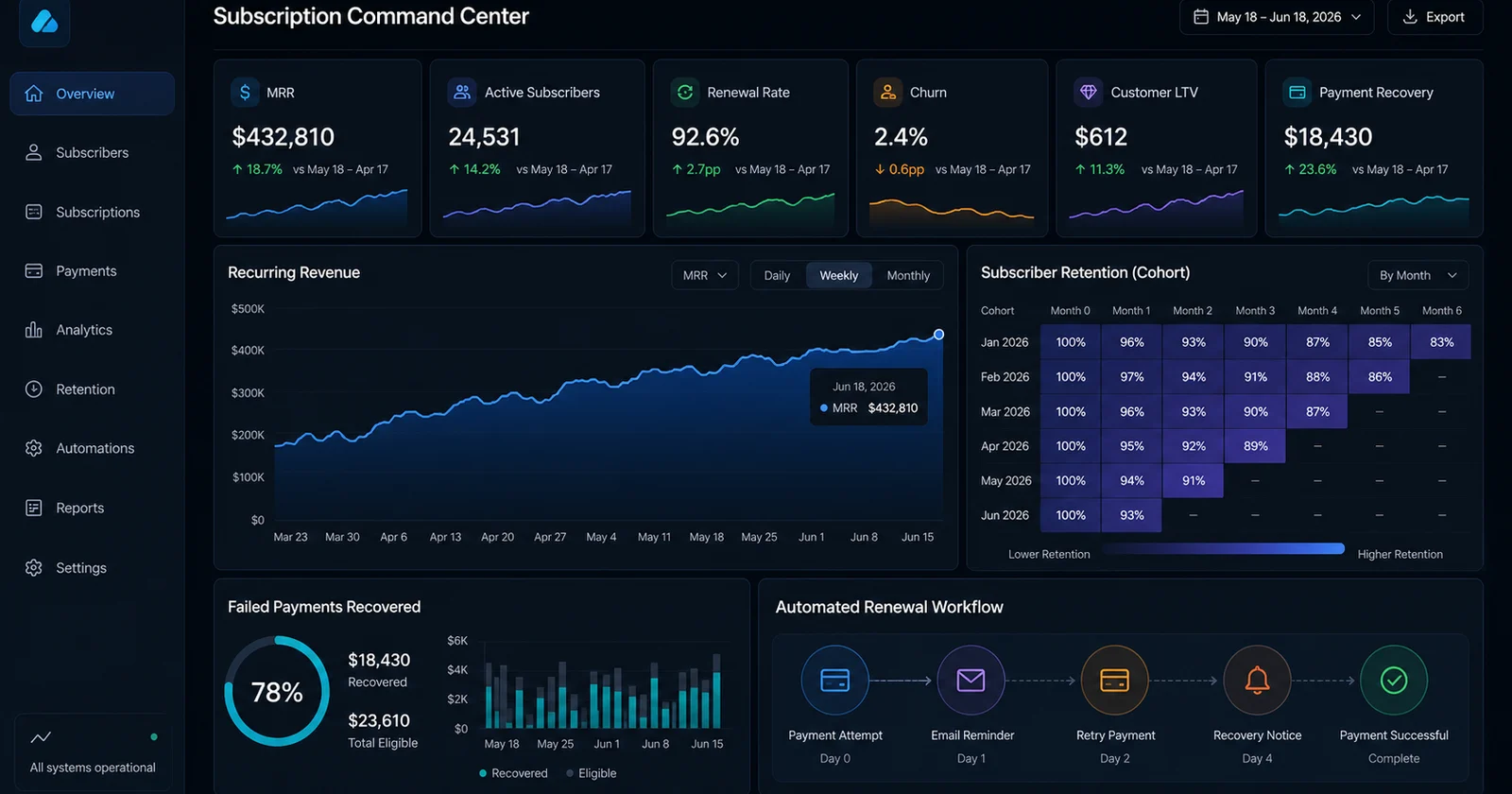
- Monthly recurring revenue (MRR) is normalized recurring subscription revenue for one month. Keep one-time add-ons separate so the metric remains useful.
- Annual recurring revenue (ARR) is the recurring revenue run rate over a year, commonly MRR multiplied by 12. It is a planning measure, not guaranteed cash.
- Customer churn rate is the share of subscribers lost during a period. Define whether the numerator includes voluntary cancellation, failed-payment loss, or both.
- Revenue churn measures lost recurring value. Losing one high-value B2B subscription can matter more than losing several low-value plans.
- Retention by cohort shows how customers acquired in the same period or channel behave over time. It is usually more actionable than a blended churn average.
For example, a supplement store can show growing MRR while economics deteriorate if paid acquisition brings discount-driven subscribers who cancel after order two. Measure renewal rate, contribution margin, refund rate, save rate, payment recovery, support cost, and cohort LTV together.
How We Selected These Shopify Subscription Apps
This is a buyer's guide, not a popularity contest. We reviewed each platform against the work a subscription team performs after launch.
- Recurring billing flexibility: Pay-as-you-go, prepaid, fixed-date, trial, gift, frequency, discount, and billing-versus-delivery options.
- Subscription management: Merchant controls, bulk actions, product swaps, price changes, contract visibility, and operational calendars.
- Customer portal: Passwordless access, mobile usability, skip, pause, reschedule, swap, add-on, address, and payment controls.
- Cancellation management: Reason capture, conditional save offers, pause alternatives, and ethical retention reporting.
- Failed-payment recovery: Retry schedules, card updates, messaging, segmentation, and involuntary churn reporting.
- Analytics: MRR, active subscribers, churn, cohorts, product performance, cancellation reasons, recovery, and exportability.
- Automation and integration: Shopify Flow, email/SMS, support, loyalty, reviews, ERP, fulfillment, attribution, and warehouse workflows.
- APIs and scalability: Admin and storefront capabilities, webhooks, permissions, headless support, rate limits, security, and migration paths.
- Pricing: Monthly fees, revenue thresholds, subscriber limits, transaction fees, fixed per-order fees, implementation, and support tiers.
- Merchant evidence: Review volume, recent patterns, support sentiment, reliability concerns, and the vendor's response to problems.
- Performance: Storefront widget weight, portal architecture, app blocks, script ownership, and theme compatibility.
No app received a recommendation merely for having AI in its positioning. Automation is valuable only when the merchant can understand the decision, measure the outcome, and override the workflow.
Quick Comparison: Best Shopify Subscription Apps
| App | Best for | Starting price* | Free plan | Recurring billing | Customer portal | Bundle support | Analytics | Shopify Plus support | Ideal business size |
|---|---|---|---|---|---|---|---|---|---|
| Recharge | Mature all-around programs | $25/mo for first 50 subscribers | No | Advanced | Strong | Yes | Advanced | Strong | Growing–enterprise |
| Appstle | Feature depth at accessible cost | Free; paid from $10/mo | Yes | Advanced | Strong | Yes | Strong | Good | Startup–enterprise |
| Loop | Boxes, automation, and retention | Free; paid from $99/mo + fees | Yes | Advanced | Strong | Yes | Advanced | Strong | Growing–enterprise |
| Seal | Low-cost flexible subscriptions | Free; paid from $5.95/mo | Yes | Strong | Good | Yes | Good | Moderate | Startup–mid-market |
| Shopify Subscriptions | Basic native pilot | Free | Yes | Basic | Basic | No | Basic | Limited | Startup–small |
| Skio | Premium portal and lifecycle UX | $599/mo + fees | No | Advanced | Excellent | Yes | Advanced | Strong | Mid-market–enterprise |
| Stay AI | Retention testing and churn intelligence | $499/mo + fees | No | Advanced | Excellent | Yes | Advanced | Strong | Mid-market–enterprise |
| Smartrr | Loyalty-led subscriber relationships | $99/mo + 1% GMV | No | Strong | Strong | Yes | Strong | Strong | Growing–enterprise |
| Subi | Memberships plus physical subscriptions | Free for development stores; $29/mo + fees live | Dev only | Strong | Good | Yes | Good | Good | Startup–enterprise |
| Bold | Developer-led and prepaid configurations | $24.99/mo + 2% | No | Strong | Good | Yes | Good | Good | Growing–enterprise |
| Propel | Simple, affordable recurring orders | Free until $500/mo subscription revenue | Yes | Good | Good | Limited | Basic | Limited | Startup–small |
*USD list pricing from official Shopify App Store pages on July 18, 2026. “Starting price” does not include payment processing, implementation, integrations, or all usage charges.
The 11 Best Shopify Subscription Apps for 2026

App 01
Recharge Subscriptions: Best overall for established brands
Best for: Growing and enterprise brands that need a mature subscription core, strong integrations, and advanced retention tools
Recharge Subscriptions is the most balanced choice for an established merchant that needs acquisition, customer self-service, churn prevention, dunning, bundles, loyalty, analytics, and a broad integration ecosystem in one mature platform.
Best for: Growing and enterprise replenishment brands with enough subscriber value to justify platform and transaction fees.
Key capabilities: Pay-as-you-go subscriptions, customizable portal, product swaps, skips, rescheduling, smart cancellation prevention, failed-payment recovery, cross-sells, curated or customizable bundles, loyalty, referrals, benchmarks, and API/Storefront tooling on higher plans.
Pricing and billing: The listed entry plan is $25 per month for the first 50 subscribers with no transaction fees for those subscribers. Starter is $99 per month plus 1.49% and $0.19 per transaction; Plus is $499 per month plus 1.34% and $0.19, with scalable rates advertised. Model cost against subscription GMV and renewal count.
Portal, analytics, and performance: The no-code portal is capable and retention analytics are deeper than budget apps. Recharge can touch product pages, account surfaces, tracking, and integrations, so test widget loading, cart state, account login, and third-party scripts on the production theme.
Pros: Mature ecosystem, broad functionality, enterprise migration experience, and a credible path from basic replenishment to retention optimization. Cons: Percentage plus fixed fees can become material, and advanced implementation requires ownership across marketing, CX, finance, and development.
Real-world use case: A high-volume skincare brand can let subscribers swap formulas, delay a shipment, add a one-time product, receive a cancellation alternative based on reason, and enter a win-back journey after lapse.
Do not choose Recharge if you are still testing whether anyone wants a subscription, need only one basic recurring plan, or cannot operationalize its retention tools. Expert recommendation: shortlist it when subscription revenue is already strategic and compare three-year total cost—not the first-month fee.

App 02
Appstle Subscriptions: Best feature-to-cost value
Best for: Startups through larger merchants that want deep subscription features without premium base pricing
Appstle Subscriptions combines recurring billing, prepaid plans, build-a-box, customer self-service, loyalty, retention controls, analytics, migration help, and 24/7 support at unusually accessible list prices.
Best for: Startups through larger merchants that want substantial configuration without a premium base fee or app transaction percentage on listed plans.
Key capabilities: Multiple frequencies, prepaid and pay-as-you-go plans, trial options, one-click portal access, payment retries, custom shipping, build-a-box, product swaps, quick-action emails, churn controls, inventory forecasting, bulk actions, integrations, APIs, and webhooks on enterprise arrangements.
Pricing and billing: Free up to $500 in monthly subscription revenue. Paid plans were listed at $10 for up to $5,000, $30 for up to $15,000, and $100 for up to $100,000 in monthly subscription revenue, with 0% app transaction fees. Revenue ceilings mean plan forecasting still matters.
Portal, analytics, and performance: The portal is feature-rich, especially on Business tiers. Analytics cover performance and churn, though teams needing custom cohort finance may still export data. Use theme app blocks where possible and validate quick-view, cart, and widget behavior across variants.
Pros: Strong breadth, low entry cost, high App Store review volume, and support accessibility. Cons: The number of options can create configuration sprawl; advanced API requirements may require enterprise contact.
Real-world use case: A coffee roaster can offer whole-bean or ground variants, several cadences, prepaid gifts, build-a-box selections, loyalty discounts, and inventory forecasts without immediately buying an enterprise platform.
Do not choose Appstle if your procurement rules require a specific enterprise architecture, deeply proven custom portal framework, or contract terms that the enterprise offering cannot meet. Expert recommendation: It should be on nearly every cost-conscious shortlist, but test the exact bundle and portal journey rather than judging the admin demo.

App 03
Loop Subscriptions: Best for boxes and lifecycle automation
Best for: Fast-growing DTC brands that need build-a-box, automated journeys, churn controls, and payment recovery
Loop Subscriptions is designed for fast-growing brands that want subscription bundles, automated workflows, cancellation paths, payment recovery, portal merchandising, and lifecycle campaigns in one platform.
Best for: Subscription box, consumable, and DTC teams that plan to actively manage retention rather than run recurring billing passively.
Key capabilities: Fixed and build-your-own boxes, dynamic discounts, prepaid and gift subscriptions, product swaps, customizable portal, one-click actions, cancellation flows, up to 15 dunning retries on Starter, subscriber journeys, rewards, permissions, APIs, and webhooks on Pro.
Pricing and billing: Free for up to 50 active subscriptions. Starter is $99 per month plus 1% per transaction. Pro is $399 plus 0.75%. API and webhook access is listed with Pro, an important cost boundary for integration-heavy stores.
Portal, analytics, and performance: The portal supports upsells and gamified journeys; analytics focus on revenue, growth, and retention. With portal offers, bundles, email actions, and marketing integrations enabled, governance matters: define which system owns each message, upsell, and metric.
Pros: Strong blend of box configuration, automation, retention, and support. Cons: Transaction fees and higher-tier API access can raise total cost; sophisticated workflows need disciplined testing.
Real-world use case: A pet brand can build species- and size-specific boxes, allow swaps before cut-off, reward consecutive renewals, retry failed cards, and offer “skip this month” before cancellation.
Do not choose Loop if you need only one simple recurring SKU or require affordable API access from day one. Expert recommendation: Compare it directly with Recharge and Appstle using the same build-a-box, dunning, cancellation, and data-export test script.

App 04
Seal Subscriptions: Best affordable launch platform
Best for: Small and mid-sized merchants that need flexible subscriptions, APIs, and zero listed app transaction fees
Seal Subscriptions offers classic and prepaid subscriptions, boxes, memberships, trials, discounts, customer self-service, cancellation controls, analytics, APIs, and webhooks with no listed app transaction fee.
Best for: Small and mid-sized merchants that need more flexibility than Shopify's free app without committing to percentage-based platform fees.
Pricing and billing: The free tier supports up to 50 subscriptions. Listed paid tiers begin at $5.95 for 100, $9.95 for 250, and $24.95 for 500 subscriptions, with larger plans available. All listed tiers advertise 0% transaction fees.
Portal, analytics, and performance: Passwordless portal access, swaps, upcoming-renewal reminders, cancellation flows, and retention insight appear across plan levels. API and webhook access is a notable value. Its Built for Shopify status is a positive integration signal, but your selected theme and widget configuration still require measurement.
Pros: Transparent low cost, multilingual support, broad model support, and developer access. Cons: Enterprise experimentation, benchmarking, and lifecycle orchestration are less central than on premium platforms.
Real-world use case: A filter-replacement store can offer fixed schedules, send renewal reminders, let customers change intervals, and use webhooks to inform fulfillment without surrendering a percentage of subscription revenue.
Do not choose Seal solely because it is inexpensive if your roadmap requires advanced cohort analytics, highly customized retention journeys, or a high-touch enterprise team. Expert recommendation: It is one of the strongest pilot choices when API access, zero app transaction fees, and straightforward operations matter.

App 05
Shopify Subscriptions: Best free native option
Best for: Merchants validating a straightforward replenishment offer with minimal software cost
Shopify Subscriptions is Shopify's first-party app for creating recurring product plans inside Shopify admin. It supports weekly, monthly, or yearly auto-billing, multiple plans, discounts, email templates, customer self-service, reporting, migration, and Shopify POS.
Best for: Merchants validating a simple replenishment offer with minimal software cost and no bundle requirement.
Pricing and billing: Free. Supported gateways and payment experiences still apply. Shopify states that subscriptions cannot use local payment methods, draft orders, or its native bundles; gift cards apply only to the first payment. Review the official eligibility and payment considerations before designing the offer.
Portal, analytics, and performance: Customers can view, resume, skip, or cancel subscriptions and manage payment and address details. Reporting covers active, paused, and canceled subscriptions. Native integration limits vendor overhead, but the app's merchant rating and reviews reflect requests for deeper management, visibility, flexibility, and recovery tools.
Pros: Free, first-party, simple, integrated with admin and POS. Cons: No native bundle compatibility and limited advanced dunning, cancellation, automation, segmentation, and analytics.
Real-world use case: A local soap maker can validate monthly replenishment on three products before funding a more sophisticated program.
Do not choose it for build-a-box, complex prepaid gifts, advanced retention, ERP logic, or large-scale subscription operations. Expert recommendation: Treat it as a clean pilot, not a guaranteed long-term platform. Define migration triggers before launch.

App 06
Skio: Best premium subscriber experience
Best for: Mid-market and enterprise DTC brands that prioritize portal UX, build-a-box, and lifecycle automation
Skio, now presented as a Recharge company, is a premium subscription platform centered on a polished no-code portal, build-a-box, automated journeys, smart cancel flows, payment recovery, analytics, and managed migration.
Best for: Mid-market and enterprise DTC brands with meaningful recurring revenue, a premium UX standard, and an internal growth team.
Pricing and billing: The Scale plan is listed at $599 per month or $5,988 annually, plus 1% and $0.20 per transaction. That economics rule it out for many early programs but can be reasonable when portal self-service, retention lift, and migration support have measurable value.
Portal, analytics, and performance: Passwordless login, quick actions, static or dynamic build-a-box, real-time analytics, segmentation, and multi-step cancellation are core strengths. Test portal accessibility, tracking, customer-account behavior, and any custom theme or landing-page acquisition flow.
Pros: Strong subscriber UX, lifecycle automation, box capabilities, migration positioning, and highly rated merchant feedback. Cons: High base and transaction cost; value depends on actually using the growth and retention layer.
Real-world use case: A premium nutrition brand can give customers a fast mobile portal, personalize add-ons, route cancellation reasons to different alternatives, and analyze retention by product and cohort.
Do not choose Skio before product-market fit or if a low-cost app already meets your measured requirements. Expert recommendation: Build a business case based on reduced support, payment recovery, incremental renewal margin, and implementation cost—not aesthetic preference alone.

App 07
Stay AI: Best for retention experimentation
Best for: Established brands with enough subscriber volume and team capacity to run measured retention programs
Stay AI Subscriptions combines subscription management with a configurable portal, ExperienceEngine promotions, RetentionEngine forecasting, cancellation tools, and analytics aimed at reducing churn and increasing subscriber value.
Best for: Established brands that have enough subscribers and operational capacity to run controlled retention experiments.
Pricing and billing: The Shopify listing shows $499 per month plus 1% and $0.19 per transaction with a 30-day trial. At that level, the platform should be evaluated against incremental contribution margin and retained cohorts.
Portal, analytics, and performance: The no-code portal supports extensive copy and design customization. Reporting and AI-assisted features are central differentiators. Keep experiments measurable: define eligibility, holdouts, success metrics, duration, and guardrails before deploying promotions.
Pros: Retention focus, advanced analytics, customizable customer experience, integrations, and high-touch migration/support. Cons: Premium cost and potential analytical overkill for a small subscriber base; algorithmic recommendations still require commercial judgment.
Real-world use case: A beauty brand could test a gift on renewal three against a control, segment by first product and acquisition source, and compare six-month contribution margin rather than relying on short-term save rate.
Do not choose Stay AI if the organization cannot run experiments, maintain clean event data, or act on insights. Expert recommendation: Ask vendors to demonstrate measurement methodology and data export using your actual retention questions.

App 08
Smartrr: Best for loyalty-led subscriptions
Best for: Growing consumer brands that want subscriptions, rewards, referrals, and portal upsells in one relationship layer
Smartrr Subscriptions positions subscriptions, loyalty, rewards, referrals, bundles, portal upsells, Klaviyo journeys, and analytics as one relationship layer for growing brands.
Best for: Consumer brands that want to differentiate recurring purchases through member benefits and loyalty rather than discount alone.
Pricing and billing: Launch is $99 per month plus 1% of subscriber GMV. Grow is $299 plus 1%; Excel starts at $499 plus 1%. Prepaid options and advanced analytics begin on Grow, while loyalty, referrals, memberships, smart retention surveys, and AI-powered Klaviyo flows are listed on Excel.
Portal, analytics, and performance: Its branded portal and one-time upsells can make account management a revenue surface. Advanced analytics require higher tiers. Coordinate portal rewards with Shopify discounts, loyalty rules, and email segmentation to prevent contradictory balances or offers.
Pros: Cohesive subscription-plus-loyalty concept, branded experience, integrations, bundles, and implementation support. Cons: A consistent 1% GMV fee plus plan cost; key retention and loyalty features sit on higher tiers.
Real-world use case: A coffee brand can reward renewal streaks, let subscribers add a limited roast, and trigger Klaviyo education based on plan and product.
Do not choose Smartrr if you need only billing or already have a mature loyalty platform that would overlap. Expert recommendation: Map reward liability, discount stacking, and system ownership before consolidating subscriptions and loyalty.

App 09
Subi Subscriptions: Best all-in-one subscription and membership option
Best for: Merchants blending recurring products with memberships, paid access, loyalty benefits, or service plans
Subi Subscriptions supports recurring products, boxes, memberships, loyalty benefits, prepaid plans, a customer portal, cancellation management, failed-payment retries, bulk actions, and enterprise support.
Best for: Merchants blending recurring products with membership perks, paid access, loyalty, or service plans.
Pricing and billing: The free listing applies to development stores. Starter is $29 per month plus 1.6% per subscription transaction; Subi is $119 plus 0.8%; Subi Plus is $479 plus 0.4%. Confirm all fixed and percentage charges in the current plan screen.
Portal, analytics, and performance: Portal and widget customization expand with tier. Advanced analytics and dedicated success management sit on Plus. Because membership benefits can affect price, shipping, content, tags, and support, test entitlement changes immediately after start, renewal, failure, pause, and cancellation.
Pros: Broad subscription and membership model coverage, loyalty, bundles, and a path to enterprise. Cons: Transaction economics on lower tiers and greater implementation complexity when many benefit systems overlap.
Real-world use case: A fitness retailer can sell a monthly membership with member pricing and content access while also offering recurring consumables.
Do not choose Subi if you need only basic replenishment or require a specialized community/course platform. Expert recommendation: Create an entitlement matrix before implementation so every plan, status, benefit, and revocation rule is explicit.

App 10
Bold Subscriptions: Best for developer-led flexibility
Best for: Merchants with technical resources, prepaid or fixed-date requirements, and custom workflow needs
Bold Subscriptions supports pay-as-you-go and prepaid plans, flexible schedules, fixed billing dates, dynamic discounts, upsells, dunning, cancellation flows, bulk changes, a customer portal, APIs, and migration support.
Best for: Merchants with technical resources, prepaid or fixed-date requirements, and workflows that benefit from Bold's APIs or wider product ecosystem.
Pricing and billing: Launch is $24.99 per month plus 2%; Grow is $49.99 plus 1%; Scale is $74.99 plus 0.9%. Percentage fees make GMV modeling essential even though the base subscription looks inexpensive.
Portal, analytics, and performance: The portal and reporting cover core subscriber operations. Developer tools can support custom experiences, but custom work adds release, monitoring, and upgrade responsibility. Its 4.0 App Store rating is lower than several alternatives, so recent support and migration references deserve careful review.
Pros: Flexible schedule types, prepaid support, API orientation, dunning, and bulk controls. Cons: Transaction fees, more mixed merchant feedback, and potential integration complexity.
Real-world use case: A magazine or curated delivery business can anchor billing to fixed dates, offer prepaid terms, and connect subscription events to downstream operations.
Do not choose Bold based on brand familiarity alone. Expert recommendation: Run a proof of concept and speak with recent merchants whose Shopify architecture and migration path resemble yours.

App 11
Propel Subscriptions: Best for a simple low-cost launch
Best for: Small stores with straightforward recurring products that need an affordable customer portal and core controls
Propel Subscriptions focuses on fast setup, recurring billing, a mobile-friendly plan picker, customer self-service, loyalty discounts, fixed processing dates, email notifications, payment retry management, and subscription shipping controls.
Best for: Small stores with straightforward recurring products that want affordable controls beyond the native app.
Pricing and billing: Free until the store reaches $500 per month in subscription revenue, with 0% app transaction fees. Growth is $9 per month and Enterprise is $19, also listed with 0% transaction fees.
Portal, analytics, and performance: The portal reduces basic support needs and analytics cover essential trends. Advanced cancellation management appears on Enterprise. Keep the storefront widget simple and test theme compatibility, frequency labels, cart attributes, and mobile tap targets.
Pros: Low cost, simple setup, no listed app transaction percentage, fixed billing dates, and practical core tools. Cons: Less suitable for complex boxes, sophisticated retention programs, enterprise analytics, and deep custom integration.
Real-world use case: A small tea merchant can launch monthly refills, let customers edit subscriptions, retry failed payments, and upgrade only after exceeding the free revenue threshold.
Do not choose Propel if subscriptions already require advanced bundles, ERP orchestration, experimentation, or global governance. Expert recommendation: A good pilot platform should make export and migration possible; confirm both before accumulating contracts.
Comparison Tables by Business Need
Best Free Shopify Subscription Apps
| Platform | Free allowance | Best use | Main constraint |
|---|---|---|---|
| Shopify Subscriptions | Free | Basic native recurring products | Limited bundles and retention depth |
| Seal | Up to 50 subscriptions | Flexible low-cost pilot | Advanced growth tooling is lighter |
| Appstle | Up to $500 monthly subscription revenue | Broad feature validation | Revenue-based plan ceiling |
| Loop | Up to 50 active subscriptions | Test Loop's portal and analytics | Advanced bundles begin on paid plan |
| Propel | Until $500 monthly subscription revenue | Straightforward recurring orders | Limited enterprise depth |
Best Premium and Shopify Plus Platforms
| Need | Strong candidates | Why | Validate before signing |
|---|---|---|---|
| Broad enterprise subscription core | Recharge, Loop | Ecosystem, portals, retention, bundles | APIs, fees, Markets, migration |
| Premium portal experience | Skio, Stay AI | Self-service and lifecycle journeys | Incremental value versus total cost |
| Retention experimentation | Stay AI, Recharge, Loop | Cancellation, recovery, journey tools | Holdouts, attribution, data export |
| Loyalty-led subscriptions | Smartrr, Recharge | Rewards, referrals, member value | Liability and discount overlap |
| Developer-led customization | Recharge Plus, Loop Pro, Bold | APIs, webhooks, storefront options | Rate limits, ownership, support model |
Best Apps by Business Model
| Business model | Best candidates | Selection priority |
|---|---|---|
| Subscription boxes | Loop, Recharge, Appstle, Skio, Seal | Box rules, inventory, swaps, cut-offs |
| Memberships | Subi, Appstle Memberships, Smartrr | Entitlements, perks, billing, revocation |
| Startups | Seal, Appstle, Propel, Shopify Subscriptions | Low fixed cost, portal, export path |
| Growing consumables | Appstle, Loop, Recharge | Dunning, cadence, swaps, analytics |
| Enterprise brands | Recharge, Skio, Stay AI, Loop | Migration, security, APIs, governance |
Subscription Apps by Industry
The same app can perform very differently across industries because consumption, spoilage, fulfillment, regulation, and customer motivation change the operating model.
Coffee and Beverage Subscriptions
Choose Appstle, Loop, Recharge, or Smartrr for cadence choice, grind or flavor swaps, add-ons, build-a-box, gifts, and loyalty. Ask customers about household consumption, not simply “monthly or weekly.” Show roast date, shipment cut-off, grind selection, and the next charge clearly. Use prepaid gifting for seasonal acquisition and suppress renewal discounts when product cost or shipping makes the order unprofitable.
Beauty and Skincare Replenishment
Choose Recharge, Stay AI, Loop, or Skio when education, routine progression, product swaps, and churn experimentation matter. Replenishment should reflect product volume and usage frequency. Trigger usage guidance before asking for a renewal. Let customers delay or swap when their routine changes; otherwise overstock becomes voluntary churn.
Pet Food and Pet Supplies
Choose Loop, Appstle, Recharge, or Seal for variant logic, bundles, cadence, and customer self-service. Capture species, age, size, dietary needs, and daily consumption. Build safety controls around substitutions and formula changes. A failed payment or late shipment can be more urgent for essential pet food than for discretionary goods, so dunning and support escalation need tighter service levels.
Vitamins and Supplements
Choose Recharge, Stay AI, Skio, or Appstle for replenishment, education, cancellation insight, and retention cohorts. Avoid medical promises and design communications around labeled usage. Track refunds, chargebacks, complaint reasons, and second-order retention by acquisition claim. A large first-order discount can attract customers with weak long-term intent.
Fashion Subscription Boxes
Choose Loop, Skio, Recharge, or Appstle if the box requires preferences, sizing, swaps, or build-a-box. Fashion adds returns, seasonality, fit, inventory fragmentation, and style fatigue. Subscription software alone will not solve recommendation or reverse-logistics complexity. Prototype the entire pick, pack, exchange, credit, and renewal process before scaling acquisition.
Meal Kits
Evaluate Recharge, Loop, Skio, or custom development. Meal kits need weekly cut-offs, skip deadlines, delivery zones, allergen and dietary preferences, capacity planning, cold-chain fulfillment, substitutions, and address validation. These operational constraints frequently make ERP, delivery, and custom portal integration more important than the app's default widget.
Digital Products and Software
Choose Subi, Appstle Memberships, Smartrr, or a custom app depending on entitlement complexity. The billing contract must trigger access provisioning and revocation reliably. Store entitlements in a durable system, reconcile them against payment state, and give support a traceable audit log. For true usage-based SaaS billing, confirm Shopify and app constraints before committing.
Membership Communities
Choose Subi or Appstle Memberships for paid tiers, member tags, gated access, discounts, or shipping benefits. Community platforms may still own discussions and content. Define grace periods, refunds, failed-payment access, downgrades, benefit stacking, and deletion. A membership survives when members receive ongoing identity, access, or utility—not just a permanent coupon.
B2B Recurring Orders
Shortlist Recharge, Bold, Appstle, or custom development, then validate Shopify B2B compatibility. B2B recurring orders can require company locations, purchase orders, approval, negotiated catalogs, tax exemption, credit terms, consolidated invoicing, minimum quantities, and ERP fulfillment. Standard consumer auto-charge logic may be insufficient. The correct answer is often an integrated reorder workflow rather than a consumer-style subscription.
Common Subscription Business Mistakes
Treating Onboarding as a Receipt
A subscriber needs to know what happens next: first charge, next renewal, delivery cadence, account access, product usage, support, and how to make changes. Send one useful orientation sequence instead of several disconnected app emails.
Ignoring Voluntary and Involuntary Churn
Voluntary churn is a customer decision; involuntary churn results from payment failure. They require different interventions. Cancellation alternatives can address overstock or price, while dunning requires retries, card updates, and clear notices.
Making Cancellation the Only Flexible Option
If a customer has too much product, offer skip, delay, frequency change, or a smaller quantity before a discount. Hiding cancellation damages trust and may create chargebacks. Retention should restore fit, not trap the customer.
Using a Weak Customer Portal
A portal that is hard to find or requires password resets pushes routine changes into support. Test it on a real mobile device for login, upcoming order, skip, address, payment, swap, add-on, cancellation, and confirmation.
Sending Poor Subscription Communication
Upcoming-order reminders need enough lead time to act before the operational cut-off. Coordinate subscription, email, SMS, support, shipping, and loyalty tools so customers do not receive duplicate or conflicting messages.
Launching Without a Retention Strategy
Discounting the first order is acquisition, not retention. Define the post-purchase education, renewal value, save logic, payment recovery, loyalty recognition, win-back rules, and cohort review before buying traffic.
Complicated Pricing
Customers should understand the recurring price, frequency, savings, shipping, minimum term, renewal, and cancellation terms near the decision. Internally, finance should understand app fees, payment fees, discounts, cost of goods, fulfillment, returns, support, and reward liability.
A Practical Subscription App Decision Framework
- Define the model. Replenishment, curated box, build-a-box, prepaid gift, membership, service, digital access, or B2B reorder all require different logic.
- Map the contract. Document price, frequency, delivery schedule, discount progression, minimum term, shipping, tax, and change rules.
- Map customer actions. Require portal support for every action customers should perform without support.
- Map operations. Cover inventory, cut-offs, substitutions, fulfillment, returns, ERP, accounting, support, and notifications.
- Model unit economics. Calculate contribution margin and total app cost at today's volume and at 2x, 5x, and 10x MRR.
- Set integration requirements. Identify systems of record, events, APIs, webhooks, latency, reconciliation, and ownership.
- Run a proof of concept. Use real products, variants, discounts, Markets, payment routes, accounts, and cancellation cases.
- Plan migration before launch. Confirm exports, contract portability, payment-token constraints, historical data, and vendor offboarding.
| Merchant profile | Recommended shortlist | Why |
|---|---|---|
| Startup pilot | Shopify Subscriptions, Seal, Appstle, Propel | Low cost and quick validation |
| Growing brand | Appstle, Loop, Recharge | Deeper portal, dunning, bundles, retention |
| Consumable products | Recharge, Loop, Appstle, Seal | Cadence, swaps, recovery, cohorts |
| Subscription boxes | Loop, Skio, Recharge, Appstle | Build-a-box and subscriber experience |
| Digital products | Subi, Appstle Memberships, custom | Billing plus entitlement logic |
| Membership website | Subi, Appstle Memberships, Smartrr | Perks, access, tags, loyalty |
| International business | Recharge, Loop, Appstle, Seal | Validate languages, Markets, gateways |
| Shopify Plus | Recharge, Skio, Stay AI, Loop | Scale, APIs, migration, retention |
| Enterprise | Recharge, Skio, Stay AI, custom architecture | Governance, integrations, support |
How to Build a Successful Shopify Subscription Business
1. Price for Durable Value
Choose a discount only after modeling lower acquisition cost, predictable demand, fulfillment efficiency, and expected retention. Test benefits beyond price: convenience, priority access, exclusive variants, credits, education, gifts, or service. Prepaid annual plans improve cash timing but create fulfillment liability; recognize the obligation correctly.
2. Bundle Around a Customer Outcome
A useful bundle completes a routine: coffee plus filters, skincare regimen, pet food plus supplements, or maintenance parts. Build-a-box works when choice increases relevance without overwhelming inventory and picking. Set minimums, maximums, substitution rules, weights, and margin floors.
3. Design the First 30 Days
Confirm the order, teach product use, explain the portal, set renewal expectations, and ask for help at the right time. The onboarding sequence should reduce uncertainty and improve outcomes before it promotes another purchase.
4. Make Skip and Pause Easy
Skip works best for temporary overstock; pause works for travel, seasonality, or budget pressure. Confirm the next scheduled date after every action. Track whether paused customers return and whether repeated skipping indicates a cadence problem.
5. Build a Failed-Payment Recovery Ladder
Use a sensible retry schedule, automatic card updater where supported, clear payment-update links, and coordinated email/SMS. Escalate high-value or essential-product subscriptions to customer support when appropriate. Measure recovered revenue and customer complaints together.
6. Segment Retention Campaigns
Do not send the same save offer to everyone. A customer canceling due to overstock needs a cadence change; a product mismatch needs a swap; financial pressure may need a pause; dissatisfaction needs service and learning. Keep a no-offer path and measure future margin.
7. Run Win-Back Campaigns After the Cause Can Change
A generic discount the day after cancellation rarely fixes anything. Wait until product, season, need, budget, or experience may be different. Use the cancellation reason and former cadence to time a relevant invitation.
8. Connect Loyalty Carefully
Reward tenure, referrals, engagement, or milestones when they reinforce the product relationship. Avoid creating several currencies across subscription credit, loyalty points, gift cards, and discount codes without a clear ledger and expiration policy.
9. Personalize Management, Not Just Marketing
Use product, cadence, tenure, inventory, and behavior to show useful portal actions. A coffee subscriber may need a grind swap; a pet customer may need a size change; a skincare customer may need a slower cadence. Personalization should reduce work and errors.
10. Establish One Communication Calendar
Map welcome, fulfillment, upcoming charge, payment failure, delivery, education, review, loyalty, cancellation, and win-back messages. Assign one system and owner to each event. Apply consent, quiet hours, market rules, and frequency caps.
When Custom Subscription Development Is Better
An app should own the commodity subscription core when it can. Custom development becomes valuable where your business is genuinely different or several systems must agree.
- Custom subscription logic: Eligibility, pricing, cadence, bundles, credits, gifts, or B2B terms exceed app configuration.
- Custom customer portals: Customers need domain-specific workflows, complex configuration, multiple accounts, or a unified service experience.
- ERP and fulfillment integration: Renewal orders require allocation, manufacturing, route planning, warehouse rules, or subscription-specific accounting.
- CRM and support integration: Teams need subscriber state, churn risk, entitlements, and next-order context in the systems where they work.
- Analytics dashboards: Finance and growth need a shared definition of MRR, cohort LTV, churn, recovery, contribution margin, and forecast.
- API and event orchestration: Webhooks require validation, retries, idempotency, dead-letter handling, reconciliation, and observability.
- Shopify Functions and checkout extensions: Discounts, validation, delivery, and checkout UI need controlled customization within Shopify's supported extension model.
- Headless Shopify: The storefront must query selling plans, add subscription lines through the cart workflow, and connect account management. Shopify documents the Storefront API subscription workflow, but app-specific portal and contract APIs still matter.
AreoTech's Shopify automation team can help define these workflows, while its custom development services can connect the selected platform to portals, APIs, ERP, CRM, analytics, and headless experiences. The goal is not to replace a proven billing core unnecessarily. It is to remove the gaps that make the business distinctive or operationally fragile.
Subscription Commerce Best Practices for 2026
- Measure gross and net retention. Separate new MRR, expansion, contraction, voluntary churn, involuntary churn, reactivation, refunds, and one-time revenue.
- Use cohorts. Compare acquisition channel, first product, offer, discount, market, and start month. Blended averages hide weak acquisition.
- Optimize the subscription UX. Explain value, frequency, price, shipping, renewal, and cancellation before checkout. Test mobile, screen readers, keyboard use, and error states.
- Protect checkout clarity. Confirm the selected selling plan persists through cart, express payment, discounts, Markets, and checkout. Never preselect a recurring commitment deceptively.
- Validate payment flexibility. Subscription eligibility varies by gateway and wallet. Shopify notes that local payment methods cannot purchase subscriptions in its first-party app. Test every target market rather than assuming parity.
- Treat dunning as customer service. Make payment updates easy, use respectful cadence, and stop messages immediately after recovery or cancellation.
- Give support full subscription context. Agents should see status, next charge, products, payment failures, recent portal actions, and prior save offers without switching across several tools. Define when support may issue credits, change contracts, or escalate fulfillment risk.
- Build ethical cancellation flows. State the consequence of pause, skip, downgrade, or cancel. Do not obscure exit controls or use misleading buttons.
- Automate with reconciliation. Webhooks can be delayed or duplicated. Every critical workflow needs idempotency, monitoring, replay, and a periodic source-of-truth comparison.
- Audit performance quarterly. Measure product-page and portal Core Web Vitals, unused scripts, duplicate tracking, app embeds, account redirects, and console errors.
- Review compliance by market. Obtain informed recurring-payment consent; disclose price, cadence, renewal, trial, shipping, cancellation, and refund terms; preserve consent evidence; and follow applicable consumer, privacy, tax, email, and auto-renewal rules. Obtain qualified legal advice for each jurisdiction.
Frequently Asked Questions
What is the best Shopify subscription app in 2026?
Recharge is the strongest general-purpose option for established programs; Appstle and Seal offer better value for many smaller stores. Loop is especially compelling for boxes and automation, while Skio and Stay AI target premium retention-led operations.
Does Shopify have a built-in subscription app?
Yes. Shopify Subscriptions is free and supports basic recurring plans, discounts, notifications, reporting, self-service, and POS. It is best used for a simple pilot rather than complex subscription operations.
Can Shopify process recurring payments?
Yes, with an eligible subscription app and supported payment setup. The app manages selling plans and contracts; Shopify's payment infrastructure securely stores the payment method and processes renewals.
Which subscription app is best for startups?
Start with Seal, Appstle, Propel, or Shopify Subscriptions. Choose based on the required portal, dunning, bundle, and export capabilities—not the lowest base price alone.
Which app is best for Shopify Plus?
Recharge, Loop, Skio, Stay AI, and Smartrr are credible Plus candidates. Run a proof of concept across checkout extensions, Markets, customer accounts, APIs, integrations, analytics, and migration.
What is the best free Shopify subscription app?
Shopify Subscriptions is the simplest fully free choice. Seal, Appstle, Loop, and Propel offer free tiers with subscription-count or revenue thresholds.
Which app is best for subscription boxes?
Loop, Recharge, Appstle, and Skio are leading candidates. Validate box composition, inventory, swaps, cut-offs, prepaid gifts, fulfillment, and portal edits with your exact catalog.
Which Shopify app is best for memberships?
Subi is strong when subscriptions, memberships, loyalty, and boxes overlap. Appstle Memberships deserves a separate evaluation for member-only access, pricing, shipping benefits, tags, and automated billing.
How much do Shopify subscription apps cost?
Anywhere from free to $599 or more per month, often plus transaction fees. Forecast base fees, GMV percentage, per-renewal charges, payment processing, implementation, and connected software.
Do subscription apps charge transaction fees?
Many premium apps do, but some value platforms list 0% app transaction fees. Appstle, Seal, and Propel advertise zero app transaction fees on listed plans; always confirm current conditions and separate app fees from payment fees.
Can subscribers pause, skip, or cancel?
Most leading platforms support these actions through a customer portal. Control depth, cancellation logic, branding, and plan availability vary, so test the exact experience before launch.
How do I reduce churn?
Align cadence with consumption, improve onboarding, warn before renewal, provide skip/pause/swap, recover payments, and act on cancellation reasons. Measure results by cohort and contribution margin.
Can I migrate subscription platforms?
Yes, but migration is a payment and data project, not a simple app reinstall. Reconcile contracts, tokens, next charges, products, discounts, addresses, taxes, history, and customer access before cutover.
Do subscriptions work internationally?
Yes, with limitations. Confirm gateways, wallets, currencies, languages, taxes, shipping, notices, cancellation rights, and app support for every market.
Can subscriptions work on a headless Shopify store?
Yes. Shopify's Storefront API exposes selling plans through the cart workflow. You also need app support for portals, contracts, APIs, webhooks, authentication, and customer-account journeys.
What is dunning?
Dunning is the recovery process for failed recurring payments. It combines retries, card updates, customer messages, account links, segmentation, and final cancellation rules.
Should every subscription offer a discount?
No. Convenience, access, curation, service, gifts, credits, or loyalty can create recurring value without permanently reducing margin.
When should I use custom development?
Use custom development when standard configuration cannot reliably express your customer or operational workflow. Common triggers include ERP, CRM, B2B, headless, custom portals, proprietary analytics, and complex entitlement or bundle logic.
Key Takeaways
- The best platform fits the business model, portal experience, operational stack, and economics—not the largest feature list.
- Recharge is the most balanced established-brand option; Appstle leads on value; Loop is strong for boxes and automation; Seal is a capable low-cost launch platform.
- Shopify Subscriptions is useful for a basic pilot but has important bundle and advanced-retention limitations.
- Skio, Stay AI, and Smartrr need enough recurring revenue and organizational maturity to justify premium fees.
- Calculate total platform cost at forecast MRR and renewal volume, including percentage and fixed transaction charges.
- Portal UX, dunning, cadence fit, and communication often matter more to retention than a bigger first-order discount.
- International, headless, B2B, meal-kit, digital, and membership models need additional technical and compliance validation.
- Plan data ownership, export, reconciliation, and migration before the first subscriber contract is created.
Quick Decision Guide
| If you are... | Recommended platform |
|---|---|
| Startup | Seal or Appstle; Shopify Subscriptions for a basic pilot |
| Subscription box brand | Loop, Appstle, Recharge, or Skio |
| Coffee or food brand | Appstle, Loop, Recharge, or Smartrr |
| Beauty brand | Recharge, Stay AI, Loop, or Skio |
| Pet products brand | Loop, Appstle, Recharge, or Seal |
| Digital products business | Subi, Appstle Memberships, or custom development |
| Membership business | Subi or Appstle Memberships |
| Shopify Plus merchant | Recharge, Loop, Skio, Stay AI, or Smartrr |
| Enterprise brand | Recharge, Skio, Stay AI, or a custom-integrated architecture |
Conclusion
Subscription commerce works when the recurring relationship is genuinely easier or more valuable for the customer. The app is important, but it is only the operating layer. Sustainable MRR comes from the right product, cadence, price, onboarding, portal, payment recovery, service, and retention discipline.
Start by mapping the customer promise and operational contract. Shortlist two or three platforms, model total cost, and run the same proof-of-concept scenarios in each. Choose the system your team can operate well for the next stage of growth, with a credible path to export and migrate later.
If your requirements involve Shopify subscription, Plus, or CRO development, platform migration, custom Shopify apps, API integrations, Shopify automation, or performance optimization and maintenance, contact AreoTech for a practical technical assessment. AreoTech can help keep the proven subscription core while engineering the customer portal, integrations, automation, data, and storefront experience around it.
For adjacent planning, read our guides to Shopify automation workflows, Shopify email marketing apps, Shopify upsell and cross-sell apps, Shopify store maintenance, and Shopify sales app selection. You can also review AreoTech case studies.