The best Shopify apps for increasing sales are not the apps with the longest feature lists. They are the smallest set of tools that removes the most expensive constraints in your customer journey.
That distinction matters. Many Shopify stores struggle to grow even after adding reviews, pop-ups, upsells, loyalty points, chat, and email automation. The problem is rarely a lack of software. It is usually an unclear diagnosis. A merchant installs a cart drawer when the real issue is weak product-market fit, adds a loyalty program before customers want a second purchase, or buys an AI personalization platform without enough traffic to learn from.
The result is an expensive stack that looks sophisticated but does not improve contribution profit. It may also make the storefront slower. Apps can add JavaScript, network requests, content blocks, tracking pixels, and third-party dependencies. Several individually reasonable tools can collectively delay interaction, shift the layout, produce conflicting discounts, and make releases harder to test.
This guide takes a different approach. It compares 12 Shopify sales apps by the business problem they solve, the maturity required to use them well, their pricing model, their storefront impact, and the operational burden they create. We reviewed current Shopify App Store data, compatibility, feature depth, merchant feedback, plan structure, and long-term fit. Prices and ratings below were verified on July 17, 2026 and can change; always confirm the official listing before installation.
The short answer: Start with measurement, trust, discovery, and retention. Add upsell, loyalty, subscriptions, or experimentation only when your data shows the opportunity. A lean, governed app stack usually creates more durable growth than a collection of disconnected Shopify conversion apps.
How We Selected These Shopify Sales Apps
This is not a popularity ranking. A five-star app can still be wrong for your economics, theme, catalog, team, or growth stage. We scored each recommendation across ten practical criteria.
- Merchant reviews: We considered rating, review volume, recent sentiment, and recurring complaints. Averages alone can hide support or reliability problems.
- Feature depth: The app must solve a meaningful revenue problem, not add a cosmetic widget with weak commercial value.
- Ease of use: Merchants should be able to operate the core product without depending on a developer for every campaign.
- Performance impact: We considered how much storefront code, rendering work, and third-party infrastructure the app may introduce.
- Customer support: Response quality matters when an app touches checkout, subscriptions, customer data, or peak-season revenue.
- Pricing: We evaluated entry cost, usage-based charges, transaction fees, order-volume tiers, and the risk of cost rising faster than value.
- Scalability: A useful startup tool should not become a data or workflow dead end as the business grows.
- Shopify compatibility: Native integration, Shopify Flow support, Checkout Extensibility, customer accounts, Markets, POS, and theme app extensions can materially affect maintainability.
- Long-term reliability: Mature vendors, clear product direction, data portability, and predictable billing received more weight than novelty.
- Overall business value: The final test is whether the app can improve conversion rate, average order value, purchase frequency, retention, or operating leverage after all costs are included.
We also excluded tools that merely promise more sales without a credible mechanism. Every app below maps to a specific revenue lever and includes situations where you should not choose it.
Quick Comparison: Best Shopify Apps for Increasing Sales
| App | Best for | Starting price | Free plan | Shopify rating* | Business size | Difficulty |
|---|---|---|---|---|---|---|
| Klaviyo | Email, SMS, and lifecycle retention | Free; email from $20/mo | Yes | 4.7 | Growing to enterprise | Medium |
| Judge.me | Reviews and user-generated content | Free; Awesome $15/mo | Yes | 5.0 | Startup to enterprise | Easy |
| Shopify Search & Discovery | Native search, filters, recommendations | Free | Yes | 2.9 | Startup to mid-market | Easy |
| Rebuy Personalization Engine | AI personalization and advanced AOV growth | From $25/mo | Limited free option | 4.7 | Growing to enterprise | Advanced |
| ReConvert by Upsell.com | Accessible upsell and post-purchase funnels | From $4.99/mo | Dev stores only | 4.8 | Startup to mid-market | Medium |
| Shopify Bundles | Simple fixed bundles and multipacks | Free | Yes | 2.8 | Startup to mid-market | Easy |
| Recharge Subscriptions | Recurring revenue and subscriber retention | From $25/mo | No | 4.8 | Growing to enterprise | Advanced |
| LoyaltyLion | Branded loyalty, VIP tiers, and referrals | Free; Classic $199/mo | Yes | 4.6 | Growing to enterprise | Medium |
| Shopify Inbox | Free live chat and AI sales assistance | Free | Yes | 4.7 | Startup to mid-market | Easy |
| Gorgias | Multichannel ecommerce support and AI service | From $10/mo | No | 4.2 | Growing to enterprise | Advanced |
| Shopify Translate & Adapt | Store localization for international markets | Free | Yes | 4.5 | Startup to enterprise | Easy |
| Intelligems | A/B testing prices, content, shipping, and profit | From $69/mo | No | 4.8 | Established to enterprise | Advanced |
*Ratings were checked on the official Shopify App Store on July 17, 2026. Ratings and pricing are snapshots, not guarantees.
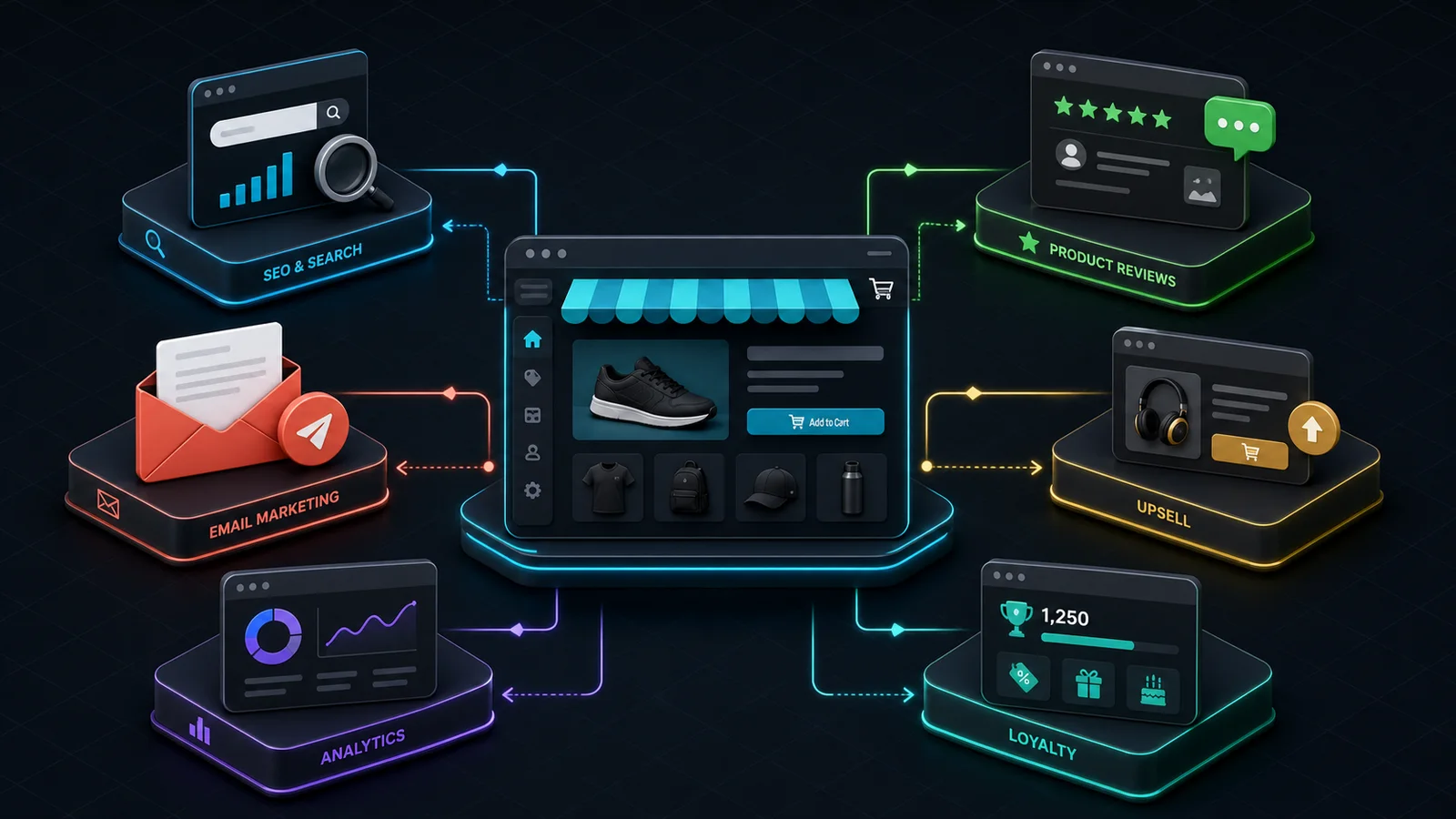
Best Shopify Apps for Increasing Sales in 2026

App 01
Klaviyo: Best for lifecycle marketing and retention revenue
Best for: Growing stores building measurable email, SMS, and customer lifecycle programs
Overview: Klaviyo: Email Marketing & SMS is a customer data and messaging platform built around real-time commerce behavior. It connects orders, catalog data, browsing activity, customer properties, and consent to email, SMS, WhatsApp, push, forms, segmentation, and automated flows.
Best for: Growing merchants that have meaningful traffic, an expanding customer list, and enough repeat-purchase potential to justify disciplined lifecycle marketing.
Key features: Welcome, browse-abandonment, cart, post-purchase, replenishment, back-in-stock, price-drop, win-back, and VIP flows; predictive analytics; product recommendations; forms; A/B testing; attribution; and a broad integration ecosystem.
Pros: Klaviyo can become the central retention layer instead of a disconnected newsletter tool. Its Shopify event depth supports useful segments such as first-time high-AOV buyers, category-specific purchasers, lapsing subscribers, or customers predicted to order again. It also scales from simple flows to complex multi-market programs.
Cons: Cost increases with active profiles and messaging volume. The interface and reporting can be more than a small team needs. Poor list hygiene, weak deliverability, and excessive discount automation can make attributed revenue look healthy while margin and brand trust decline.
Pricing: Free for up to 250 contacts and 500 monthly emails, with limited SMS credits. At verification, email started at $20 per month for 251-500 contacts and SMS at $15 per month for 1,250 credits. Pricing rises with usage.
Performance considerations: Klaviyo forms and onsite tracking add storefront code. Load only the features you use, delay nonessential scripts appropriately, and avoid running a second pop-up or personalization tool that duplicates the same behavior.
Ideal business size: Growing, mid-market, and enterprise stores. Early stores can use the free plan, but the platform creates the most value once there is enough behavioral data and repeat demand.
Real-world implementation example: A skincare merchant could separate first-time buyers by product routine, send usage education before the expected replenishment window, and trigger a replenishment flow only when the product has not already been reordered. That is more useful than sending every buyer the same 15% discount.
Limitations: Klaviyo cannot fix a weak offer, low-quality acquisition, poor deliverability practices, or products with no natural repeat cycle. Attribution is directional and should be reconciled with Shopify, analytics, margin, and holdout testing.
When not to choose it: Do not choose Klaviyo if you only send a monthly newsletter, have a tiny list with no retention strategy, or cannot assign an owner to campaigns, flows, consent, and deliverability.
Expert recommendation: Implement four high-confidence flows first: welcome, abandonment, post-purchase, and win-back. Define a contribution-margin baseline before expanding channels. Complexity should follow proven revenue, not precede it.

App 02
Judge.me: Best-value reviews and social proof
Best for: Merchants that need credible product reviews and visual user-generated content
Overview: Judge.me Product Reviews collects and displays product and store reviews, including photos and videos. It supports automated requests, review widgets, rich snippets, Shop App sync, imports, social sharing, coupons, referrals, and integrations with major ecommerce tools.
Best for: Almost any merchant selling products where buyer confidence, fit, quality, results, or authenticity affects conversion.
Key features: Unlimited reviews on the free plan, photo and video reviews, star badges, carousels, review pages, Q&A, product grouping, Google rich snippets, multilingual collection, moderation, and imports from several platforms.
Pros: The free plan is unusually capable, the paid plan is transparent at $15 per month, and the app carries Shopify's Built for Shopify designation. It is suitable for testing a review program without committing to a large annual contract.
Cons: Review widgets can become visually heavy when every possible element is enabled. Incentives require clear disclosure and careful policy compliance. Imported or poorly moderated reviews can weaken trust instead of strengthening it.
Pricing: Forever Free includes unlimited product, store, photo, and video reviews. The Awesome plan was $15 per month and added advanced collection, integrations, deeper widgets, customization, AI tools, and channel syndication.
Performance considerations: Star ratings near product titles are usually worth the small rendering cost. Large carousels, media galleries, and several widgets on one page deserve measurement. Keep the product page hierarchy focused on buying decisions.
Ideal business size: Startup through enterprise, especially merchants that want strong core functionality without enterprise review-platform pricing.
Real-world implementation example: An apparel brand could request a review after delivery, ask structured questions about fit and size, and surface those answers beside the size selector. The review program then reduces a specific purchasing objection rather than merely accumulating stars.
Limitations: Judge.me cannot manufacture customer trust. Review volume depends on order volume, timing, request quality, product experience, and how easily customers can respond. Advanced syndication requirements may still justify a different enterprise platform.
When not to choose it: Avoid any review app if you plan to hide legitimate negative feedback or import reviews that cannot be substantiated. Choose a more specialized vendor if your retail syndication contracts require capabilities Judge.me does not support.
Expert recommendation: Ask questions that help the next buyer: fit, use case, skin type, room size, setup difficulty, or durability. A smaller set of decision-rich reviews can outperform a wall of generic praise.

App 03
Shopify Search & Discovery: Best free native merchandising tool
Best for: Stores improving catalog search, filters, recommendations, and product discovery
Overview: Shopify Search & Discovery is Shopify's free tool for storefront filters, synonym groups, product boosts, related products, complementary products, and search analytics.
Best for: Stores with a searchable catalog that need better findability and basic merchandising without adding another paid vendor.
Key features: Search filters, synonyms, product boosts, complementary and related recommendations, query reporting, and search/discovery performance analytics.
Pros: It is free, native, multilingual, and integrated with Shopify admin. It can improve high-intent product discovery with less vendor overhead than a fully external search platform. Complementary product data also supports product-page cross-selling.
Cons: Its 2.9 rating reflects real merchant frustration and capability gaps. Complex catalogs may need more control over ranking, merchandising rules, semantic search, analytics, or custom result experiences than the native app provides.
Pricing: Free.
Performance considerations: Native integration is a major advantage, but the theme still determines how filters and recommendation blocks render. Test collection-page interaction, mobile filter behavior, zero-result states, and visual stability.
Ideal business size: Startup to mid-market. It can also serve enterprise catalogs with straightforward requirements, but it is not an automatic substitute for advanced search infrastructure.
Real-world implementation example: A footwear store could map shopper language such as "trainers" and "sneakers," add filters for activity, surface high-stock products for valuable queries, and recommend socks or care kits as complementary products.
Limitations: The app works with the catalog data it receives. Inconsistent product types, tags, variants, metafields, or naming will produce a weak discovery experience regardless of the interface.
When not to choose it: Do not rely on it as the only search solution when you require sophisticated personalization, natural-language intent, complex B2B catalogs, advanced merchandising workflows, or dedicated search relevance support.
Expert recommendation: Start here before paying for search. Analyze top queries, no-result searches, filter usage, search conversion, and exit rate. Upgrade only after you can describe the missing capability and its financial impact.
Expert Insight: The first three apps should fix fundamentals
Klaviyo, Judge.me, and Search & Discovery cover retention, trust, and findability. They do not require the merchant to interrupt every shopping session with another offer.
This is a useful stopping point. Before installing an upsell app, confirm that shoppers can find the right product, trust it, understand it, and receive relevant follow-up. Otherwise, an upsell widget simply asks a hesitant customer to make a larger uncertain decision.
Also check overlap. Klaviyo can run forms and recommendations. Judge.me can issue coupons and referrals. Search & Discovery can show complementary products. Document which platform owns each customer-facing function so the store does not show two pop-ups, two recommendation blocks, or contradictory incentives.

App 04
Rebuy Personalization Engine: Best for advanced personalization and AOV
Best for: Established brands with enough traffic and order data for personalized merchandising
Overview: Rebuy Personalization Engine combines AI recommendations, Smart Cart, product and collection merchandising, search, checkout and post-purchase offers, reorder experiences, flows, and A/B testing.
Best for: Established brands with enough traffic and order volume to benefit from personalized merchandising across several journey stages.
Key features: AI and rules-based recommendations, slide-out cart, tiered rewards, free gifts, bundles, product discovery, checkout blocks, post-purchase upsells, segmentation, A/B testing, and integrations with Klaviyo, Recharge, reviews, and support platforms.
Pros: Rebuy can consolidate functions otherwise spread across several Shopify upsell apps. It supports no-code configuration while leaving room for custom implementation. Its broad surface area is valuable when one merchandising strategy must follow the customer from product page to reorder.
Cons: Breadth creates complexity. Poorly governed recommendations can feel repetitive, aggressive, or irrelevant. Pricing scales with orders and selected products. Implementation and experimentation require more expertise than installing a single widget.
Pricing: Paid packages started at $25 per month and scaled with monthly orders; packages cover Cart & Merchandising, Checkout & Post-Purchase, Search & Collections, and Flows & A/B Testing. A free Rebuy Monetize option and development-store plan were also listed.
Performance considerations: Rebuy can replace several scripts, but enabling every surface can still add meaningful client-side work. Audit the cart, recommendations, search, pop-ups, and experiments as one system. Remove the tools it replaces.
Ideal business size: Growing, mid-market, Shopify Plus, and enterprise stores with an owner for merchandising and experimentation.
Real-world implementation example: A nutrition brand could recommend a shaker only to first-time powder buyers, offer a larger size to repeat buyers, show a subscription upgrade to customers with a matching reorder pattern, and suppress offers that conflict with an active promotion.
Limitations: Personalization quality depends on catalog structure, order history, business rules, creative, and testing discipline. Small datasets may not justify AI-led complexity.
When not to choose it: Skip Rebuy if your catalog is small, traffic is limited, your theme already has an effective cart, or you only need one simple post-purchase offer.
Expert recommendation: Write a merchandising matrix before configuration: customer segment, trigger product, eligible offer, margin floor, exclusion, placement, and success metric. Personalization should encode strategy, not substitute for it.

App 05
ReConvert by Upsell.com: Best accessible upsell funnel builder
Best for: Small and growing stores testing focused cart and post-purchase offers
Overview: Upsell.com - ReConvert Upsell provides product-page, cart, checkout, post-purchase, and thank-you-page offers with recommendations, bundles, segmentation, analytics, and A/B testing.
Best for: Small and growing merchants that want a focused AOV program without adopting a larger personalization platform.
Key features: One-click post-purchase offers, cart and product upsells, frequently bought together, thank-you-page widgets, conditional funnels, AI recommendations, conversion reporting, and testing. Checkout upsells are restricted to Shopify Plus.
Pros: Entry pricing is low and the funnel builder covers the most valuable upsell placements. Post-purchase offers reduce pre-purchase friction because the original order is already complete.
Cons: Pricing rises with monthly orders or upsell revenue. Aggressive default offers can reduce trust or train customers to expect a deal after every purchase. The app's breadth overlaps with Rebuy, cart drawers, bundle apps, and theme recommendations.
Pricing: The Basic plan started at $4.99 per month for up to 50 orders or $50 in upsell revenue; Growth at $9.99 and Business at $19.99 covered higher thresholds. Charges rise with volume. Development stores were free.
Performance considerations: Post-purchase and thank-you-page functions have less impact on the initial product-page experience than pre-purchase widgets. If you enable product and cart features, measure their scripts and avoid another upsell layer.
Ideal business size: Startup to mid-market; particularly useful when a merchant has one or two obvious complementary offers.
Real-world implementation example: A coffee equipment store could offer replacement filters after a brewer purchase, but suppress the offer when filters are already in the order. The offer should protect margin and never delay the original checkout.
Limitations: Upsell attribution does not prove incrementality. Some buyers would have purchased the add-on without a widget, while discounts may reduce the profit gained from higher AOV.
When not to choose it: Do not choose ReConvert alongside a mature Rebuy implementation unless responsibilities are deliberately separated. Avoid it if there is no genuinely complementary product or operational capacity for the extra line item.
Expert recommendation: Begin post-purchase with one high-fit, full-margin product. Compare gross profit per order and refund rate against a holdout, not only displayed "upsell revenue."

App 06
Shopify Bundles: Best free option for fixed bundles
Best for: Merchants selling straightforward multipacks, kits, and curated product sets
Overview: Shopify Bundles creates fixed bundles and multipacks inside Shopify admin while synchronizing component inventory in real time.
Best for: Merchants that need straightforward kits, multipacks, or curated sets and value native simplicity over advanced bundle logic.
Key features: Fixed bundles, multipacks, selectable component variants, custom bundle product pages, native inventory synchronization, and broad language support.
Pros: It is free, requires no coding for standard setups, and keeps inventory aligned with bundle components. Native administration reduces vendor and billing overhead.
Cons: Its 2.8 rating is a warning against assuming native means feature-complete. Merchants report limitations around bundle presentation and more complex scenarios. It is not a full build-a-box, subscription bundle, wholesale pricing, or sophisticated promotion engine.
Pricing: Free.
Performance considerations: Native bundle data is generally lighter than a heavily interactive bundle builder. Theme implementation still matters, particularly product media, option selection, price communication, and mobile layout.
Ideal business size: Startup to mid-market stores with simple bundle requirements. Larger stores can use it when operations remain straightforward.
Real-world implementation example: A home-care brand could create a cleaning starter set made from three existing SKUs, sell it at a clear fixed price, and allow component inventory to determine availability.
Limitations: Complex mix-and-match logic, conditional discounts, high-variant build-a-box experiences, subscription boxes, and specialized fulfillment may require another app or custom development.
When not to choose it: Do not choose Shopify Bundles if the bundle experience is a core product differentiator and requires guided steps, personalization, sophisticated discounts, or ERP-specific order decomposition.
Expert recommendation: Use it to validate bundle demand. If customers buy the concept but struggle with the interface or request flexibility, you then have evidence for a specialist builder or custom bundle experience.
Expert Insight: Upsell revenue is not the same as incremental profit
Upsell tools often report the value of orders that interacted with an offer. That number is useful, but it is not automatically new revenue caused by the app.
Evaluate an upsell or bundle on incremental contribution profit per session or order. Subtract discounts, cost of goods, payment fees, fulfillment cost, returns, app fees, implementation, and any conversion loss introduced by extra friction. Where possible, keep a control group.
Subscription fatigue begins when several tools charge by the same growth event. A merchant might pay Klaviyo by contacts, Rebuy by orders, ReConvert by orders or upsell revenue, and a loyalty platform by orders. Model app costs at today's volume and at the next two growth milestones before committing.

App 07
Recharge Subscriptions: Best for established recurring-revenue programs
Best for: Brands managing subscriber acquisition, self-service, churn, and recurring revenue
Overview: Recharge Subscriptions is a subscription platform for recurring products, memberships, bundles, subscriber self-service, cancellation prevention, failed-payment recovery, win-back, loyalty, and retention analytics.
Best for: Brands with replenishable or recurring products and a serious plan to manage subscriber acquisition, experience, churn, and lifetime value.
Key features: Subscription widgets, no-code customer portal, skip/swap/reschedule, churn interventions, payment recovery, bundles, cross-sells, loyalty credits, cohort benchmarks, APIs, and integrations with Klaviyo, Gorgias, Shopify Flow, POS, and analytics tools.
Pros: Recharge addresses the full subscription lifecycle rather than only taking recurring payment. Its ecosystem and advanced tools can support complex programs as subscriber count grows.
Cons: Transaction fees and plan upgrades materially affect economics. Subscription operations create customer-service, inventory, forecasting, cancellation, payment, and compliance responsibilities. A discount is not a retention strategy.
Pricing: A $25-per-month entry plan covered the first 50 subscribers without transaction fees. Starter was $99 per month plus 1.49% and $0.19 per transaction. Plus was $499 per month with a lower percentage and advanced features. A 60-day trial was listed.
Performance considerations: Product-page widgets and account portals must match the theme and load predictably. Keep the one-time purchase choice clear. Test selling-plan selection, cart changes, customer accounts, accelerated checkout, and mobile behavior.
Ideal business size: Growing through enterprise. Very early merchants should validate replenishment demand before accepting a large recurring platform cost.
Real-world implementation example: A pet food merchant could let subscribers change delivery frequency, swap flavors, skip an order, and accept a smaller shipment before cancelling. Support agents could see the subscriber context inside Gorgias, while Klaviyo sends usage and renewal education.
Limitations: Recharge cannot create subscription suitability. Products with irregular consumption, high return rates, or low satisfaction may generate avoidable cancellations and support volume.
When not to choose it: Do not choose Recharge merely to place a "subscribe and save" toggle on products customers do not naturally replenish. Shopify's simpler native subscription options or another lower-cost app may be enough for a small test.
Expert recommendation: Model subscriber contribution margin by cohort after discounts, failed payments, shipping, support, and churn. Optimize the second and third order before spending heavily on new subscriber acquisition.

App 08
LoyaltyLion: Best for branded loyalty and VIP programs
Best for: Brands with proven repeat purchasing across ecommerce, retail, or subscriptions
Overview: LoyaltyLion Loyalty Program supports points, VIP tiers, referrals, memberships, custom rewards, customer segments, POS, checkout, account-page placement, and integrations with the broader retention stack.
Best for: Brands with proven repeat purchase behavior that want a differentiated loyalty experience across ecommerce and retail.
Key features: Points for purchases and activities, referral incentives, VIP tiers, free products, shipping, early access, custom perks, loyalty analytics, segments, notifications, and integrations with Klaviyo, Gorgias, Recharge, reviews, and mobile apps.
Pros: LoyaltyLion can build a program around access and recognition rather than endless coupons. It supports a more integrated brand experience than a generic points launcher.
Cons: The pricing jump from free to Classic is significant, and advanced tiers require a quote. Loyalty programs create financial liability, customer questions, fraud risk, and operational work. Points do not repair a weak repurchase proposition.
Pricing: The free plan covered up to 400 monthly orders with core points, discount rewards, customization, analytics, and segments. Classic was $199 per month and added VIP tiers, unlimited integrations, onboarding, POS, and revenue reporting.
Performance considerations: An embedded loyalty page is usually manageable, but product, checkout, account, and pop-up placements can accumulate. Limit real-time widgets to moments where the balance or reward changes a decision.
Ideal business size: Growing, mid-market, omnichannel, and enterprise brands. Startups should first establish repeat demand.
Real-world implementation example: A beauty brand could award early product-drop access at the second tier, a consultation at the third tier, and bonus points for verified reviews. The rewards reinforce the brand and cost less than permanent discounts.
Limitations: Attributed loyalty revenue includes customers who may have purchased anyway. Breakage, redemption cost, tier benefits, and program administration must be included in ROI.
When not to choose it: Skip a paid loyalty platform when repurchase frequency is low, customer identity is not captured, margins cannot fund rewards, or the team has no calendar for member communications.
Expert recommendation: Build the program around desired behavior and customer value. Use discounts sparingly. Access, education, services, community, and convenience often create stronger differentiation with better margin.

App 09
Shopify Inbox: Best free AI-assisted sales chat
Best for: Stores that receive pre-purchase questions and want native conversational selling
Overview: Shopify Inbox is Shopify's free live chat and AI sales-assistance tool. It connects to catalog, inventory, policies, orders, and shopper context to answer questions and recommend products.
Best for: Merchants that receive pre-purchase questions and want to test conversational selling without buying a full helpdesk.
Key features: AI agent, live chat, product recommendations, order updates, FAQs, quick replies, discounts, customer context, push notifications, brand controls, chat assignment, and assisted-order analytics.
Pros: Inbox is free, native, quick to deploy, and rated 4.7. It can expose the questions preventing customers from buying while giving small teams a practical support channel.
Cons: AI answers require supervision. Recent merchant feedback shows why locale, time-sensitive delivery, policy, and product claims must be tested. It is not a complete multichannel ticketing platform.
Pricing: Free.
Performance considerations: A chat launcher adds an interface element to every configured page. Check mobile obstruction, interaction delay, accessibility, and overlap with sticky add-to-cart or consent controls.
Ideal business size: Startup to mid-market, or any store validating whether conversational commerce deserves a larger investment.
Real-world implementation example: A furniture store could teach Inbox to answer material, dimension, delivery, and care questions, then review conversations weekly to identify missing product-page information. Chat becomes both a sales channel and research input.
Limitations: The assistant depends on accurate catalog and policy content. It should not improvise medical, legal, safety, compatibility, delivery, or warranty claims. Human escalation still matters.
When not to choose it: Do not rely on Inbox alone when support spans email, social, phone, several stores, complex returns, SLAs, or a large agent team.
Expert recommendation: Launch with a reviewed knowledge base, explicit escalation rules, and a weekly quality sample. Fix recurring questions on the product page so chat handles exceptions instead of hiding content problems.
Expert Insight: Automation needs governance, not blind trust
AI sales and service features can answer faster, but speed is only valuable when the answer is correct. Define which information the agent may use, which claims require a human, how locale and inventory are handled, and who reviews failures.
This applies beyond chat. Subscription cancellation flows, loyalty rewards, post-purchase offers, and email automations all make decisions at scale. A small configuration mistake can affect thousands of customers. Use staging where available, keep change logs, assign owners, and test the entire journey after app updates.
For growing stores, Shopify automation should connect systems with explicit rules and monitoring. Automation without exception handling simply makes errors faster.


App 10
Gorgias: Best for scaled ecommerce customer support
Best for: Growing support teams connecting service, retention, orders, and assisted sales
Overview: Gorgias: AI, Helpdesk & Chat centralizes email, live chat, social, voice, SMS, help center, and ecommerce customer data. Its AI agent and shopping assistant automate support while routing important conversations to people.
Best for: Growing and high-volume merchants whose support operation directly affects conversion, retention, refunds, and team efficiency.
Key features: Unified inbox, Shopify order actions, macros, routing, tags, self-service, AI responses and summaries, product recommendations, cart recovery, cross-sell, analytics, multi-store support, and integrations with Klaviyo, Recharge, and loyalty platforms.
Pros: Agents work with customer and order context instead of switching tools. Automation can remove repetitive "where is my order" work and give humans more time for sales, retention, and complex resolutions.
Cons: The 4.2 rating is materially lower than several alternatives in this guide. Recent feedback includes both long-term praise and serious onboarding/support complaints. Ticket-based pricing and automation add-ons can become expensive at scale.
Pricing: Starter was $10 per month for 50 tickets and three agents, with overage fees. Basic was $60 for 300 tickets, Pro $360 for 2,000, and Advanced $900 for 5,000. Automation may cost extra.
Performance considerations: The helpdesk itself is operational, but chat, tracking, self-service, and onsite campaigns affect the storefront. Configure only the onsite features that earn their place.
Ideal business size: Growing to enterprise, especially multi-channel or multi-store teams with measurable support volume.
Real-world implementation example: An apparel brand could automate order-status questions, route size exchanges to a specialist queue, expose order history to agents, and trigger a saved response that recommends the correct replacement rather than immediately refunding.
Limitations: Gorgias cannot fix unclear policies, fulfillment failures, understaffing, or a poor knowledge base. AI rollout and vendor onboarding require internal ownership.
When not to choose it: A small store with light chat volume should start with Shopify Inbox. Avoid Gorgias if ticket-based pricing does not fit your support model or you cannot manage automation quality.
Expert recommendation: Calculate cost per resolved ticket, first-response time, resolution time, repeat contact, refund avoidance, and support-assisted revenue. Pilot AI on low-risk intents before allowing autonomous actions.

App 11
Shopify Translate & Adapt: Best free international localization app
Best for: Merchants using Shopify Markets to build multilingual, locally relevant stores
Overview: Shopify Translate & Adapt localizes Shopify content by language and market. It offers free automatic translation for two languages, unlimited manual translations, a side-by-side editor, and market-specific content adaptation.
Best for: Merchants using Shopify Markets who need a native first step toward multilingual and regionally relevant storefronts.
Key features: Machine translation, manual editing, bulk translation, SEO and URL translation, metafields, theme-editor access, and content variants for markets that share a language.
Pros: It is free, native, and rated 4.5. The ability to adapt content for different English-speaking or French-speaking markets is commercially useful because localization is more than literal translation.
Cons: Automatic translation requires human review, particularly for product claims, sizing, ingredients, legal terms, idioms, and search language. Third-party app content and custom theme elements may need additional work.
Pricing: Free.
Performance considerations: Translation data itself should not require a heavy storefront widget. The bigger risk is duplicated selectors, third-party translation scripts, or incorrectly localized app blocks.
Ideal business size: Startup through enterprise as a baseline localization layer. Complex global teams may add translation management, professional review, or custom integrations.
Real-world implementation example: A Canadian merchant expanding to France could translate catalog content, then adapt sizing, shipping language, seasonal references, and merchandising for the French market rather than publishing a direct machine copy.
Limitations: The app does not configure international tax, duties, inventory, domains, payments, pricing, shipping, returns, or customer service. Localization is one component of an international operating model.
When not to choose it: Do not treat automatic translation as publication-ready for regulated or high-consideration products. A specialist workflow is better when many translators, approvals, glossaries, or dynamic third-party content are involved.
Expert recommendation: Localize the entire conversion journey, including navigation, product data, search terms, size guides, errors, emails, policies, checkout-adjacent content, and support. Review conversion and returns by market, not only traffic.

App 12
Intelligems: Best for profit-focused Shopify CRO testing
Best for: Established stores with enough traffic for pricing, content, shipping, and profit tests
Overview: Intelligems: A/B Testing tests content, themes, prices, discounts, shipping, bundles, checkout, and post-purchase experiences. It can report revenue, profit, cost of goods, and profit per visitor.
Best for: Established merchants with enough qualified traffic to reach decisions and a team capable of turning test results into a CRO roadmap.
Key features: Content and theme experiments, price testing, discount and bundle tests, shipping-rate and threshold tests, checkout and post-purchase tests, audience personalization, COGS-aware reporting, and AI-assisted ideation and analysis.
Pros: Intelligems targets decisions that materially affect profit, not only button colors. Segmentation and COGS support make results more commercially interpretable than conversion rate alone.
Cons: Low-traffic stores may wait too long for useful results. Pricing scales with order volume, and advanced testing requires disciplined hypothesis design, quality assurance, statistics, and stakeholder alignment.
Pricing: Smart Content started at $69 per month. Smart Merchandise and Smart Shipping started at $112 each. Unlimited was $349 per month. All tiers scaled with sitewide order volume and included a 14-day trial.
Performance considerations: Experiment code can affect page rendering and create flicker when poorly implemented. Test scripts, targeting, analytics, and variant assets under real mobile conditions. Do not run conflicting experiments in the same journey.
Ideal business size: Established, high-volume, Shopify Plus, and enterprise stores. It is usually premature for an early startup.
Real-world implementation example: A merchant could test a $60 versus $75 free-shipping threshold while measuring conversion, AOV, fulfillment cost, and profit per visitor. The winning choice may be the option with lower conversion but higher contribution profit.
Limitations: A testing platform does not choose the right business questions. Seasonality, promotions, returning visitors, tracking gaps, and novelty effects can distort interpretation.
When not to choose it: Do not subscribe when traffic is insufficient, analytics are unreliable, or the team cannot ship winning changes. Start with qualitative research and obvious usability fixes.
Expert recommendation: Create a test backlog from analytics, customer research, support conversations, and usability evidence. Predefine the primary metric, guardrails, minimum detectable effect, run conditions, and decision rule before launch.
Expert Insight: At scale, app strategy becomes architecture
By the time a store needs Gorgias, advanced localization, and a testing platform, individual app choices are no longer isolated. Customer identity, consent, events, discounts, orders, subscriptions, support, and experiments form a connected system.
Document data ownership and failure modes. Decide which platform is authoritative for customer status, loyalty balance, subscription state, attribution, and consent. Test integration changes in a controlled environment. Maintain a release calendar so a theme deployment, email campaign, pricing test, and checkout update do not launch simultaneously.
At this stage, app consolidation or custom Shopify development may create more value than another subscription.
Comparison Tables by Use Case
Best free Shopify apps
| App | Free value | Best next step |
|---|---|---|
| Judge.me | Unlimited reviews and core widgets | Upgrade only for advanced integrations and customization |
| Shopify Search & Discovery | Filters, synonyms, boosts, recommendations | Improve catalog data before buying search software |
| Shopify Bundles | Fixed bundles and inventory sync | Validate bundle demand before adding complexity |
| Shopify Inbox | Live chat and AI sales assistance | Build a reviewed knowledge base and escalation rules |
| Shopify Translate & Adapt | Two auto-translated languages and manual localization | Add human review and market operations |
| Klaviyo | Up to 250 contacts and core automation | Prove lifecycle contribution before list cost rises |
Best premium Shopify apps
| App | Premium advantage | Cost risk to monitor |
|---|---|---|
| Rebuy | Consolidated personalization and merchandising | Order-based scaling and implementation complexity |
| ReConvert | Accessible, focused upsell funnels | Volume and upsell-revenue pricing |
| Recharge | Full subscription lifecycle management | Platform and transaction fees |
| LoyaltyLion | Branded VIP and omnichannel loyalty | Large free-to-paid pricing jump |
| Gorgias | Unified support operation and AI automation | Tickets, overages, and add-ons |
| Intelligems | Profit-aware experimentation | Order-volume pricing and traffic requirements |
Best AI Shopify apps
| App | AI use | Human responsibility |
|---|---|---|
| Klaviyo | Segmentation, content, predictions, send optimization | Consent, deliverability, offer strategy |
| Rebuy | Recommendations and personalized merchandising | Eligibility, margin, exclusions, testing |
| ReConvert | Product recommendations and funnel optimization | Incrementality and customer experience |
| Shopify Inbox | Conversational product and policy assistance | Accuracy, escalation, sensitive claims |
| Gorgias | Ticket resolution, summaries, shopping assistance | Quality assurance and action permissions |
| Intelligems | Test ideation, content changes, analysis support | Hypotheses, statistics, implementation decisions |
Best apps for Shopify Plus and enterprise stores
| Need | Recommended app | Why it fits scale |
|---|---|---|
| Cross-journey personalization | Rebuy | Checkout, cart, search, merchandising, and testing |
| Subscription retention | Recharge | APIs, bundles, churn prevention, and analytics |
| Loyalty across channels | LoyaltyLion | VIP, POS, checkout, integrations, custom rewards |
| Scaled support | Gorgias | Multi-channel, multi-store, routing, automation |
| Profit-focused CRO | Intelligems | Pricing, shipping, checkout, and COGS measurement |
| Lifecycle orchestration | Klaviyo | Rich segmentation, multiple channels, broad ecosystem |
Best apps for startups
| Priority | Recommended app | Reason |
|---|---|---|
| Trust | Judge.me | Strong free plan and fast setup |
| Product discovery | Shopify Search & Discovery | Native and free |
| Simple AOV test | Shopify Bundles | Validate fixed bundles without app cost |
| Sales questions | Shopify Inbox | Free chat with customer context |
| Basic localization | Translate & Adapt | Native market content tools |
| Early retention | Klaviyo free plan | Start essential flows before the list grows |
Best apps for established and enterprise stores
| Business problem | Established brand | Enterprise store |
|---|---|---|
| Email and retention | Klaviyo | Klaviyo with data and consent governance |
| AOV and personalization | ReConvert or Rebuy | Rebuy with structured experimentation |
| Recurring revenue | Recharge Starter | Recharge Plus or evaluated custom integrations |
| Customer loyalty | LoyaltyLion Classic | LoyaltyLion advanced plan or custom loyalty layer |
| Customer service | Gorgias Basic/Pro | Gorgias Advanced with controlled AI rollout |
| CRO | Intelligems | Intelligems plus internal experimentation process |
Common Mistakes When Choosing Shopify Conversion Apps
Installing too many apps
The issue is not an arbitrary number. Ten admin-only tools can be harmless, while three storefront apps can compete for the cart, discounts, and customer attention. Inventory every app by business owner, purpose, storefront surface, data access, script, monthly cost, renewal date, and replacement risk.
Ignoring store speed
Measure before installation and after configuration, not only after clicking "install." Test representative product, collection, cart, search, account, and content pages on mobile. Watch Core Web Vitals, JavaScript execution, network requests, layout shifts, and interaction delay. AreoTech's store maintenance and performance work includes ongoing app and theme review because speed can deteriorate gradually.
Choosing based only on ratings
A high rating may reflect easy onboarding rather than performance at your scale. A lower-rated native app may still be the right simple tool. Read recent positive and negative reviews from merchants with similar order volume, catalog complexity, markets, and requirements.
Paying for overlapping features
Klaviyo, Rebuy, ReConvert, Judge.me, LoyaltyLion, Gorgias, and theme features can all create offers, messages, recommendations, or incentives. Assign one owner per function. Overlap increases cost, tracking ambiguity, and customer friction.
Ignoring long-term ROI
Model the next pricing tier before installing. Include subscription fees, usage, transaction charges, discounts, implementation, maintenance, training, support, performance, and switching cost. Compare incremental contribution profit, not vendor-attributed revenue alone.
Poor app maintenance
Apps are production dependencies. Review permissions, billing, integrations, theme embeds, web pixels, staff access, data retention, and vendor notices. Audit quarterly and before peak periods. After removal, check for leftover theme code and broken workflows.
How to Choose Apps by Business Stage
Startup
Prioritize trust, product discovery, customer questions, basic retention, and measurement. A sensible stack is Judge.me, Search & Discovery, Inbox, and a carefully configured free Klaviyo account. Add Shopify Bundles only when a bundle makes product sense. Avoid paid loyalty and advanced testing until repeat behavior and traffic exist.
Growing store
Identify the binding constraint. If acquisition is expensive, improve lifecycle marketing. If AOV is low, test one relevant bundle or post-purchase offer. If repeat purchase is proven, evaluate loyalty or subscriptions. Use a monthly scorecard for conversion, AOV, purchase frequency, contribution margin, app cost, and page performance.
Established brand
Consolidate overlapping tools and build an experimentation roadmap. Rebuy, Recharge, LoyaltyLion, Gorgias, and Intelligems may make sense, but not all at once. Every platform needs an owner and integration map.
International business
Start with Shopify Markets and Translate & Adapt, then review domains, currency, catalog, pricing, payment methods, duties, taxes, shipping, returns, consent, and customer support. Translation without operational localization creates a polished promise the business may not fulfill.
Wholesale and B2B
B2B needs often involve company accounts, price lists, payment terms, minimums, sales-rep workflows, ERP data, and repeat ordering. Consumer loyalty or upsell apps may be a poor fit. Shopify Plus B2B capabilities, Functions, and custom integrations deserve priority.
Subscription store
Treat subscriber experience as a product. Recharge is strongest when the merchant owns onboarding, consumption education, account self-service, cancellation reasons, payment recovery, inventory planning, and cohort economics.
Shopify Plus
Use Plus capabilities deliberately. Checkout customizations, B2B, Shopify Flow, Functions, and higher-scale integrations can replace brittle app layers. An app is still valuable when it accelerates a standard capability; custom development is better when the workflow creates competitive advantage.

When Custom Shopify Development Is Better Than Another App
An app is usually the fastest route to a standardized capability. Custom development becomes better when the requirement is distinctive, the app stack overlaps, performance is critical, or several systems must behave as one.
Consider custom work in these situations:
- Custom Shopify development: Your product configuration, bundle, account, merchandising, or B2B experience is part of the value proposition and cannot be expressed cleanly by a generic widget.
- Private or custom apps: Internal workflows need secure access to Shopify data, proprietary logic, or a tailored admin interface. Shopify now calls these custom apps, even though many merchants still use the phrase private apps.
- Shopify Functions: Discounts, delivery, payment, cart transforms, and validation need server-side logic that runs within Shopify's supported model. Review the official Shopify Functions documentation.
- Automation: Orders, inventory, fulfillment, finance, CRM, support, or ERP processes need monitored workflows and exception handling. Shopify Flow can help; see Shopify's official Flow documentation.
- API integrations: Product, customer, order, subscription, or inventory data must move reliably between Shopify and another system with observability, retries, and reconciliation.
- Performance optimization: Several apps duplicate UI or load heavy scripts. Replacing them with theme-native functionality can improve speed and reduce ongoing fees.
- Checkout customization: Shopify Plus merchants may need supported Checkout Extensibility components, validation, or business logic. Use Shopify's checkout app documentation rather than legacy script injection.
The financial comparison should cover total ownership over 12 to 24 months. Include discovery, design, development, QA, hosting or infrastructure, monitoring, maintenance, app subscriptions avoided, performance improvement, and the value of a differentiated experience.
AreoTech helps merchants make that decision before writing code. Our work spans Shopify store development, custom code and app integrations, Shopify automation, and ongoing store maintenance. For complex growth programs, review our case studies or discuss the stack through the contact page. The goal is not custom development for its own sake; it is a cleaner system with a defensible commercial return.
Frequently Asked Questions
What is the best Shopify app for increasing sales?
There is no universal winner. Klaviyo is strongest for retention marketing, Judge.me for affordable social proof, Rebuy for advanced personalization, and Intelligems for evidence-led testing. Choose the app that addresses the largest verified constraint in your funnel.
How many apps should a Shopify store have?
Use the fewest apps needed to solve measured problems. App count matters less than duplicated scripts, overlapping features, weak governance, and unproven ROI. A quarterly app inventory is more useful than aiming for a fixed number.
Do Shopify apps slow down a store?
Some do. Storefront apps can add JavaScript, requests, widgets, and layout work that affect Core Web Vitals. Admin-only and server-side tools usually have less direct storefront impact. Always compare before-and-after performance on representative pages.
What are the best free Shopify apps for increasing sales?
Judge.me, Shopify Search & Discovery, Shopify Bundles, Shopify Inbox, and Shopify Translate & Adapt provide strong free starting points. Klaviyo also has a useful free tier for small contact lists.
Which Shopify app is best for upselling?
ReConvert is a practical entry point for focused cart and post-purchase offers. Rebuy is better for larger brands needing personalization across cart, checkout, search, merchandising, and reorder journeys.
What is the best Shopify app for email marketing?
Klaviyo is the strongest all-around choice for merchants that need deep Shopify data, segmentation, flows, email, SMS, and lifecycle reporting. Smaller stores with basic needs should still compare Shopify's native messaging options.
Is Klaviyo worth the cost for Shopify?
Yes, when lifecycle campaigns produce measurable contribution margin and an owner manages segmentation, deliverability, consent, and flows. It is poor value when used only for occasional newsletters while the contact bill grows.
What is the best review app for Shopify?
Judge.me offers the best value for most merchants. Its free plan supports unlimited reviews, while the paid plan adds integrations, customization, advanced collection, syndication, and AI features.
Are Shopify's own apps better than third-party apps?
Not automatically. Shopify-built apps are often free, simpler, and tightly integrated, but specialist apps usually provide more customization, analytics, support, and advanced workflows. Start native when requirements are simple.
Which Shopify apps are best for Shopify Plus?
Rebuy, Recharge, LoyaltyLion, Gorgias, Klaviyo, and Intelligems are strong candidates when advanced capabilities match a documented need. Plus merchants should also consider native B2B, Flow, Functions, and Checkout Extensibility before adding apps.
Which Shopify app is best for subscriptions?
Recharge is a strong option for established subscription programs that need self-service, churn prevention, payment recovery, bundles, and retention analytics. Validate product suitability and unit economics first.
Should a startup install a loyalty app?
Usually not immediately. First prove that customers want to buy again. Improve product quality, service, email capture, post-purchase education, and basic retention before funding a complex rewards program.
How do I measure a Shopify app's ROI?
Measure incremental contribution profit, then subtract the app fee, usage charges, transaction fees, discounts, implementation, maintenance, and performance cost. Use holdouts or controlled tests where possible. Vendor-attributed revenue is not enough.
Can I use Rebuy and ReConvert together?
You can, but most stores should not. Their upsell capabilities overlap and may create competing offers, duplicate scripts, confusing attribution, and extra cost. If both are present, define separate responsibilities and test the combined journey.
What is the best Shopify app for international sales?
Shopify Translate & Adapt is the best free localization starting point. International growth also depends on Markets, currency, catalog, tax, duties, shipping, returns, local content review, and service.
When is custom Shopify development better than an app?
Custom development is better when the requirement differentiates the business, apps overlap, performance is critical, workflows span systems, or recurring app pricing exceeds the likely ownership cost of a maintained custom solution.
How often should Shopify apps be audited?
Review the stack quarterly and before peak trading periods. Also audit after theme, checkout, account, international, or analytics changes and whenever conversion or performance shifts unexpectedly.
What should I check before uninstalling a Shopify app?
Map dependencies, export needed data, remove embeds and leftover theme code, test affected journeys, verify tracking, and monitor errors. Confirm what happens to customer-facing data such as reviews, subscriptions, points, or saved preferences.
Key Takeaways
- The best Shopify apps are those tied to a measured revenue constraint, not the longest feature list.
- Start with trust, discovery, lifecycle marketing, and customer questions before adding aggressive offer layers.
- Judge.me, Search & Discovery, Bundles, Inbox, and Translate & Adapt provide a strong free foundation.
- Rebuy and ReConvert serve different maturity levels; most stores should not run both.
- Recharge and LoyaltyLion only create durable value when repeat-purchase economics are already proven.
- Gorgias is an operational platform, not merely a chat widget, and requires careful AI governance.
- Intelligems is valuable when traffic, analytics, and a testing process are mature enough to make decisions.
- Measure incremental contribution profit and storefront performance, not attributed revenue alone.
- Audit app ownership, overlap, permissions, billing, integrations, and leftover code every quarter.
- Choose custom development when it simplifies the system or creates a differentiated customer experience.
Quick Decision Guide
| If you are... | Recommended solution |
|---|---|
| A startup | Judge.me + Search & Discovery + Inbox + Klaviyo free tier |
| A growing brand | Klaviyo plus one focused AOV tool: ReConvert or Shopify Bundles |
| A high-volume store | Rebuy + Intelligems, supported by strict app and data governance |
| An international seller | Shopify Markets + Translate & Adapt + human localization review |
| A B2B merchant | Shopify Plus B2B, Functions, Flow, and custom ERP/account integrations |
| A subscription business | Recharge + Klaviyo, with cohort and churn management |
Conclusion
The best apps to increase Shopify sales in 2026 are not a universal bundle. A startup may gain more from free reviews, better filters, and responsive chat than from an enterprise personalization engine. A high-volume brand may save money by consolidating several Shopify marketing apps into one governed platform. A Shopify Plus merchant may discover that Functions, automation, or a custom integration is more reliable than stacking another monthly subscription onto checkout.
Begin with the customer and the economics. Identify the constraint, establish the baseline, choose one owner, implement the smallest credible solution, and measure contribution profit and performance. Keep the tool only if it earns its operational and technical cost.
AreoTech supports merchants with Shopify development, Shopify Plus strategy and implementation, store optimization and custom integrations, performance optimization and maintenance, and Shopify automation. If your app stack has become expensive, slow, or difficult to operate, contact AreoTech for a practical audit and implementation roadmap.