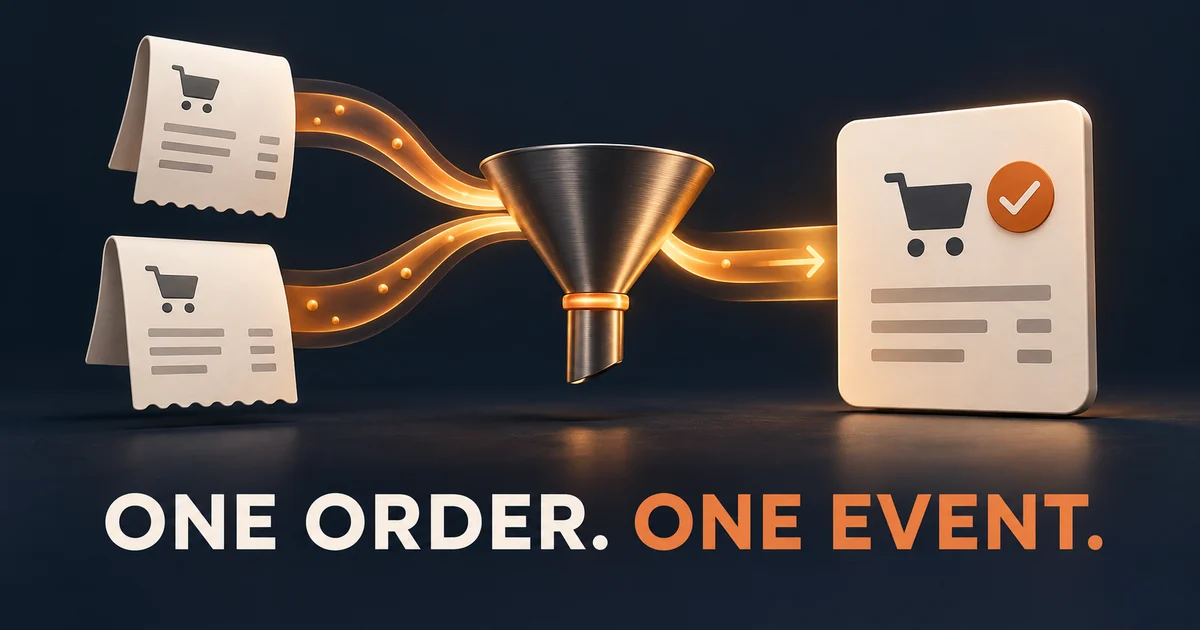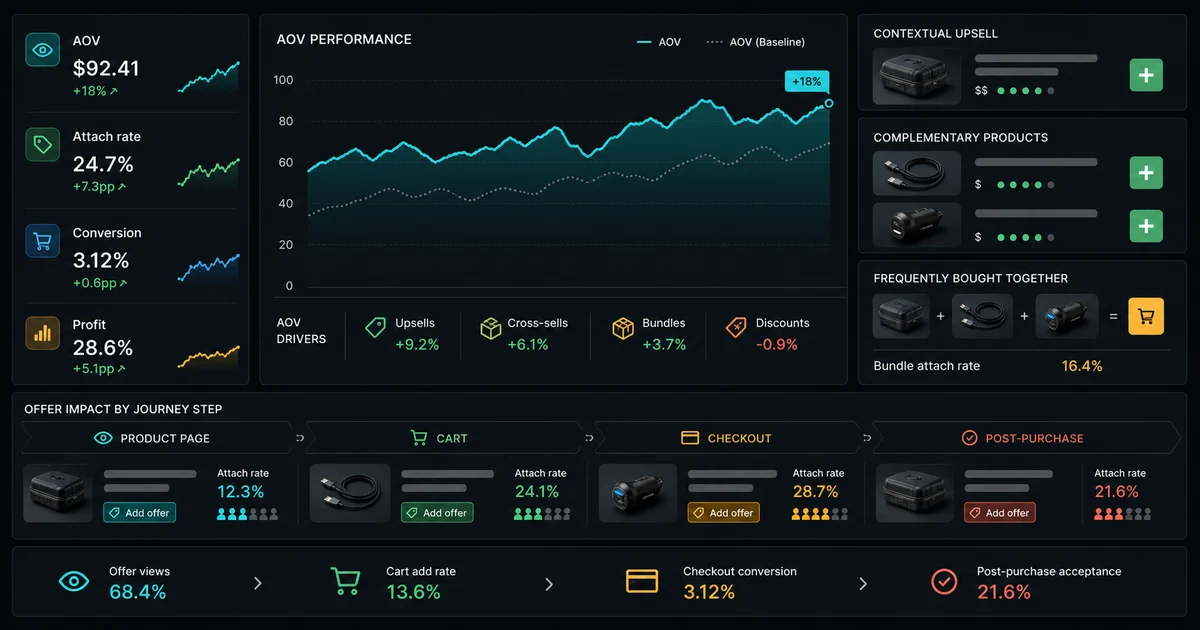
The best Shopify upsell apps increase average order value by matching a relevant offer to the customer's product, intent, and journey stage without weakening checkout completion. This guide compares 10 leading upsell and cross-sell tools for product-page offers, cart recommendations, bundles, checkout extensions, post-purchase funnels, personalization, pricing, and performance.
The strategy is often implemented badly. Merchants install several Shopify upsell apps, show unrelated products at every stage, discount too aggressively, and celebrate vendor-attributed revenue without checking whether checkout completion or contribution profit fell. The result can be more interface noise, slower pages, lower trust, and expensive app overlap.
Upselling, cross-selling, bundles, and product recommendations are related but not interchangeable. An upsell proposes a better version of the intended purchase. A cross-sell adds something complementary. A bundle packages several products into one proposition. A recommendation system decides which item or offer to show. Good execution matches the strategy, product relationship, customer intent, and journey stage.
This guide compares 10 of the strongest Shopify upsell and cross-sell apps available in 2026. We evaluated official App Store information, merchant ratings, offer coverage, AI and merchandising controls, checkout compatibility, bundles, analytics, performance risk, pricing, support, scalability, and long-term business value. Prices and ratings were checked on July 17, 2026 and can change.
The short answer: Choose Selleasy for accessible full-funnel value, ReConvert for practical post-purchase and thank-you-page growth, Rebuy for advanced personalization, Zipify OCU for experiment-led one-click funnels, Frequently Bought Together for focused product-page bundles, Monk for sophisticated gift and eligibility rules, or Shopify Bundles for simple native fixed bundles. Start with one measurable use case, not an app stack.
Understanding Upselling and Cross-Selling
Upselling
An upsell encourages the customer to choose a higher-value version of what they already intend to buy. A laptop with more storage, a premium skincare size, or an annual subscription instead of monthly billing are true upsells. The customer should understand the additional value, not merely see a higher price.
Cross-selling
A cross-sell recommends a complementary item. A protective case for a phone, a brush for foundation, filters for a coffee machine, and care products for footwear are cross-sells. Relevance and compatibility matter more than popularity.
Bundles and frequently bought together
A bundle packages products under one clear proposition, such as a complete morning routine or a three-room lighting kit. It may use fixed contents, selectable variants, mix-and-match rules, or quantity tiers.
Frequently Bought Together (FBT) is a presentation pattern for complementary items that can be added together. The relationship may come from order data, an algorithm, or manual merchandising. Calling every FBT rule “AI” does not make it intelligent; validate whether the suggestions are actually useful.
Cart, checkout, and post-purchase offers
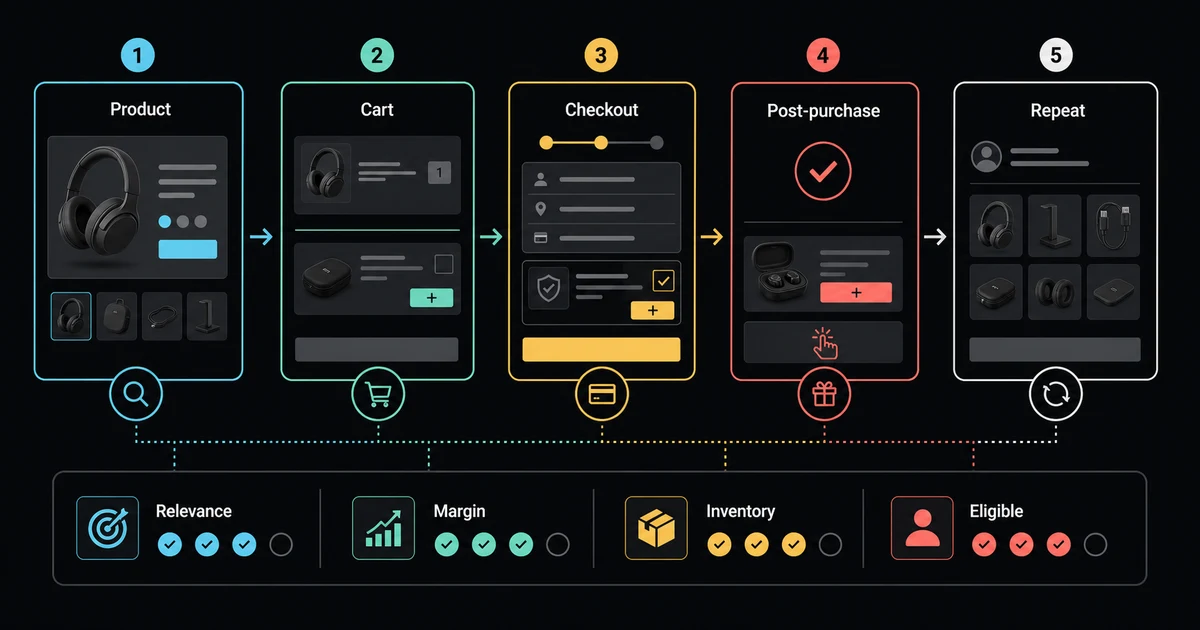
A cart offer appears after buying intent is established but before checkout. It can qualify the customer for free shipping or add a low-friction accessory. A checkout offer appears inside Shopify checkout and must be especially restrained because the customer is completing payment. Some checkout surfaces require Shopify Plus.
A post-purchase offer appears after the initial payment is accepted. For eligible orders, the customer can add a product without repeating the entire checkout. This protects the original conversion from added friction, but availability varies by payment method, currency, subscription, and platform constraints.
AI and dynamic recommendations
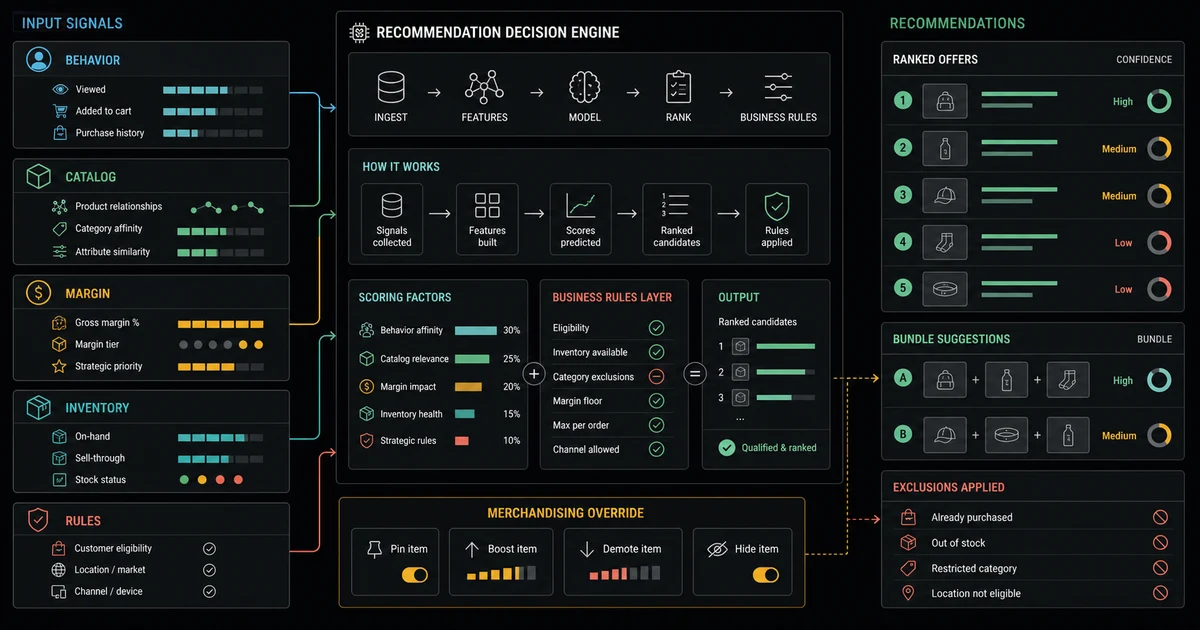
AI recommendations rank products using signals such as browsing, cart contents, purchase history, catalog relationships, and aggregate behavior. Dynamic rules can also use market, inventory, product tags, customer status, or order value. Neither approach removes merchandising responsibility. Exclude incompatible, unavailable, low-margin, regulated, or already-purchased products and provide manual overrides.
Practical example: A camera store could upsell a higher-spec body on the product page, cross-sell a compatible memory card in the cart, offer a curated creator bundle, and show a post-purchase cleaning kit. Showing a random best seller at all four stages is not a strategy.
How We Selected These Apps
- Revenue impact: Can the app support an offer with plausible incremental profit, rather than merely claim attribution?
- Ease of setup: Can a merchant configure, preview, test, pause, and roll back an offer without fragile theme work?
- AI and merchandising: Are automatic recommendations governed by exclusions, inventory, eligibility, manual rules, and reporting?
- Customization: Can the experience match the theme, remain accessible, and work on mobile without turning checkout into an advertisement?
- Performance: We considered storefront scripts, cart replacements, network calls, app embeds, layout shift, and duplicated trackers.
- Analytics: Useful tools expose views, acceptance, revenue, funnel performance, and tests. Merchants still need independent contribution-profit analysis.
- Pricing: We reviewed free access, order or revenue tiers, trials, usage charges, and the cost of scaling.
- Shopify integration: Native app blocks, checkout extensions, Shopify Functions, Markets, Flow, subscriptions, and current theme compatibility matter.
- Support and reliability: Ratings, review patterns, documentation, launch history, and support access help indicate operational quality.
- Scalability: We assessed whether the app can support larger catalogs, markets, teams, data needs, and Shopify Plus governance.
No rating can tell you whether an app fits your theme, catalog, margin model, or checkout. Every recommendation below requires a controlled storefront test.
Quick Comparison: Best Shopify Upsell and Cross-Sell Apps
| App | Best for | Starting price | Free plan | AI recommendations | Checkout upsell | Post-purchase | Bundles | Ideal store size |
|---|---|---|---|---|---|---|---|---|
| Selleasy | Best-value full-funnel offers | Free; paid from $9/mo | Yes | Yes | Yes | Yes | Yes | Startup to growing |
| ReConvert | Post-purchase and thank-you optimization | Dev stores; from $4.99/mo | Dev only | Yes | Plus | Yes | Limited | Startup to mid-market |
| Rebuy | Advanced personalization and merchandising | From $25/mo | Limited/dev | Yes | Yes | Yes | Yes | Growing to enterprise |
| Zipify OCU | One-click funnels and testing | Dev free; from $8/mo plus scaling | Dev only | Yes | Plus | Yes | FBT/offers | Growing to enterprise |
| Frequently Bought Together | Focused product-page FBT | Free; paid from $9.99/mo | Yes | Yes | No | No | Yes | Startup to mid-market |
| Monk | Gift-with-purchase and eligibility logic | From $49/mo | Dev only | Rules-led | Yes | Yes | Yes | Growing to enterprise |
| Candy Rack | Branded all-in-one offer UX | Dev free; from $29.99/mo | Dev only | Yes | Yes | Yes | Yes | Growing to enterprise |
| Bundler | Mix-and-match and volume bundles | Free; paid from $8.99/mo | Yes | No | Limited | Funnel | Yes | Startup to mid-market |
| Essential Upsell | Easy multi-surface entry | Free; paid from $9.99/mo | Yes | Yes | Listed | Yes | Yes | Startup to growing |
| Shopify Bundles | Native fixed bundles and multipacks | Free | Yes | No | No | No | Fixed | Startup to mid-market |
Checkout capabilities can depend on Shopify Plus and platform eligibility. “AI” reflects the official listing, not an independent quality endorsement. Pricing and ratings are snapshots from July 17, 2026.
Best Shopify Upsell and Cross-Sell Apps in 2026

App 01
Selleasy: Best-value full-funnel upsell app
Best for: Startups and growing stores that need product-page, cart, checkout, post-purchase, and thank-you offers without enterprise pricing
Overview and best for: Upsell & Cross Sell - Selleasy covers FBT bundles, add-ons, cart funnels, checkout extensions, post-purchase offers, and related products. Its broad coverage and order-based pricing make it the strongest general-value starting point.
Key features and customization: Product-page lists, grids, carousels and pop-ups; cart-drawer offers; automatic recommendations; bundles and discounts; checkout, one-click post-purchase, thank-you, multi-language, multi-currency, custom CSS, and analytics.
Pros: All main offer surfaces, accessible pricing, theme styling, broad language support, and a 4.9 App Store rating. Cons: Total store orders determine the tier, even when an order does not use an offer; broad capability still requires careful surface selection.
Pricing: Free to install through 50 total monthly orders; $9 through 500; $19 through 1,000; $29 for 1,000+ orders, with a 30-day trial on paid tiers.
AI, performance, and ideal size: Automatic recommendations help scale catalog coverage. Startup to growing stores should enable one surface at a time and test cart drawer compatibility, interaction latency, and mobile layout.
Real-world use case: An outdoor-parts store can pair each roof rack with compatible mounting hardware, offer installation accessories in cart, and show a low-friction maintenance product after purchase.
Limitations and when not to choose it: Do not choose it solely for a complicated multi-region recommendation engine, extensive experimentation program, or proprietary ERP eligibility logic.
Expert recommendation: Selleasy is the best first shortlist for merchants that want breadth without a large contract. Begin with manual compatibility rules on the highest-volume products, then compare automatic recommendations against that baseline.

App 02
ReConvert: Best for post-purchase and thank-you growth
Best for: Merchants that want accessible one-click post-purchase offers, checkout blocks, thank-you customization, segmentation, and A/B testing
Overview and best for: ReConvert is a focused post-purchase and funnel tool with product-page, cart, checkout, thank-you, and order-status capabilities. It suits merchants that want to protect initial checkout while increasing order value after payment.
Key features: One-click offers, AI product recommendations, gift-with-purchase, checkout blocks, thank-you editor, surveys, birthday collection, segmentation, analytics, and A/B testing.
Pros: Low entry price, strong post-purchase workflow, broad funnel coverage, and a 4.8 rating. Cons: Pricing increases with order count or generated upsell revenue, and checkout upsells require Shopify Plus.
Pricing: Development stores are free. Basic starts at $4.99, Growth at $9.99, and Business at $19.99 monthly, with usage thresholds disclosed in the listing.
Performance and ideal size: Startup to mid-market. Post-purchase placement can avoid pre-payment friction, but product-page and cart widgets still require performance testing.
Real-world use case: A coffee brand can offer a sampler after a machine purchase, collect a preference on the thank-you page, and route the answer into future lifecycle segmentation.
Limitations and when not to choose it: Payment, market, subscription, and order eligibility can limit one-click offers. Avoid it when bundles, complex catalog merchandising, or pre-purchase personalization are the main requirement.
Expert recommendation: Treat post-purchase as a service moment. The best offer makes the original product easier to use; a random clearance item may raise short-term acceptance while damaging trust.

App 03
Rebuy Personalization Engine: Best for advanced personalization
Best for: Established brands with enough traffic, catalog depth, experimentation capacity, and data governance to operate personalized merchandising across the journey
Overview and best for: Rebuy Personalization Engine combines AI recommendations, Smart Cart, search, collection merchandising, checkout and post-purchase offers, flows, and A/B testing. It is the most expansive personalization platform in this shortlist.
Key features: Behavior-informed recommendations, product and cart experiences, checkout, post-purchase, search, collections, merchandising rules, segmentation, flows, testing, and no-code through custom-code implementation paths.
Pros: Broad customer-journey coverage, sophisticated merchandising, experimentation, enterprise headroom, and a 4.7 rating. Cons: Modular scope and order-based pricing increase implementation and governance complexity.
Pricing: Development stores are free; commercial packages start at $25 monthly and scale with orders and selected capabilities.
AI, performance, and ideal size: Growing to enterprise. Rebuy can consolidate several recommendation surfaces, but Smart Cart and multiple modules must be performance-tested together. Data volume improves learning; business rules remain essential.
Real-world use case: A large beauty catalog can rank complementary routine steps by observed behavior while excluding out-of-stock products, allergens, duplicate purchases, and offers below a contribution-margin threshold.
Limitations and when not to choose it: It is excessive for a small catalog or team without an experimentation owner. Buying more personalization capability than the team can operate creates cost, not advantage.
Expert recommendation: Define baseline, holdout, margin rules, exclusions, ownership, and experiment cadence before implementation. Rebuy is strongest when treated as a merchandising system, not a widget.
Expert insight: attributed revenue is not incremental profit
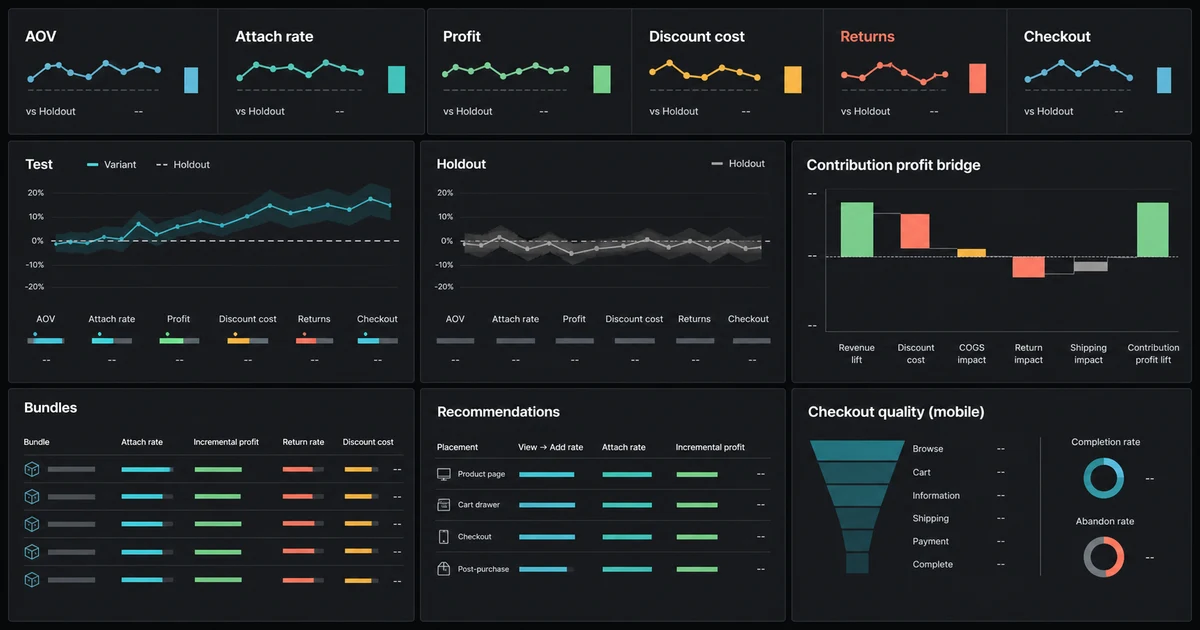
An app may claim the full value of an order after a shopper interacts with an offer. That does not prove the purchase would not have happened otherwise. Use a holdout or A/B test and calculate contribution profit after product cost, discount, shipping, payment fees, returns, and app cost. A smaller lift with clean margin can be more valuable than a large discounted revenue number.

App 04
Zipify OCU: Best for one-click funnel testing
Best for: Growing and Shopify Plus teams that want pre-purchase, checkout, post-purchase, thank-you, AI offers, cart functionality, and built-in split testing
Overview and best for: One Click Upsell - Zipify OCU is built around offer funnels and experimentation. It covers product pages, cart, checkout, post-purchase, thank-you and order-status pages, with prebuilt AI funnels and reporting.
Key features: AI-powered offer creation, cart drawer, one-click post-purchase, checkout order bumps for Plus, targeting, subscription upgrades, funnel analytics, A/B testing, and on-brand design controls.
Pros: Strong testing orientation, full-funnel reach, development-store access, and pricing tied to generated upsell revenue rather than total orders. Cons: Revenue-based scaling can become expensive, and a 4.5 rating warrants review-level due diligence.
Pricing: Development and partner stores are free. The Unlimited plan begins at $8 monthly and scales with generated upsell revenue; a 30-day trial is available.
AI, performance, and ideal size: Growing to enterprise. Consolidating cart and offers may reduce app overlap, but replacing an existing cart is a meaningful UX change that needs regression and speed testing.
Real-world use case: A nutrition brand can test a complementary subscription upgrade against a one-time accessory, stratified by new versus returning customer, then evaluate repeat value as well as immediate AOV.
Limitations and when not to choose it: Avoid when the team cannot maintain tests or when revenue-based fees make marginal offers uneconomic.
Expert recommendation: OCU belongs on an experiment-led shortlist. Use its reporting with independent order and profit data, and predefine how long a test runs and what metric decides the winner.

App 05
Frequently Bought Together CBB: Best focused frequently-bought-together app
Best for: Stores that want clean product-page bundles with automatic or manual recommendations and do not need a complete cart or checkout platform
Overview and best for: Frequently Bought Together CBB concentrates on one-click product-page bundle recommendations. It supports AI, manual and global rules without forcing a broader cart replacement.
Key features: Automatic and manual bundles, global presets, four discount types, review-star integrations, configurable placement, translations, analytics, and A/B testing on paid tiers.
Pros: Focused scope, mature listing, 4.9 rating, review integration, and predictable order tiers. Cons: It is not a checkout or post-purchase platform; the free tier permits only three manual bundles.
Pricing: Free for three manual bundles; $9.99 up to 50 orders, $19.99 up to 500, and $39.99 for 500+ monthly orders.
AI, performance, and ideal size: Startup to mid-market. A single product-page widget is easier to govern than a full-funnel suite, but recommendations and review integrations still add rendering work.
Real-world use case: A cigar-accessory store can show a compatible cutter and storage product with the correct bundle discount directly beside the primary product decision.
Limitations and when not to choose it: Avoid when cart, checkout, post-purchase, mix-and-match configuration, or subscription upgrades are essential.
Expert recommendation: This is a strong narrow tool. Use manual rules for compatibility-critical items and automatic recommendations only where the cost of an irrelevant match is low.

App 06
Monk: Best for gifts and advanced eligibility rules
Best for: Growing and high-volume stores that need free gifts, BOGO, quantity discounts, progress mechanics, and precise customer or cart eligibility
Overview and best for: Monk Free Gift BOGO CartUpsell combines free gifts, Buy X Get Y, BOGO, upsells, cross-sells and quantity discounts across product, cart, checkout and post-checkout surfaces.
Key features: Robust eligibility, tiered progress, customizable widgets and pop-ups, market-aware experiences, cart and checkout rewards, post-purchase offers, translations, and Shopify Functions-based discount logic.
Pros: Strong promotion logic, broad journey coverage, 4.9 rating, development-store access, and useful high-volume positioning. Cons: $49 entry pricing is high for a simple accessory offer; it can become a large promotional system requiring QA.
Pricing: Start is $49 monthly for 0-1,000 online-store orders; Scale is $149 for 1,000+; development and sandbox stores are free and a seven-day trial is available.
Performance and ideal size: Growing to enterprise. Test cart and checkout interaction, gift inventory, threshold updates, discount combinations, and accelerated payment routes.
Real-world use case: A beauty merchant can let eligible customers choose one of three samples above a market-specific spend threshold, suppress the offer for subscription renewals, and prevent out-of-stock gifts.
Limitations and when not to choose it: Do not pay for Monk when a fixed bundle or single FBT row solves the problem. Avoid promotions the fulfillment team cannot reconcile.
Expert recommendation: Monk is strongest where rules are the strategy. Map eligibility and edge cases before configuring the UI, including returns that move an order below the gift threshold.
Expert insight: app conflicts usually begin in the cart
Cart drawers, free-shipping bars, bundle discounts, gift apps, subscription selectors, and upsell widgets frequently modify the same state. Choose one owner for cart behavior. Test line-item properties, selling plans, discount combinations, inventory changes, localization, accelerated checkout, and back-button behavior before release.

App 07
Candy Rack: Best for a polished all-in-one offer experience
Best for: Design-conscious growing stores that want AI recommendations, product-to-post-purchase placements, a built-in cart drawer, localization, and deep styling
Overview and best for: Candy Rack provides AI or manual upsells across product, cart, checkout and post-purchase, plus a built-in slide cart and extensive design controls.
Key features: AI recommendations, product add-ons, warranties, gifts, bundles, cart rewards, Shopify Flow, checkout and customer-account integrations, multi-language and currency, custom CSS/HTML, analytics, and Intelligems testing integration.
Pros: Strong visual customization, 5.0 rating, full-funnel scope, recommendation-engine choice, and a consolidated cart. Cons: Commercial tiers scale with total online-store orders; A/B testing relies on an external integration; free access is for trial and development stores.
Pricing: Free for trial and development stores. Lite is $29.99 for 0-50 orders, Starter $39.99 for 51-200, and Growth $59.99 for 201-500 monthly orders; higher tiers are listed separately.
AI, performance, and ideal size: Growing to enterprise. Its built-in cart can consolidate scripts, but migrating cart behavior requires full visual, analytics, accessibility, and speed regression testing.
Real-world use case: A premium luggage store can offer monogramming on the product page, packing accessories in cart, a compatible organizer at checkout, and care products post-purchase.
Limitations and when not to choose it: Avoid when order-based pricing is disproportionate to offer profit or the existing custom cart cannot be replaced safely.
Expert recommendation: Candy Rack is a good brand-experience shortlist. Compare its complete cart implementation with the current cart, not an isolated demo widget.

App 08
Bundler: Best for mix-and-match and volume bundles
Best for: Stores that need classic bundles, mix-and-match, quantity breaks, tiered discounts, landing pages, subscriptions, and POS support
Overview and best for: Bundler - Product Bundles focuses on bundle architecture rather than personalized journey-wide offers. It supports fixed, mix-and-match, quantity and tiered mechanics.
Key features: Buy X Get Y, volume discounts, product-page upsells, Shopify POS, mix-and-match sections, custom landing pages, free shipping, funnel upsells, subscription compatibility, and analytics by plan.
Pros: Generous free tier, 4.9 rating, no generated-revenue limit, broad bundle types, and low paid pricing. Cons: Advanced bundle experiences and analytics are paid; complex bundles still need fulfillment and ERP validation.
Pricing: Free for core bundles and volume discounts; Premium $8.99; Executive $12.99 monthly.
Performance and ideal size: Startup to mid-market. Bundle landing pages and selectors should be tested for mobile layout, variant availability, and add-to-cart latency.
Real-world use case: A food merchant can let customers build a six-item variety box while maintaining section rules, stock availability, and a fixed merchandising proposition.
Limitations and when not to choose it: Do not choose Bundler for advanced behavioral personalization or checkout experimentation. Confirm subscription, POS, inventory, and fulfillment behavior for every bundle type.
Expert recommendation: Bundler provides unusually strong bundle economics. Define the bundle's operational model before its visual design: SKU representation, picking, returns, tax, discounts, and reporting determine whether it scales.

App 09
Essential Upsell: Best easy multi-surface entry
Best for: Startups and growing stores that want product-page, cart, FBT, AI recommendations, and post-purchase offers with a revenue-capped free plan
Overview and best for: Essential Upsell & Cross Sell packages FBT, related products, add-ons, cart and post-purchase offers in a simple Built for Shopify tool.
Key features: Product and cart widgets, one-click add-ons, automatic discounts, BOGO, AI recommendations, post-purchase offers, translations, custom rules, analytics, and mobile-responsive configuration.
Pros: 5.0 rating, free entry, broad surface coverage, straightforward tiers, and fast setup. Cons: Pricing is based on additional revenue generated; cart offers begin on a higher tier; the platform is newer than several alternatives.
Pricing: Free through $100 of generated additional revenue; $9.99 through $500; $19.99 through $1,000 with cart offers; $39.99 for unlimited generated revenue.
AI, performance, and ideal size: Startup to growing. Limit widgets to the placements that answer a real purchase question and verify how “additional revenue” is attributed.
Real-world use case: A small stationery store can pair notebooks with the correct refill on product pages and offer a complementary pen after purchase.
Limitations and when not to choose it: Avoid when attribution-based fees are hard to reconcile or when enterprise governance, headless rendering, or proprietary data logic is required.
Expert recommendation: The free plan is useful for validating a narrow offer. Record your own baseline before installing so the upgrade decision is based on incremental economics.

App 10
Shopify Bundles: Best free native fixed-bundle app
Best for: Merchants that need simple fixed bundles or multipacks, variant selection, and real-time component inventory directly inside Shopify
Overview and best for: Shopify Bundles is Shopify's free native app for fixed bundles and multipacks. It keeps component inventory synchronized and lets customers choose associated variants.
Key features: Admin-native setup, fixed bundles, multipacks, variant options, bundle product pages, fixed pricing, multi-language support, and real-time inventory protection.
Pros: Free, native, low conceptual overhead, and dependable component inventory for simple use cases. Cons: A 2.8 App Store rating, fixed bundle scope, limited merchandising, and no AI, checkout, or post-purchase system.
Pricing: Free.
Performance and ideal size: Startup to mid-market. Native simplicity reduces the need for a large storefront layer, but merchants should test theme presentation and downstream order handling.
Real-world use case: A personal-care brand can sell a three-product starter set with selectable scent variants while component stock updates in real time.
Limitations and when not to choose it: It is not the right choice for mix-and-match builders, advanced quantity rules, behavioral recommendations, complex subscriptions, or custom ERP bundle representations.
Expert recommendation: Start here when the requirement is genuinely a fixed bundle. Do not buy a personalization platform to solve an inventory-aware multipack.
Expert insight: subscription fatigue is a systems problem
Three inexpensive apps can cost more than one governed platform after support time, script weight, conflicting discounts, and reporting reconciliation. Quarterly, map every app to its storefront surface, data access, owner, measurable outcome, and replacement risk. Remove dormant experiments and old theme snippets after a controlled rollback check.
Comparison Tables by Use Case
Best free Shopify upsell apps
| App | Free value | Best next step |
|---|---|---|
| Shopify Bundles | Native fixed bundles and inventory | Upgrade only when bundle logic exceeds fixed sets |
| Selleasy | All features through 50 total monthly orders | Validate one high-volume compatibility offer |
| Essential Upsell | Up to $100 generated offer revenue | Audit attribution before entering a paid tier |
| Frequently Bought Together | Three manual bundles | Prove FBT demand before automatic expansion |
| Bundler | Core bundles, volume discounts, POS | Upgrade for mix-and-match or analytics |
Best premium platforms
| Platform | Premium advantage | Cost risk to monitor |
|---|---|---|
| Rebuy | Personalization across cart, search, checkout, and post-purchase | Orders, modules, implementation ownership |
| Zipify OCU | Full-funnel testing and one-click offers | Generated-revenue pricing |
| Candy Rack | Branded consolidated cart and offer UX | Order-tier scaling |
| Monk | Advanced gifts, rewards, and eligibility | Higher base fee and promotion QA |
| ReConvert | Accessible post-purchase optimization | Order or attributed-revenue thresholds |
Best checkout upsell apps
| App | Checkout strength | Important constraint |
|---|---|---|
| Rebuy | Personalized checkout and post-purchase ecosystem | Package selection and Plus requirements |
| Zipify OCU | Native order bumps plus funnel testing | Checkout placement is positioned for Plus |
| Monk | Gifts, tiers, recommendations, eligibility | Test discount and checkout edge cases |
| Candy Rack | Styled checkout and post-purchase offers | Confirm plan and checkout eligibility |
| ReConvert | Checkout blocks plus post-purchase | Checkout upsells require Plus |
Best AI recommendation apps
| App | AI use | Human responsibility |
|---|---|---|
| Rebuy | Behavioral personalization and merchandising | Exclusions, margin, experiments, governance |
| Zipify OCU | Prebuilt and self-optimizing funnels | Incrementality and revenue-based fee review |
| Candy Rack | Product selection with recommendation-engine options | Compatibility and brand review |
| Selleasy | Automatic complementary recommendations | Manual rules for high-risk products |
| Essential Upsell | AI product recommendations | Attribution and catalog quality |
Best bundle apps
| App | Best bundle model | Watch for |
|---|---|---|
| Shopify Bundles | Fixed bundles and multipacks | Limited advanced logic |
| Bundler | Mix-and-match, tiered, volume, subscriptions | Fulfillment and discount complexity |
| Frequently Bought Together | Curated complementary groups | Product-page focus |
| Selleasy | FBT and cross-sell bundles across the journey | Total-order pricing |
| Candy Rack | Styled bundle offers within a broader funnel | Order-tier cost |
Best for Shopify Plus
| Need | Recommended shortlist | Evaluation focus |
|---|---|---|
| Cross-journey personalization | Rebuy | Checkout extensions, data, governance, holdouts |
| Experiment-led funnel | Zipify OCU | Incrementality, subscription and payment routes |
| Gifts and eligibility | Monk | Functions, Markets, returns, fulfillment |
| Brand-controlled journey | Candy Rack | Cart replacement, accessibility, performance |
| Accessible post-purchase | ReConvert | Eligibility, attribution, thank-you workflow |
Best for small businesses
| Requirement | Recommended app | Why |
|---|---|---|
| Simple fixed bundle | Shopify Bundles | Free and native |
| Broad low-cost upsells | Selleasy | Full features at low order tiers |
| Focused FBT | Frequently Bought Together | Narrow, understandable scope |
| Mix-and-match | Bundler | Strong free and inexpensive plans |
| Low-cost post-purchase | ReConvert | Accessible entry and focused workflow |
Common Upselling Mistakes
Offering irrelevant products
Relevance is the foundation. Use compatibility data, product relationships, customer intent, and purchase context. Suppress items the customer already owns, cannot use, or cannot receive in their market.
Showing too many offers
More surfaces do not guarantee more value. A product widget, pop-up, cart drawer, progress bar, checkout block, and post-purchase sequence can make the store feel adversarial. Give each stage one job.
Slowing down cart or checkout
Recommendation calls, cart re-renders, trackers, and app conflicts are especially damaging close to payment. Test on real mobile hardware and monitor cart-to-checkout and checkout-completion rates, not only Lighthouse.
Ignoring mobile experience
Check long product names, variant selectors, keyboard focus, sticky buttons, images, translations, discount messaging, error states, and thumb reach. An offer that covers the checkout button is a conversion defect.
Discounting without measuring margin
AOV can rise while profit falls. Include COGS, discount, shipping, payment fee, returns, fulfillment, support, and app cost. Free shipping thresholds also affect economics.
Using conflicting apps
Two apps may both own the cart, discount function, recommendation area, or analytics event. Consolidate overlapping functions and document one source of truth for offer state.
Trusting vendor attribution
Measure against a control. Track incremental AOV, offer acceptance, checkout completion, return rate, and contribution profit by device, market, product, and customer cohort.
Decision Framework by Business Stage
Startup: Use Shopify Bundles for fixed sets, Selleasy for broad low-cost testing, or Frequently Bought Together for one product-page use case. Do not install three free apps.
Growing store: ReConvert or Selleasy can cover multiple surfaces economically. Add a testing plan and consolidate cart ownership before expanding.
Fashion store: Use outfit completion, care products, and variant-aware bundles. Candy Rack, Rebuy, or Bundler can fit depending on catalog size and styling needs.
Beauty brand: Sequence products by routine, ingredient compatibility, and usage order. Rebuy supports large personalized catalogs; Monk suits sample gifts and spend thresholds.
Electronics store: Compatibility must override popularity. Use manual rules, structured product data, and warranties or accessories with clear specifications. Frequently Bought Together or Rebuy are relevant at different scales.
Subscription business: Test subscription upgrades, replenishment cadence, first-order bundles, and add-ons carefully. Zipify OCU, Rebuy, and Selleasy list subscription-oriented capabilities, but compatibility must be verified.
International store: Validate Markets, currency, translated copy, tax, duty, inventory, payment method, claims, and checkout eligibility. Selleasy and Candy Rack disclose broad localization support.
Shopify Plus: Shortlist based on checkout extension requirements, data architecture, experimentation, governance, and total cost. Rebuy, Zipify OCU, Monk, Candy Rack, and ReConvert merit proof-of-concept testing.
Upselling Strategy by Industry
Fashion and apparel
Cross-sell complete looks, care products, belts, socks, and compatible accessories. Use variant-aware rules so an unavailable size or mismatched color is not recommended. Bundles can work for basics; premium products often need styling relevance rather than discounts. Track returns because a higher AOV can hide increased fit-related returns.
Beauty and cosmetics
Organize offers by routine order: cleanse, treat, moisturize, protect. Capture skin type, ingredient conflicts, product size, and replenishment cadence. Samples and gifts can introduce adjacent categories, but claims and allergens need human governance. Avoid recommending too many actives together.
Electronics
Build a compatibility source of truth using model, connector, voltage, generation, and regional specifications. Cross-sell cables, storage, cases, setup services, or warranties only when applicable. Premium upgrades need a concise benefit comparison. Manual and rules-based merchandising often beats opaque AI here.
Home and furniture
Use room sets, material care, assembly services, cushions, lighting, and coordinated dimensions. Large-item delivery and split fulfillment can erase bundle margin, so include shipping economics. Visual room bundles should not obscure exact measurements or lead times.
Food and beverage
Variety packs, flavor discovery, quantity tiers, gift sets, and replenishment offers work well. Respect shelf life, temperature-controlled shipping, dietary attributes, and subscription cadence. Bundle savings should reflect pick-and-pack cost and weight-based shipping.
Pet products
Segment by species, size, age, allergy, behavior, and product compatibility. Pair durable goods with refills or care items, but avoid unsafe or age-inappropriate suggestions. Replenishment and subscription upgrades can create more value than a one-time discount.
Health and wellness
Use careful eligibility, evidence-based copy, dosage boundaries, ingredient exclusions, and market-specific compliance. Do not let generative recommendations create medical claims or unsafe combinations. Human-reviewed rules and consent-aware data practices are mandatory.
B2B wholesale
Focus on case packs, volume tiers, reorder lists, compatible consumables, and account-specific assortments. Pricing, terms, tax exemptions, inventory, ERP data, approvals, and minimum quantities matter more than consumer-style pop-ups. Custom Functions and account integrations often outperform a generic widget.
Industry summary: The right upsell reflects how the product is selected, used, fulfilled, returned, and regulated. Industry context should shape recommendation logic before app selection.
Revenue Optimization Strategies and When They Work
- Product bundles: Best when several items solve one clear job. State the bundle value and preserve variant, inventory, fulfillment, and return clarity.
- Frequently bought together: Best for obvious complementary items near the product decision. Keep the set small and compatibility-safe.
- Volume discounts: Best where consumption or business usage justifies quantity. Protect margin and avoid teaching occasional customers to overbuy.
- Tiered pricing: Best for wholesale, consumables, or planned household supply. Display the actual unit economics and inventory constraints.
- Cart upsells: Best for low-consideration accessories, shipping qualification, or omitted essentials. Avoid blocking the checkout command.
- Checkout upsells: Best for one highly relevant, low-friction offer. Use restraint because purchase completion is the primary objective.
- Post-purchase offers: Best when an add-on improves the order without changing the original decision. Confirm payment and subscription eligibility.
- Personalized recommendations: Best with a broad catalog and enough behavior data. Add exclusions, confidence thresholds, and merchandising overrides.
- AI-driven recommendations: Best for ranking a large candidate set, not inventing product compatibility. Audit bias toward popular products and margin-blind choices.
- Subscription upgrades: Best when recurring value, cadence, and cancellation terms are clear. Evaluate customer lifetime value and churn, not first-order AOV alone.
When Custom Development Is Better
Apps are efficient when the offer fits a supported pattern. Custom development becomes more rational when the business rule, experience, or integration is the competitive advantage.
- Custom recommendation engines: Use proprietary compatibility, customer, margin, return, inventory, or lifecycle data that a standard algorithm cannot model safely.
- Custom bundle builders: Support complex configuration, dependent variants, kits, personalization, pricing, fulfillment, subscriptions, or ERP representation.
- Shopify Functions: Implement governed discount, delivery, payment, and validation logic within Shopify's supported extensibility model. Review the current Shopify Functions documentation before architecture decisions.
- Checkout extensions: Build brand-appropriate, eligible checkout experiences using Shopify checkout UI extensions, with Shopify Plus requirements checked for the target surface.
- API and ERP integrations: Synchronize inventory, customer contracts, product relationships, bundles, order routing, and reporting across systems.
- Shopify Flow automations: Route events such as bundle purchases, high-value acceptance, inventory thresholds, or experiment assignments into operations. See Shopify's official Flow documentation.
- Advanced personalization: Combine first-party signals with consent, governance, human overrides, and measurable experiment logic.
AreoTech helps teams translate these requirements into Shopify development, automation and Flow implementations, and performance-conscious maintenance. The goal is not to replace a capable app unnecessarily. It is to remove constraints when app configuration can no longer express the business safely.
Best Practices for Increasing AOV
- Establish a baseline. Record AOV, items per order, conversion, checkout completion, margin, returns, and device mix before installing anything.
- Choose one hypothesis. Example: “Customers buying this camera need a compatible memory card, and a cart offer will increase attach rate without lowering checkout completion.”
- Protect relevance. Define compatibility, exclusions, inventory, market, customer, subscription, and margin rules.
- Test one surface. Product page, cart, checkout, and post-purchase answer different needs. Do not launch everywhere simultaneously.
- Use a holdout. Compare against customers who do not see the offer. Run long enough to cover weekday, campaign, and product-mix variation.
- Measure profit. Include discount, COGS, shipping, returns, payment fees, app fees, and operational cost.
- Segment results. New versus returning, mobile versus desktop, market, traffic source, product, customer value, and offer type can behave differently.
- Review qualitative evidence. Support tickets, returns, session recordings, usability tests, and customer feedback explain what aggregate metrics miss.
- Monitor performance. Measure storefront Core Web Vitals, cart response, checkout transition, client errors, and app-request failures.
- Create stop rules. Pause an offer when inventory, margin, conversion, return rate, or data quality crosses a defined threshold.
Frequently Asked Questions
What is the best Shopify upsell app in 2026?
ReConvert is a practical full-funnel choice for many growing stores, while Selleasy offers excellent value. Rebuy fits advanced personalization, Zipify OCU fits experiment-led funnels, and Shopify Bundles fits simple fixed sets. Requirements should choose the app.
What is the difference between upselling and cross-selling?
Upselling proposes a better version; cross-selling adds a complementary item. A premium laptop is an upsell. Its case is a cross-sell. A package containing both is a bundle.
Do Shopify upsell apps really increase AOV?
They can, but only a controlled comparison proves the lift is incremental. Monitor conversion, returns, discount cost, and contribution profit alongside AOV.
What is the best free Shopify upsell app?
Shopify Bundles is best for free native fixed bundles. Selleasy, Essential Upsell, Frequently Bought Together, and Bundler provide useful free entry points with different limits.
Can I add upsells to Shopify checkout?
Yes, on eligible checkout surfaces. Some customizations require Shopify Plus, and eligibility depends on the app, payment route, market, subscription, and Shopify rules.
What is a post-purchase upsell?
It is an offer shown after the first order is accepted. Eligible customers may add it without repeating payment entry, reducing risk to the initial conversion.
Are AI recommendations better than manual rules?
Not universally. AI helps rank large catalogs; manual rules are safer for compatibility, regulation, strategic inventory, and new products. A hybrid is usually strongest.
Which app is best for Shopify Plus?
Rebuy, Zipify OCU, Monk, Candy Rack, and ReConvert are relevant candidates. Run a proof of concept for checkout extensions, Markets, data, subscriptions, governance, and total cost.
What is the best Shopify bundle app?
Shopify Bundles is best for simple fixed bundles, Bundler for mix-and-match and volume mechanics, and Frequently Bought Together for complementary product groups. Operational requirements decide the winner.
Can upsell apps slow down a Shopify store?
Yes. Cart replacements, recommendation calls, scripts, and overlapping trackers can affect rendering and interaction. Test before and after on mobile.
How many offers should a store show?
Usually one primary offer at each decision point. Additional choices must be clearly relevant; stacking interruptions creates cognitive load.
Should an upsell always include a discount?
No. Convenience, compatibility, curation, premium value, and shipping qualification can motivate acceptance without reducing margin.
How should upsell ROI be measured?
Use incremental contribution profit against a control. Include AOV, attach rate, checkout completion, COGS, discounts, shipping, returns, fees, and app cost.
Do upsell apps work with subscriptions?
Some do, but compatibility varies. Test selling plans, renewal behavior, inventory, discounts, payment eligibility, and customer communication.
Can upsells be localized for Shopify Markets?
Yes, when the app and implementation support the market. Verify currency, language, pricing, tax, duties, inventory, payment methods, and legal claims.
When should multiple upsell apps be consolidated?
Consolidate when they compete for cart, discounts, recommendations, or analytics. One governed owner reduces conflicts and reporting ambiguity.
When is custom development better?
Use custom development when unique eligibility, bundle, ERP, performance, or brand requirements cannot be expressed reliably by app configuration. Keep standard functions in established apps where they work well.
What should I test first?
Test one complementary offer on a high-volume product or cart segment. Validate variants, inventory, discounting, mobile UX, subscriptions, accelerated payments, analytics, and rollback.
Key Takeaways
- AOV is useful only when conversion, customer trust, and contribution profit remain healthy.
- Start with the offer strategy and journey stage, then choose the app.
- Selleasy is the strongest accessible all-rounder; ReConvert is strong post-purchase; Rebuy leads advanced personalization; Zipify OCU leads funnel testing.
- Frequently Bought Together and Shopify Bundles are better than a large platform when the requirement is narrow.
- AI needs catalog quality, exclusions, margin logic, inventory, governance, and human overrides.
- Checkout offers require exceptional restraint and may require Shopify Plus.
- One primary offer system is usually healthier than several overlapping apps.
- Measure incrementality with a holdout and contribution-profit model, not vendor attribution alone.
Quick Decision Guide
| If you are... | Recommended app type | Strong shortlist |
|---|---|---|
| Startup | Free fixed bundle or focused FBT | Shopify Bundles, Selleasy, Frequently Bought Together |
| Growing store | Broad multi-surface platform | Selleasy, ReConvert, Candy Rack |
| Luxury brand | Brand-controlled, low-pressure personalization | Candy Rack, Rebuy, custom implementation |
| Subscription business | Subscription-compatible upgrade and add-on system | Zipify OCU, Rebuy, Selleasy after compatibility test |
| International seller | Markets-aware, localized offer platform | Selleasy, Candy Rack, custom rules |
| Shopify Plus merchant | Governed checkout and personalization platform | Rebuy, Zipify OCU, Monk, ReConvert |
Conclusion
The best Shopify upsell and cross-sell app is not the one with the most widgets. It is the one that can present a useful, profitable offer at the correct moment without weakening the original purchase.
For many stores, that means starting with Selleasy, ReConvert, Frequently Bought Together, Bundler, or Shopify Bundles. Larger brands may justify Rebuy, Zipify OCU, Monk, or Candy Rack when personalization, checkout extensions, experimentation, and governance are real operating capabilities rather than a feature wishlist.
Before installing, define the customer problem, offer relationship, margin floor, eligible audience, placement, control group, success metric, and rollback condition. Then test in the real theme across mobile, Markets, subscriptions, inventory changes, discounts, and accelerated payment paths.
AreoTech supports Shopify CRO and development, Shopify automation, checkout optimization, custom bundle development, Shopify Functions, integrations, and performance optimization. Explore our Shopify services, review relevant case studies, read the related guides to Shopify sales apps, review platforms, and email marketing tools, or contact AreoTech to discuss an implementation grounded in incremental profit.