
Opening a new Shopify market is more than displaying another currency. Customers may need a different language, assortment, delivery explanation, size convention, and support experience. Search engines also need discoverable URLs and consistent signals about how those destinations relate to one another.
Effective Shopify Markets international SEO connects that commercial experience to the technical configuration. A well-formed alternate-language tag cannot rescue an untranslated buying guide or a product that cannot ship to the visitor's country. Equally, excellent localized copy is difficult to discover if the relevant URL is hidden or redirected away.
This guide provides a planning and verification process for an existing store expanding internationally. It emphasizes maintainable choices and representative testing rather than treating every country as a reason to create another nearly identical version of the catalogue.
Define the market before choosing a URL
Describe the customers you intend to serve, their languages, the products available to them, and the fulfillment promise. A country can contain several language audiences, while one language can serve customers across several countries with different commercial requirements.
Write down what actually changes: prices, currency, stock, shipping, returns, support hours, sizing, terminology, or payment options. This record helps distinguish a meaningful localized experience from a cosmetic country selector.
Assign an owner for each change. International pages need ongoing maintenance when products or policies change. Launching more destinations than the team can keep accurate creates a growing operational burden that no SEO plugin can remove.
Choose a URL structure you can maintain
Compare subfolders, subdomains, and separate country domains against the business's existing structure and resources. Consider brand recognition, domain management, analytics, localization workflows, and migration effort alongside search considerations.
Shopify's international domain guidance explains supported options and their trade-offs. It also distinguishes dedicated regional URLs from experiences that share one domain without separate regional destinations. A country selection parameter is not automatically a durable search landing page.
Avoid changing an established structure simply because another store uses a different one. First identify the problem the change would solve. If the current URLs are useful and maintainable, improving their content and consistency may be more valuable than a migration.
Build a market and language inventory
Create a table for each intended market containing the domain or subfolder, published language, currency, key collections, product availability, and policy pages. Include the default experience and any fallback destination.
Then map equivalent pages across markets. A product should connect to the corresponding product where it exists, not to the other market's homepage merely because that URL is convenient. Mark genuinely unavailable equivalents as decisions requiring review.
Use the inventory as a shared planning artifact for merchandising, translation, development, and customer support. It prevents each team from implementing a different understanding of what the new market contains and gives testing a concrete expected result.
Understand what the platform already generates
Shopify's international SEO documentation for Markets describes automated handling of elements such as alternate-language references, canonical URLs, and sitemaps for configured markets. Review the current settings before adding another layer of custom tags.
Inspect several rendered pages after configuration. Record which system generates each technical signal and whether an app or theme customization changes it. Two independent systems can create conflicting output even when each appears reasonable in its own interface.
Prefer a clear owner for the generated relationships. Custom overrides should solve a demonstrated requirement and have their own test coverage. Adding tags speculatively can make future platform updates harder to evaluate because nobody knows which output is authoritative.
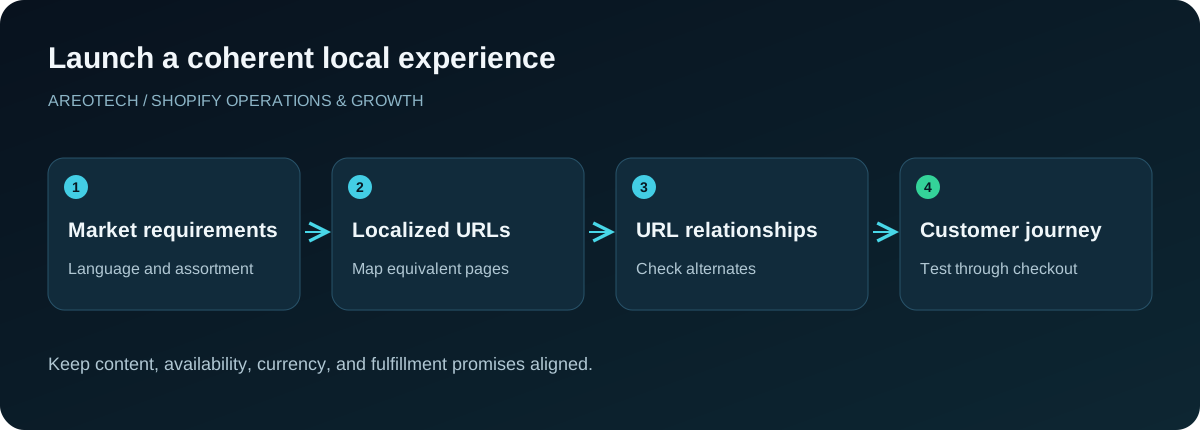
Check alternate-language relationships
Inspect the alternate URLs for representative product, collection, and content pages. Confirm that they point to real corresponding destinations and use supported language and region values. A valid-looking tag that references a nonexistent page does not describe a useful relationship.
Google's localized page guidance explains reciprocal references, self-references, fully qualified URLs, and fallback options. Use those rules to review the output as a connected set, not as isolated tags on one page.
Remember that language annotations do not translate the content or force a particular ranking. They describe relationships. If two destinations contain different products or incompatible promises, settle the commercial mapping before trying to repair the relationship through markup alone.
Review canonicals alongside localization
Canonicalization identifies a preferred representative where appropriate; alternate-language references describe localized relationships. They are different signals and should not be configured as substitutes for one another.
Check whether a localized page intended for discovery points to a sensible canonical destination. A theme customization that sends every market back to one default URL may conflict with the intended independent experience. Investigate the reason before copying the pattern across the catalogue.
Google's canonicalization guidance explains how preferred URLs are communicated. Have a developer evaluate canonicals, redirects, internal links, and sitemap entries together so the store does not send inconsistent preferences through different mechanisms.
Translate the buying decision, not only navigation
Review product descriptions, collection introductions, size information, compatibility notes, delivery explanations, returns, and important support pages. A translated menu surrounding default-language product details is an incomplete experience.
Use a qualified language reviewer for commercially important content. Machine assistance can produce a useful draft, but terminology, measurements, materials, and tone need context. Pay particular attention to statements that affect whether someone can use the product correctly.
Build a glossary for repeated product terms and a process for newly added items. A one-time translation project quickly becomes stale if the daily catalogue workflow publishes new descriptions only in the default language.
Localize search intent and assortment together
Research how customers in the market describe the need, using available search data and local language expertise. A literal translation of the home market's category name may not be the phrase customers use or the distinction they find useful.
Map those needs to products the market can actually buy. Do not create localized collections around an attractive keyword if most of the assortment is unavailable there. A smaller accurate selection can provide a clearer experience than a broad category full of exceptions.
Apply the collection SEO process within each meaningful market context. Keep the underlying category purpose stable while adapting the information customers need to compare products, including sizes, climate, delivery, and regional terminology.
Keep metadata and images in the review
Check page titles, descriptions, image text, social previews, and visible headings in each published language. These fields are easy to miss when the translation review focuses only on the main description editor.
Review images containing embedded words, measurements, or regional claims. An otherwise translated page can still show an obsolete delivery promise inside a campaign graphic. Ensure the asset itself is appropriate or provide a localized version where necessary.
Avoid automatically inserting every country name into every title. Geographic wording should clarify a genuine distinction, not make the catalogue read like a collection of location keywords. The title should still describe the product or category plainly.
Test selectors and redirection carefully
Customers need a dependable way to choose another market or language, especially when travelling, buying gifts, or using a browser preference that differs from their shipping destination. Test that a deliberate selection remains understandable through browsing and checkout.
Shopify's automatic redirection guidance describes supported behaviour and configuration. Review it with your URL strategy and inspect the actual experience rather than assuming every visitor should always be forced into one inferred location.
Include fresh sessions and returning sessions in tests. Cookies or remembered choices can make one computer appear correct while first-time visitors receive a different result. Record the starting state when reporting a redirection problem so another person can reproduce it.
Verify product availability through checkout
Open a localized product URL directly, select a variant, add it to the cart, and continue to the shipping stage using an appropriate test destination. Confirm language, currency, availability, delivery choices, and customer messaging remain coherent.
Test products that differ across markets, not just the universally available bestseller. Include an unavailable item, a mixed cart, and a product with several variants. Inspect what a customer sees when switching market after adding an item.
For cross-border fulfillment, review the Canada to US shipping guide. International SEO should attract visitors to an experience the operation can honor; it should not conceal unresolved shipping or duty arrangements behind localized copy.
Audit discovery and sitemap coverage
Check that important localized destinations are reachable through ordinary links and appear in the expected sitemap output. Inspect the live XML and sample destination responses rather than assuming successful configuration proves every page is discoverable.
Verify access for the relevant Search Console properties and submit the appropriate sitemaps. Keep ownership with the business so a staffing change does not remove access to the evidence needed to monitor an international launch.
If pages remain absent from search, use the indexing diagnostic guide. Separate discovery, crawling, canonical selection, indexing, and ranking instead of treating every missing localized result as an alternate-language tag problem.
Plan migrations as URL changes
If an existing market moves from one structure to another, inventory its old URLs and map them to equivalent new destinations. Include important products, collections, articles, policy pages, and campaign links used outside the store.
Test redirects and update internal links, alternate relationships, canonicals, feeds, and analytics references as needed. Avoid sending every old URL to a new homepage. Visitors and crawlers should reach the corresponding content wherever a meaningful equivalent exists.
Keep a release record and monitor errors after the change. A migration can affect external links, cached search results, and saved customer bookmarks long after the new menu looks correct. Preserve a way to investigate the original URL that produced a complaint.
Measure each market without losing context
Review search visibility, landing pages, engagement, checkout progress, and completed orders by market and language where your measurement setup supports it. Keep definitions consistent when comparing periods and annotate launches or major configuration changes.
Do not interpret low sales as proof of an SEO defect without examining the customer journey. Delivery costs, unavailable sizes, payment choices, translation quality, and traffic relevance can all affect outcomes after the visitor arrives.
Compare the results with the original market hypothesis. If the local assortment or support model is not meeting demand, improve that experience before expanding the number of URLs. More pages are useful only when they represent something the store can serve well.
Give international content a maintenance owner
Schedule checks when products, prices, shipping policies, themes, or translation tools change. Keep the market inventory current and make new-market approval depend on operational readiness as well as technical configuration.
Maintain a small regression set containing a homepage, collection, simple product, variant product, and policy page for each important market. Those examples make it easier to detect broad inconsistencies after an update without reviewing the entire catalogue manually.
For a coordinated review, request an AreoTech audit with the intended market map and representative URLs. The goal is a discoverable localized store whose content, technical relationships, and fulfillment promises remain consistent as the business grows.