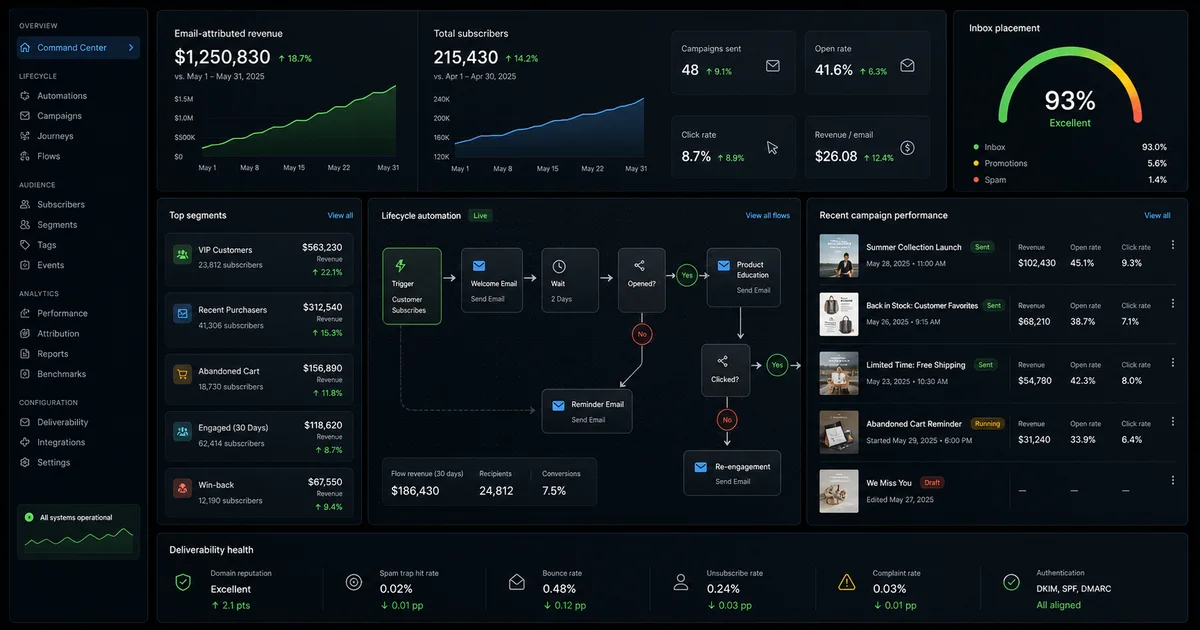
The best Shopify email marketing apps turn consented customer and order data into useful lifecycle communication without sacrificing deliverability or sending discipline. This guide compares 10 platforms for welcome, abandonment, post-purchase, retention, SMS, segmentation, AI, analytics, pricing, and scale so merchants can choose a system their team can operate profitably.
Shopify merchants commonly underuse the channel in two opposite ways. Some send an occasional newsletter to everyone and leave welcome, abandonment, post-purchase, and win-back revenue untouched. Others install an advanced platform, activate every template, send too frequently, and use discounts as the answer to every customer behavior. Both approaches weaken long-term value.
Choosing the wrong platform becomes expensive gradually. Contact-based pricing rises as the list grows. Duplicate profiles remain billable. SMS fees, support tiers, implementation, creative work, migrations, and integrations add cost. More importantly, a platform can become the operating system for years of consent records, behavioral history, segments, templates, and automations. Moving later is a data and deliverability project, not a simple app swap.
This guide compares 10 current Shopify email marketing apps by the job each does best. We evaluated official pricing, Shopify integration, deliverability controls, automation, segmentation, analytics, SMS, AI, support, performance, and the operational maturity needed to use the platform well. Prices and App Store data were checked on July 17, 2026 and can change.
The short answer: Choose Shopify Messaging or Seguno for native simplicity, Omnisend for accessible ecommerce automation, Klaviyo for the deepest Shopify lifecycle program, ActiveCampaign for CRM-led automation, and Attentive for enterprise cross-channel service. The best platform is the one your team can govern profitably, not the one with the longest feature list.
How We Selected These Shopify Email Marketing Apps
- Deliverability: Authentication support, suppression, reputation visibility, warming, consent, complaints, bounces, and vendor guidance matter more than a promised open rate.
- Automation: We assessed triggers, branching, filters, delays, testing, event depth, reusable workflows, and whether the platform supports the entire customer lifecycle.
- Segmentation: Strong tools combine profile, order, catalog, engagement, predicted, and custom-event data in dynamic audiences.
- Ease of use: A small team should be able to launch safely; an enterprise team should be able to apply roles, approvals, templates, and governance.
- Shopify integration: We considered order history, product catalog, customer tags and segments, checkout events, discounts, Shopify Flow, webhooks, and data latency.
- Pricing: We compared free limits, contact or send-based billing, SMS, scaling tiers, contracts, add-ons, and the cost of inactive profiles.
- Analytics: Useful reporting connects campaigns and flows to customers, orders, products, cohorts, and profit-aware business decisions.
- Templates and support: Editors should produce dependable mobile email, while support quality becomes critical during domain setup, migrations, and peak campaigns.
- Scalability: The platform should handle list growth, markets, permissions, integrations, deliverability operations, and increasingly complex customer journeys.
- AI capabilities: We valued practical drafting, prediction, send-time, segmentation, and analysis tools while treating outputs as decisions to review.
- Performance: Email is offsite, but pop-ups, onsite tracking, recommendations, and duplicated pixels can affect storefront performance and privacy.
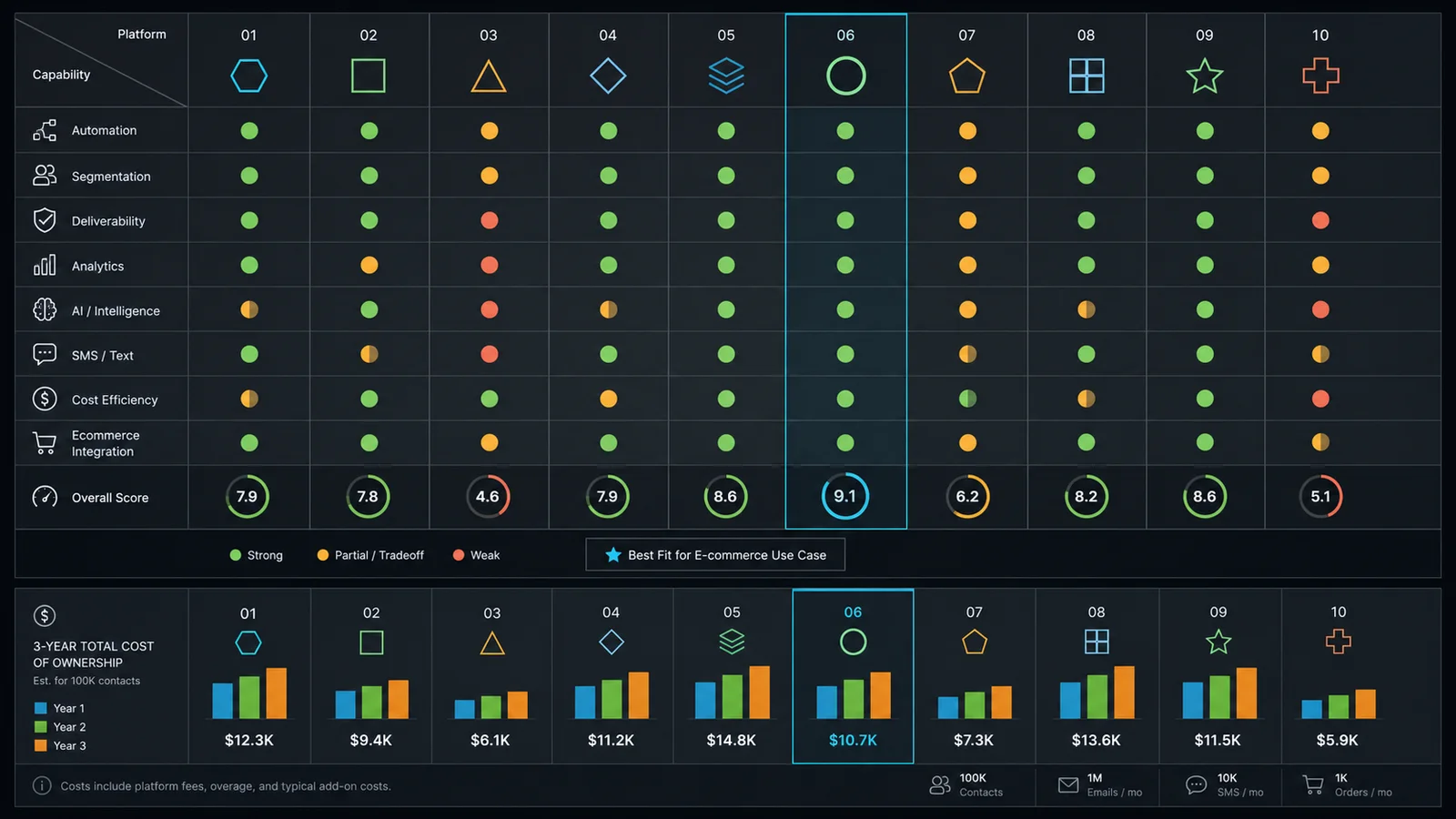
Quick Comparison: Best Shopify Email Marketing Apps
| App | Best for | Starting price | Free plan | Email automation | SMS support | AI features | Ideal store size |
|---|---|---|---|---|---|---|---|
| Klaviyo | Advanced ecommerce lifecycle marketing | Free; email from $20/mo | Yes | Advanced | Yes | Advanced | Growing to enterprise |
| Omnisend | Best value ecommerce automation | Free; Standard $16/mo | Yes | Strong | Yes | Yes | Startup to mid-market |
| Shopify Messaging | Native email and SMS simplicity | First 10,000 emails/mo free | Yes | Basic to moderate | Yes | Sidekick | Startup to growing |
| Mailchimp | Broad marketing suite and familiar editor | Free; Essentials $13/mo | Yes | Moderate to strong | Add-on | Yes | Startup to mid-market |
| Seguno | Shopify-native newsletters and automation | Free; Standard $35/mo | Yes | Moderate | No native SMS focus | Sidekick | Startup to mid-market |
| ActiveCampaign | CRM-led automation and B2B journeys | From $19/mo | No | Advanced | Yes | Advanced | Growing to enterprise |
| Brevo PushOwl | Email, push, and SMS with unlimited contacts | Free; Plus $19/mo | Yes | Moderate to strong | Yes | Yes | Startup to mid-market |
| Drip | Flexible behavioral email automation | $39/mo | No | Advanced | Listed support varies | Yes | Growing stores |
| Yotpo Email & SMS | Send-based pricing and multichannel retention | Free; Starter $19/mo | Yes | Strong | Yes | Yes | Startup to enterprise |
| Attentive | Enterprise mobile-first email and SMS | Custom after trial | Trial | Advanced | Yes | Advanced | Mid-market to enterprise |
Best Shopify Email Marketing Apps in 2026

App 01
Klaviyo: Best overall for advanced Shopify lifecycle marketing
Best for: Growing and enterprise brands that will use behavioral data, segmentation, experimentation, and multichannel flows
Overview and best for: Klaviyo is the strongest overall Shopify CRM and lifecycle platform in this guide. It is best for brands with meaningful traffic, repeat-purchase potential, a growing customer database, and someone accountable for retention.
Key features and automation: Real-time Shopify events, email, SMS, WhatsApp, push, forms, product recommendations, predictive analytics, send-time optimization, A/B testing, flows, and more than 160 campaign templates. Flows support branching by customer, product, engagement, purchase, consent, and predicted behavior.
Segmentation and analytics: Segments update dynamically from profiles, events, orders, catalog relationships, consent, engagement, and predictions. Reporting covers campaigns, flows, products, cohorts, attribution, and customer value, though platform attribution should be reconciled with Shopify and holdout tests.
SMS, AI, and integration: SMS is integrated with multichannel consent and flows. AI supports campaign creation, send time, predictions, and reputation repair. Shopify data sync is deep and suitable for sophisticated personalization.
Pros: Excellent event depth, flexible segmentation, mature ecosystem, strong automation, and enterprise headroom. Cons: Cost grows with active profiles and messaging; complexity can exceed a small team's needs; list hygiene and deliverability require active ownership.
Pricing: Free up to 250 contacts and 500 monthly emails. Email started at $20 per month for 251–500 contacts; SMS started at $15 for 1,250 credits.
Performance considerations: Forms and onsite tracking add storefront code. Use one capture layer, remove duplicate pixels, and load only required features.
Ideal size and use case: Growing to enterprise. A skincare brand can segment first purchases by routine, educate before expected replenishment, suppress customers who already reordered, and test a reminder against a true control.
Limitations and when not to choose it: Klaviyo cannot create repeat demand or fix a weak offer. Do not choose it for a tiny list, occasional newsletter, or team without a lifecycle owner.
Expert recommendation: Launch welcome, abandonment, post-purchase, and win-back first. Define contribution margin, consent, exclusions, and reporting before adding complexity.

App 02
Omnisend: Best value for ecommerce automation
Best for: Small and growing Shopify stores that want email, SMS, forms, and prebuilt lifecycle workflows at accessible pricing
Overview and best for: Omnisend is an ecommerce-focused alternative to Klaviyo with campaigns, forms, web push, global SMS, and practical prebuilt automations. It is best for merchants that need strong commerce workflows without enterprise operating overhead.
Key features and automation: Welcome, cart and browse abandonment, post-purchase, back-in-stock, price-drop, reactivation, product recommendations, pop-ups, landing pages, and more than 250 email templates.
Segmentation and analytics: Merchants can combine shopping behavior, profile data, campaign engagement, order history, and lifecycle status. Standard reporting is useful for small teams; Pro adds more advanced reports and recommendations.
SMS, AI, and integration: SMS and web push can join email workflows. AI drafts subject lines, preheaders, and body copy. Shopify setup is strong and purpose-built, with product blocks, discounts, order triggers, and catalog data.
Pros: Fast setup, generous feature access, 24/7 support even on free, and strong automation value. Cons: Advanced analysis and enterprise governance are lighter than Klaviyo; contact and send costs still rise; support experiences can vary.
Pricing: Free reaches up to 250 contacts with 500 emails monthly. Standard started at $16 per month for 500 contacts and 6,000 emails; Pro at $59 for 2,500 contacts and unlimited email.
Performance considerations: Pop-ups and tracking affect the storefront. Avoid a separate form app unless it serves a genuinely different requirement.
Ideal size and use case: Startup to mid-market. A homeware store can launch an educational welcome series, category-aware cart recovery, and post-purchase care instructions without building every workflow from scratch.
Limitations and when not to choose it: It may not suit a global enterprise needing deep custom events, complex permissions, or a large integration architecture.
Expert recommendation: Omnisend is the best cost-conscious default for a growing Shopify store. Validate contact-tier cost at 12 and 24 months before migrating.

App 03
Shopify Messaging: Best native email and SMS option
Best for: Merchants that prioritize simplicity, low initial cost, Shopify segments, and administration in one place
Overview and best for: Shopify Messaging, the current evolution of Shopify Email, sends email and SMS from Shopify admin. It is best for early and operationally lean merchants that do not yet need a separate customer data platform.
Key features and automation: Newsletters, email and SMS templates, Shopify Forms, customer segments, discounts, product content, welcome, browse, cart, checkout, follow-up, drip, and win-back automations through Shopify's marketing and automation tools.
Segmentation and analytics: It uses Shopify's customer segments and reports clicks, conversions, and campaign results inside the commerce admin. This keeps customer and order data close, but analysis and journey orchestration are less flexible than specialist platforms.
SMS, AI, and integration: SMS is native where available. Sidekick helps create and restyle content. Integration quality is the primary advantage: Shopify Admin, Forms, Flow, products, discounts, and customer data share the platform.
Pros: Low cost, minimal data plumbing, many languages, simple product insertion, and no separate interface. Cons: Lighter prediction, testing, attribution, and complex branching than lifecycle specialists.
Pricing: First 10,000 emails each month are free; additional email starts at $1 per 1,000. SMS charges vary.
Performance considerations: Native tooling reduces integration duplication, but forms and tracking should still be tested on mobile and against Core Web Vitals.
Ideal size and use case: Startup to growing. A new food brand can send monthly campaigns and build a welcome, cart, and post-purchase education sequence while maintaining Shopify as the source of truth.
Limitations and when not to choose it: Do not choose it when predictive CLV, complex multichannel branching, detailed experimentation, or many external data sources are requirements.
Expert recommendation: Start here when lifecycle needs are simple. Migrate only after documenting the capability gap and the profit it prevents.
Expert insight: when a merchant outgrows basic email
A store has outgrown a basic platform when the limitation is operational, not aspirational. Typical signals include several customer journeys needing different treatment, subscription or loyalty data outside Shopify, international consent rules, deliverability management across large volumes, or the need to suppress, prioritize, and test overlapping flows.
Do not migrate because an agency prefers another editor. Export consent state, suppression, templates, segment logic, flow maps, engagement history, and sender authentication. Plan warming and run reconciliation before retiring the old system.

App 04
Mailchimp: Best familiar all-purpose marketing suite
Best for: B2C or B2B teams that want email, SMS, landing pages, social tools, and broad integrations in one established platform
Overview and best for: Mailchimp combines a marketing CRM, email, SMS, forms, landing pages, social publishing, surveys, and automation. It suits teams already invested in Mailchimp or businesses mixing ecommerce with broader lead generation.
Features, automation, and segmentation: Welcome, abandoned cart, browse abandonment, back-in-stock, win-back, product recommendations, unique discounts, behavioral targeting, tags, Shopify segments, and multi-step journeys. Standard and Premium unlock stronger automation and segmentation.
Analytics, SMS, and AI: Reporting includes attributed Shopify revenue and campaign performance. SMS is an add-on. AI assists creative and optimization, with send-time and behavioral tools on paid tiers.
Integration quality: The official Shopify app syncs products, customers, segments, events, orders, and revenue, and works with Shopify Flow. It is materially better integrated than older third-party connector arrangements.
Pros: Familiar editor, broad ecosystem, useful non-commerce marketing, mature templates, and a free entry point. Cons: Pricing and feature gates can become confusing; contacts across audiences need governance; ecommerce data depth is not as purpose-built as Klaviyo.
Pricing: Free plan available. Essentials started at $13, Standard $20, and Premium $350 per month, with pricing increasing by contacts; SMS costs extra.
Performance and size: Forms and tracking can duplicate other apps. Best for startup to mid-market, or B2B teams using campaigns beyond the store.
Use case: A wholesale-and-retail brand can nurture trade leads, send consumer product launches, and coordinate event landing pages in one platform.
Limitations and when not to choose it: Avoid it when deep Shopify event modeling is more important than general marketing breadth.
Expert recommendation: Existing Mailchimp teams should optimize before migrating. New pure-play DTC stores should compare Omnisend and Klaviyo first.

App 05
Seguno Email Marketing: Best Shopify-native newsletter workflow
Best for: Small teams that want polished campaigns, Canva, discounts, and automations without leaving Shopify admin
Overview and best for: Seguno is a Built for Shopify email platform and 2024 Shopify Build Award winner. It is designed around Shopify-native workflows rather than a separate marketing database.
Features and automation: More than 200 templates, Canva integration, unique codes, product blocks, welcome, abandoned cart, browse abandonment, back-in-stock, multi-email custom automations, pop-ups, reviews, and banners.
Segmentation and analytics: It uses Shopify customer data and segments. Standard includes enhanced reporting; Pro adds deliverability support and a customer success layer. Analytics are practical but less expansive than enterprise lifecycle suites.
SMS, AI, and integration: Seguno is email-first rather than an SMS platform. Sidekick and Shopify context support creation. Integration quality is excellent because campaign creation and commerce data remain in admin.
Pros: Native ergonomics, unlimited sending within subscriber tiers, strong design workflow, support, and low data-fragmentation risk. Cons: Smaller integration and multichannel universe; pricing jumps with subscribers; advanced modeling is limited.
Pricing: Free up to 250 subscribers. Standard was $35 per month including 2,500 subscribers; Pro $215 including 25,000.
Performance and size: Native operation is clean, though onsite pop-ups, reviews, and banners still add storefront features. Best for startup to mid-market.
Use case: A design-led boutique can build reusable product-launch sections in Canva, insert live Shopify products, and run welcome and back-in-stock messages without moving between systems.
Limitations and when not to choose it: Skip it when native SMS, predictive analytics, complex cross-channel journeys, or extensive external events are required.
Expert recommendation: Choose Seguno over Shopify Messaging when email design, coaching, and richer native automation justify the subscriber-tier cost.

App 06
ActiveCampaign: Best for CRM-led and B2B automation
Best for: Businesses combining Shopify purchases with sales pipelines, lead scoring, services, wholesale, or long consideration cycles
Overview and best for: ActiveCampaign combines marketing automation with CRM, site tracking, lead management, email, SMS, and WhatsApp. It is strongest when Shopify is one part of a broader customer journey.
Features and automation: Multi-step workflow builder, abandoned cart, order-status triggers, product catalogs, post-purchase, lead scoring, CRM stages, goals, testing, forms, landing pages, APIs, and webhooks.
Segmentation and analytics: Segments can combine Shopify purchase data, CRM records, tags, site behavior, lead status, and custom events. Reporting supports journey and pipeline decisions, though ecommerce attribution may require custom analysis.
SMS, AI, and integration: SMS and WhatsApp are part of the multichannel model. Active Intelligence supports creation, analysis, and goal-aware automation. The official integration sends real-time store data and catalogs; confirm plan entitlements for the exact Shopify features needed.
Pros: Powerful automation logic, CRM depth, broad integration ecosystem, and flexibility beyond DTC. Cons: Higher learning curve, more configuration, and less commerce-native simplicity than Klaviyo or Omnisend.
Pricing: Starter began at $19 per month with a 14-day trial; pricing increases by contacts and tier.
Performance and size: Site tracking and forms should be governed like any third-party script. Best for growing to enterprise B2B, hybrid, or service-led commerce.
Use case: A commercial equipment seller can nurture retail buyers differently from wholesale leads, notify sales when a high-value account revisits, and coordinate post-purchase onboarding with CRM tasks.
Limitations and when not to choose it: It is excessive for simple DTC newsletters and four basic flows.
Expert recommendation: Choose ActiveCampaign because CRM logic is necessary, not because advanced automation looks impressive.
Expert insight: automation mistakes and data ownership
The most common automation error is allowing several flows to compete. A customer can receive welcome, abandonment, post-purchase, review, promotion, and win-back messages within days unless priority and suppression rules exist. Create a contact policy covering transactional priority, promotional frequency, quiet periods, channel consent, and flow exits.
Data ownership must be explicit. Document Shopify as the commerce system of record, the email platform as the messaging and consent execution layer, and the CRM or warehouse as appropriate. Preserve event definitions, consent timestamps, source, and export access. A platform relationship should never make the brand unable to explain why a customer received a message.

App 07
Brevo PushOwl: Best for email, push, and SMS without contact-based limits
Best for: Cost-conscious stores that value unlimited contacts and coordinated email, web push, and SMS
Overview and best for: Brevo PushOwl combines Brevo-powered email with PushOwl web push, forms, automation, and SMS. It is attractive when a large contact database makes contact-based pricing inefficient.
Features and automation: Newsletters, pop-ups, welcome, cart and browse abandonment, back-in-stock, price-drop, flash sales, shipping updates, product recommendations, web push, SMS, custom automation, and segmentation.
Segmentation and analytics: Purchase, behavior, profile, geography, and engagement data can drive segments. Higher plans add custom segmentation, smart delivery, and account management.
SMS, AI, and integration: SMS and push are core channels. AI generation is listed in the app feature set. Shopify integration includes Checkout, customer accounts, Flow, review apps, and Brevo sync; merchants connecting an existing Brevo account should confirm which account remains the source of truth.
Pros: Unlimited subscribers, multiple channels, accessible paid entry, broad languages, and highly rated support. Cons: Send allowances can be small at entry tiers; the combined Brevo/PushOwl model needs careful setup; advanced journeys require higher plans.
Pricing: Free with 500 web pushes and email from 500 monthly. Plus $19 per month; Power $79 with browse abandonment, custom automation, and account support.
Performance and size: Push permission prompts, pop-ups, and tracking affect the storefront. Coordinate timing and avoid stacking capture prompts. Best for startup to mid-market.
Use case: A flash-sale retailer can use email for detail, push for back-in-stock urgency, and SMS for explicitly opted-in high-value alerts without paying for every dormant contact.
Limitations and when not to choose it: Do not choose it solely for unlimited contacts if actual send volume makes another model cheaper.
Expert recommendation: Price the platform using contacts, monthly sends, SMS countries, and push volume together.

App 08
Drip: Best for flexible behavioral email automation
Best for: Growing ecommerce teams that value workflow control and real-time customer segmentation
Overview and best for: Drip is an ecommerce automation platform built around customer events, segments, workflows, forms, and email. It fits teams that want more control than a basic sender without adopting a large enterprise suite.
Features and automation: Shopify templates for welcome, price drop, abandonment and back-in-stock; workflow split tests; product blocks; Liquid personalization; pop-ups; quizzes; embedded forms; and custom behavioral paths.
Segmentation and analytics: Real-time segments use orders, customers, engagement, onsite behavior, and custom data. Reporting and workflow testing support iterative lifecycle work.
SMS, AI, and integration: The Shopify listing includes SMS campaign capabilities, but merchants should verify current regional availability and packaging. AI content features are listed. Integration covers products, orders, discounts, browsing, Markets, pixels, and review/loyalty partners.
Pros: Strong workflow builder, unlimited users, approachable behavioral segmentation, and migration support on some plans. Cons: $39 starting price, smaller Shopify review base, contact/send-based price increases, and mixed recent value feedback.
Pricing: From $39 per month, scaling by active people and email volume, with a 14-day trial.
Performance and size: Its pop-ups and web pixel require performance and consent review. Best for growing stores with an experienced email operator.
Use case: A nutrition merchant can branch post-purchase education by product, engagement, and repeat order while testing timing inside the automation.
Limitations and when not to choose it: Do not choose Drip if Omnisend covers the same workflows at lower total cost or if enterprise integrations are the main requirement.
Expert recommendation: Trial the workflow builder using one real flow and one year's projected billing, not a demo list.

App 09
Yotpo Email Marketing & SMS: Best flexible send-based multichannel pricing
Best for: Shopify merchants that prefer to pay for sending rather than every stored contact
Overview and best for: Yotpo Email Marketing & SMS combines email, SMS, list growth, segmentation, automations, and reporting with pay-as-you-send economics.
Features and automation: More than 40 prebuilt flows, welcome, abandonment, low-stock, win-back, product recommendations, forms, QR and keyword opt-in, multi-message journeys, Canva, and two-way SMS on higher plans.
Segmentation and analytics: The platform advertises extensive purchase, onsite, engagement, geography, and predictive data points plus more than 12 dashboards for campaigns, flows, subscribers, and revenue.
SMS, AI, and integration: SMS is central, with tiered US rates and compliance tools. AI supports generation, predictions, and Premium AI segments. Shopify integration includes Checkout, POS, Flow, Recharge, and the wider Yotpo ecosystem.
Pros: Free entry, send-based email pricing, strong multichannel feature set, and broad ecommerce flows. Cons: SMS verification and billing require attention; some merchant complaints involve support, charges, and leftover onsite behavior; governance is essential.
Pricing: First 1,000 emails monthly free. Starter $19, Pro $59, Premium $199, plus usage; US SMS rates decreased by tier.
Performance and size: Remove old pop-ups and verify theme cleanup during migration. Best for startup to enterprise depending support tier.
Use case: A brand with a large dormant database but a tightly engaged segment can avoid paying the same platform fee for every stored contact while coordinating email and SMS.
Limitations and when not to choose it: Send-based pricing is not always cheaper at high frequency. Do not choose without modeling campaign and automation volume.
Expert recommendation: Record consent evidence, billing ownership, send caps, and removal steps before launch.
Expert insight: deliverability is an operating discipline
No platform can guarantee inbox placement. Authenticate a dedicated branded sending domain, warm volume deliberately, remove hard bounces, suppress persistent non-engagers, monitor complaints, and avoid sudden list or frequency changes. Open rates are distorted by privacy features, so use clicks, conversions, replies, complaints, and holdouts as stronger signals.
Segment by relationship, not only demographics. A first-time high-margin buyer, a subscription customer at churn risk, a product researcher, and a long-term VIP should not receive the same campaign cadence. Good segmentation reduces irrelevant volume before it adds personalization.

App 10
Attentive: Best enterprise mobile-first email and SMS platform
Best for: Mid-market and enterprise brands that want cross-channel personalization, strategic support, and sophisticated mobile list growth
Overview and best for: Attentive is an enterprise-oriented email, SMS, push, and RCS platform known for mobile list growth, personalization, compliance resources, and hands-on service.
Features and automation: Two-tap signup units, journey builder, real-time audiences, triggered email and SMS, browse and cart abandonment, back-in-stock, product recommendations, testing, APIs, webhooks, and cross-channel orchestration.
Segmentation and analytics: Identity and behavioral data update audiences in real time. Reporting emphasizes performance, attribution, testing, and cross-channel engagement, supported by strategic account guidance.
SMS, AI, and integration: SMS is a core strength, with email, push, and RCS expanding the lifecycle. AI supports send time, personalization, content, and testing. Shopify integration is designed for accurate commerce events and enterprise operation.
Pros: Strong mobile acquisition, service model, segmentation, compliance support, and enterprise execution. Cons: Pricing is not publicly transparent after the trial, contracts may require negotiation, and the platform can be excessive for smaller teams.
Pricing: Minimum 30-day trial; month-to-month and longer agreements available afterward through custom pricing.
Performance considerations: Signup units and identity scripts need storefront, consent, and Core Web Vitals review. Keep a single onsite identity layer.
Ideal size and use case: Mid-market to enterprise. A national apparel brand can coordinate email and SMS journeys, suppress recent purchasers from acquisition promotions, and use account support during high-volume launches.
Limitations and when not to choose it: Do not choose Attentive without enough revenue, list scale, staff, and SMS strategy to justify enterprise service and contract cost.
Expert recommendation: Run a structured procurement process covering data export, deliverability ownership, service scope, overages, international channels, implementation, and termination.
Shopify Email Platform Comparison Tables
Best free email marketing apps
| Platform | Free value | Best next step |
|---|---|---|
| Shopify Messaging | First 10,000 emails monthly free | Add specialist software only when lifecycle requirements outgrow native tools |
| Omnisend | 500 emails to 250 contacts plus automations | Upgrade for higher sends and reporting |
| Klaviyo | 250 contacts, 500 emails, limited SMS | Prove flow profit before profile cost rises |
| Seguno | Unlimited sending to 250 subscribers | Upgrade for multi-email custom automations |
| Yotpo | First 1,000 emails and pay-per-send model | Model send volume and SMS cost |
Best premium and AI platforms
| Need | Recommended platform | Why |
|---|---|---|
| Deep ecommerce lifecycle | Klaviyo | Predictions, segmentation, flows, and integration ecosystem |
| Value-focused automation | Omnisend | Strong prebuilt commerce workflows at accessible tiers |
| CRM and B2B | ActiveCampaign | Pipelines, lead scoring, goals, and custom journeys |
| Enterprise mobile CRM | Attentive | SMS strength, identity, AI, and strategic support |
| Flexible behavioral workflows | Drip | Real-time segments and workflow control |
Best platforms by business size
| Business type | Best candidates | Selection priority |
|---|---|---|
| Startup | Shopify Messaging, Omnisend, Seguno | Cost, speed to launch, and essential flows |
| Growing brand | Omnisend, Klaviyo, Drip | Segmentation, lifecycle ownership, and integrations |
| Shopify Plus | Klaviyo, Attentive, Yotpo | Data architecture, support, SMS, and governance |
| Enterprise | Klaviyo, Attentive, ActiveCampaign | Scale, contracts, roles, APIs, and deliverability |
| International | Klaviyo, Omnisend, Brevo PushOwl | Languages, consent, regions, sender setup, and channel availability |
| B2B | ActiveCampaign, Mailchimp | CRM journeys, lead stages, sales coordination, and content nurture |
Common Shopify Email Marketing Mistakes
- Sending too many emails: Use engagement tiers, channel priority, frequency caps, and flow exclusions. More sends can increase attributed revenue while lowering true incrementality and future reach.
- Ignoring segmentation: “All subscribers” is rarely a strategy. Separate prospects, new buyers, repeat buyers, categories, lifecycle stages, engagement, value, and consent.
- Weak welcome sequences: Deliver the promised benefit immediately, set expectations, explain differentiation, collect useful preferences, and create a path to the first purchase.
- One weak cart email: Recovery should address uncertainty, preserve the cart, use product context, and stop immediately after purchase. Discount only when economics and testing support it.
- No post-purchase automation: Education, setup, care, support, replenishment, and review timing often create more lifetime value than another acquisition offer.
- Poor deliverability: Authenticate, warm responsibly, monitor complaints and bounces, sunset chronic non-engagers, and never conceal acquisition source.
- Ignoring analytics: Platform revenue is not automatically incremental. Review profit, customers, cohorts, discounts, cancellations, returns, and controlled tests.
- Buying lists: Purchased contacts did not grant the brand permission. They damage reputation and create legal and commercial risk.
Decision Framework
- Define the lifecycle problem. Is the missing capability list growth, first purchase, repeat purchase, subscription retention, B2B nurture, or enterprise orchestration?
- Map the required data. List Shopify events plus subscription, loyalty, reviews, support, POS, ERP, and CRM fields.
- Estimate three-year cost. Model active contacts, stored contacts, sends, SMS countries, users, support, implementation, creative, and integration maintenance.
- Test one real journey. Build the hardest necessary flow, not a welcome-email demo.
- Audit deliverability and ownership. Confirm authentication, consent, suppression, exports, roles, and migration support.
- Choose the smallest sufficient platform. Complexity should follow proven lifecycle value.
| Store type | Recommendation |
|---|---|
| Startup | Shopify Messaging or Omnisend; Seguno for a design-led native workflow |
| Growing store | Omnisend for value; Klaviyo when data and segmentation depth justify it |
| Subscription business | Klaviyo or Yotpo with subscription events, churn logic, and suppression |
| International brand | Klaviyo, Omnisend, or Brevo after region-by-region consent and channel review |
| B2B | ActiveCampaign or Mailchimp for CRM stages and longer nurture |
| Shopify Plus | Klaviyo or Attentive through a formal data and cost evaluation |
| Enterprise | Klaviyo, Attentive, or ActiveCampaign with warehouse, identity, and governance planning |
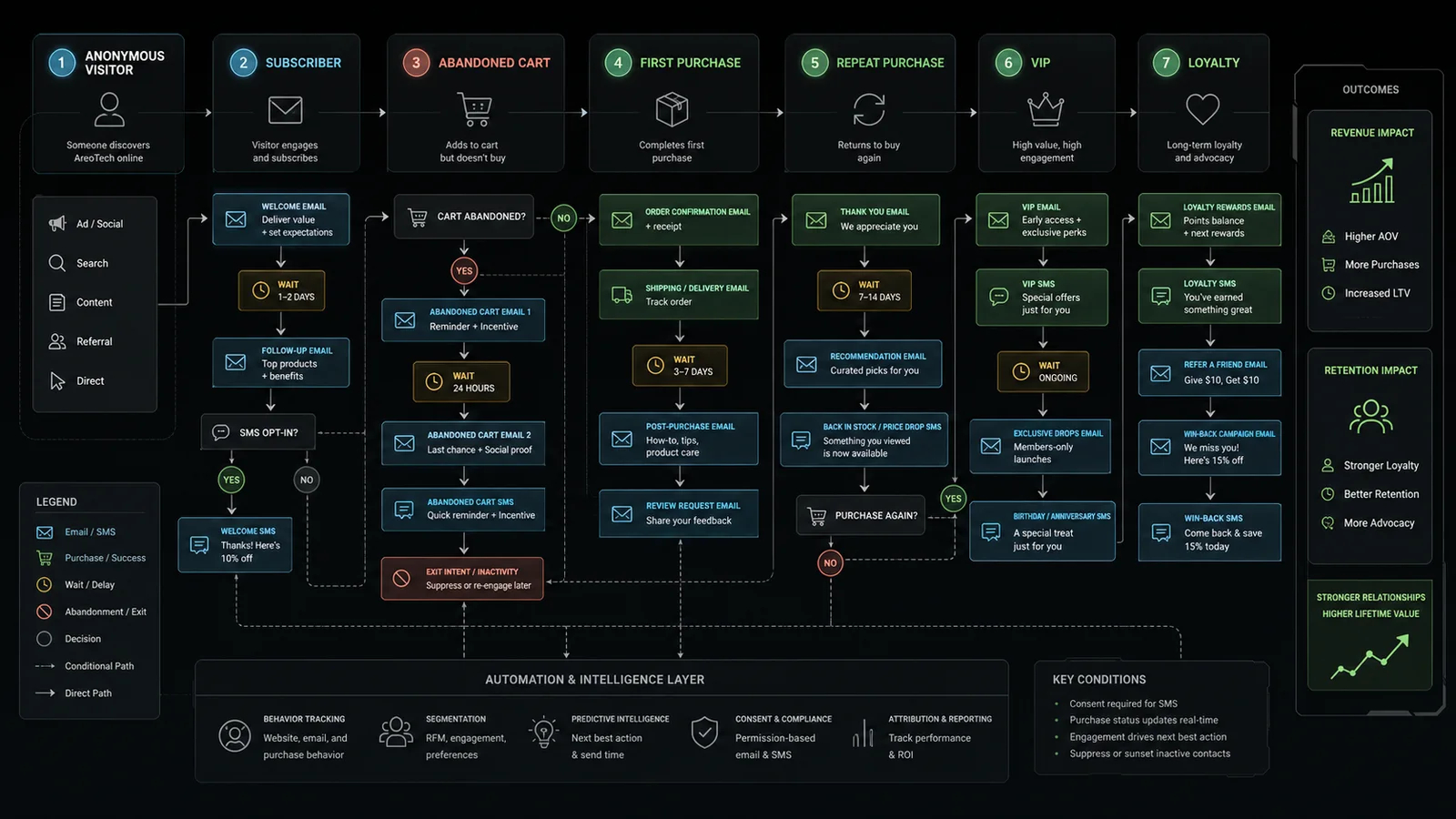
Essential Shopify Email Automations
1. Welcome series
Implement this first because the subscriber has just expressed intent. Deliver the promised incentive, explain the product and brand difference, answer a common objection, and present a relevant next step. Branch purchasers out of prospect messages immediately.
2. Abandoned cart or checkout
Recover high intent without teaching every shopper to wait for a coupon. Remind first, resolve concerns second, and test an incentive only in eligible segments. Stop after purchase and exclude support or fraud-sensitive situations.
3. Browse abandonment
Add only when traffic is sufficient and identity tracking is reliable. Focus on the viewed category or product, offer useful decision content, and apply strict frequency limits because browsing is weaker intent than carting.
4. Post-purchase follow-up
Confirm what happens next, then educate around setup, use, care, and support. The best post-purchase flow reduces anxiety and returns before asking for another order.
5. Product review request
Time the request after delivery and realistic product use. Ask decision-helpful questions, route service problems to support, and do not reward only positive sentiment.
6. Win-back campaign
Define lapse from the actual reorder cycle. A replenishable product may need 60 days; durable goods may need a different category or accessory path. Test education and novelty before discounting.
7. VIP customer flow
Recognize value with access, service, feedback opportunities, and relevant benefits. VIP should reflect contribution and relationship, not only gross revenue.
8. Birthday and anniversary emails
Use only with valid date data and clear consent expectations. A purchase or membership anniversary is often more relevant than collecting a birthday solely to send a discount.
9. Back-in-stock notification
Send quickly to customers who requested it, include the exact variant, and avoid claiming scarcity unless inventory supports the statement. Follow-up should stop when stock sells out.
10. Cross-sell, upsell, and replenishment
Use product compatibility, ownership, consumption window, inventory, and margin. Suppress products already purchased or returned. A relevant care item at the right time is better than a generic recommendation grid.
When Custom Shopify Development Is Better
A standard connector is ideal when Shopify orders and customer events contain everything needed. Custom development becomes valuable when decisions depend on data distributed across systems.
- Custom Shopify and CRM integrations: Sync account type, salesperson, pipeline stage, wholesale eligibility, and offline orders without flattening every contact into one list.
- API integrations: Send versioned events from subscriptions, ERP, loyalty, support, inventory, warranty, or product-information systems.
- Advanced segmentation: Calculate cohorts, predicted replenishment, contribution margin, category affinity, churn risk, and exclusions in a warehouse or custom service.
- Custom automation workflows: Use Shopify Flow, webhooks, Functions, and APIs to coordinate tagging, approvals, data quality, and message triggers.
- Custom dashboards: Reconcile email-platform attribution with Shopify orders, discounts, returns, cost of goods, and controlled experiments.
- AI personalization: Generate constrained recommendations or content from approved catalog data, with validation and fallbacks rather than uncontrolled output.
AreoTech can connect Shopify development, Shopify automation, CRM and email integrations, performance optimization and maintenance, and migration planning. The practical goal is not custom code everywhere. It is a clear source of truth and reliable automation where off-the-shelf connections stop being sufficient.
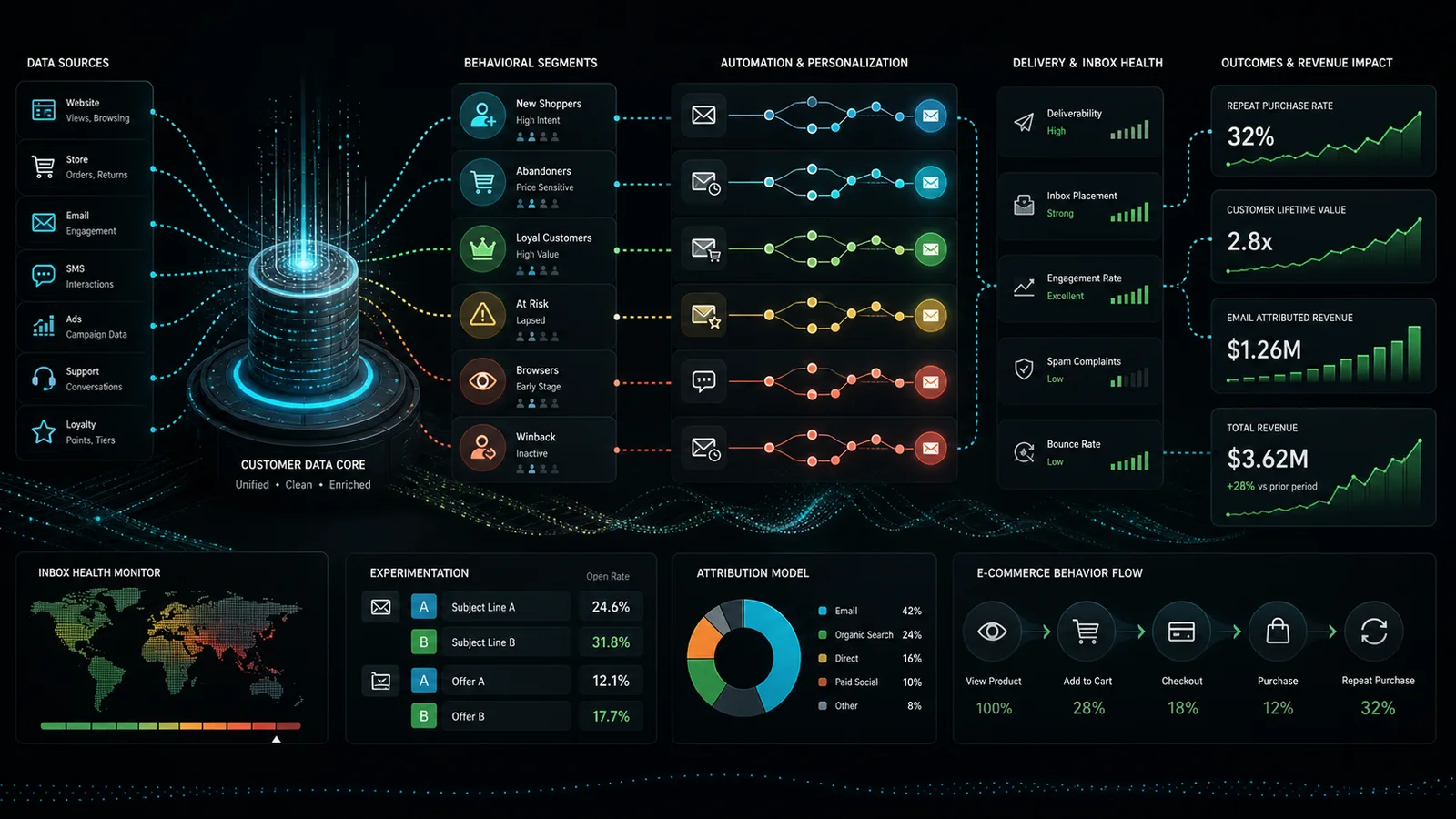
Email Marketing Best Practices for 2026
Deliverability
Configure a branded domain, SPF, DKIM, and DMARC using official vendor instructions. Warm new infrastructure, avoid volume spikes, monitor bounces and complaints, suppress risky acquisition sources, and keep transactional and marketing responsibilities clear.
Consent and compliance
Record consent source, timestamp, channel, region, and disclosed purpose. Provide clear unsubscribe controls and honor them promptly. SMS consent is not interchangeable with email consent. Obtain qualified legal advice for markets where the business operates.
List hygiene
Remove invalid addresses, prevent bot and form abuse, merge duplicates carefully, and create a sunset policy for chronic non-engagers. Do not delete consent evidence when suppressing a profile.
Mobile-friendly design
Use a clear hierarchy, readable type, sufficient contrast, useful alt text, large tap targets, concise copy, restrained image weight, and a dependable plain-text version. Test dark mode and major inboxes.
Personalization
Personalization should change relevance, not only insert a first name. Use lifecycle stage, owned products, preferences, inventory, market, and behavior. Always define fallbacks for missing or stale data.
A/B testing
Write a hypothesis, choose one primary metric, size the audience, hold other variables stable, and retain a control. Test offers, content, timing, and journey logic, not only subject lines.
Analytics
Track delivery, complaints, clickers, buyers, contribution profit, repeat rate, cohort retention, and unsubscribe behavior. Use consistent attribution windows and holdouts. Open rate is useful diagnostically but unreliable as the only success measure.
Frequently Asked Questions
What is the best Shopify email marketing app in 2026?
Klaviyo is the strongest overall for advanced lifecycle marketing. Omnisend offers better value for many growing stores, while Shopify Messaging is best for native simplicity.
What is the best free email marketing app for Shopify?
Shopify Messaging is the best native free starting point. The first 10,000 emails each month are free. Compare Omnisend, Klaviyo, Seguno, Mailchimp, Brevo, and Yotpo when their automation model fits better.
Is Klaviyo worth it for Shopify?
Yes, when the team uses its data depth. It is poor value when used only for newsletters, simple coupons, or automations that a lower-cost platform can run equally well.
Is Omnisend better than Klaviyo?
It can be for a smaller team. Omnisend is easier to justify on price and prebuilt commerce workflows. Klaviyo has more headroom for prediction, custom segmentation, integrations, and enterprise operations.
Can Shopify send marketing emails without an app?
Use Shopify Messaging, Shopify's native app. It keeps email, SMS, customer segments, products, discounts, analytics, Forms, and Flow close to Shopify admin.
Which platform has the best automation?
Klaviyo is the strongest ecommerce choice for most stores. ActiveCampaign is strong for CRM and B2B logic; Attentive is strong for enterprise mobile journeys.
Which platform is best for startups?
Shopify Messaging, Omnisend, and Seguno are practical choices. Start with essential flows and prove retention economics before adopting enterprise complexity.
Which platform is best for Shopify Plus?
Klaviyo and Attentive are leading candidates. Evaluate both against markets, data, SMS, support, roles, APIs, deliverability, contract terms, and projected cost.
Does email marketing slow down Shopify?
Sending does not, but onsite features can. Audit pop-ups, forms, behavioral tracking, recommendation blocks, and duplicate pixels. Keep one owner for identity and capture.
How many automations should a store have?
Begin with four: welcome, abandonment, post-purchase, and win-back. Add flows when they address a distinct lifecycle event and have suppression, ownership, and measurement.
How often should merchants send campaigns?
Frequency should follow value and engagement. Use subscriber expectations, lifecycle stage, buying cycle, frequency caps, and suppression rather than a universal weekly number.
What is a campaign versus an automation?
A campaign is scheduled; an automation is triggered. Campaigns serve launches and promotions. Automations respond to a profile, behavior, date, transaction, or predictive condition.
Do I need SMS as well as email?
Only when consent, urgency, and economics justify it. SMS is concise and immediate; email supports richer education and lower-cost nurture. Coordinate rather than duplicate both channels.
How should email ROI be measured?
Use incremental contribution profit. Subtract discounts, costs, returns, message fees, platform, and labor, then compare against a control whenever possible.
Can I buy an email list?
No. Purchased lists create complaint, consent, compliance, and sender-reputation risk. Build a transparent first-party list.
What authentication is required?
Configure SPF, DKIM, and DMARC for a branded sending domain. Follow the selected platform's official records and monitor alignment, reputation, and errors after launch.
When should I migrate platforms?
Migrate when a material capability or cost problem is proven. Treat consent, suppression, authentication, warming, templates, flows, historical data, and QA as a formal project.
When is custom integration better?
Use custom integration when lifecycle logic depends on systems beyond the standard Shopify connector. Common examples are subscriptions, ERP, CRM, wholesale, service, loyalty, POS, and proprietary scoring.
Key Takeaways
- Choose by lifecycle requirement, team maturity, data, and three-year cost, not feature count.
- Klaviyo is the strongest overall; Omnisend is the strongest value alternative.
- Shopify Messaging and Seguno are excellent when native simplicity matters more than advanced modeling.
- ActiveCampaign fits CRM and B2B; Attentive fits enterprise mobile-first retention.
- Protect deliverability with authentication, consent, hygiene, controlled volume, and suppression.
- Build four high-confidence automations before adding more campaigns or channels.
- Measure incremental profit and customer outcomes, not attributed revenue alone.
- Use custom integrations when important customer data lives outside Shopify and the email platform.
Quick Decision Guide
| If you are... | Recommended platform |
|---|---|
| A startup | Shopify Messaging, Omnisend, or Seguno |
| A growing brand | Omnisend or Klaviyo |
| An enterprise brand | Klaviyo or Attentive |
| A subscription store | Klaviyo or Yotpo with subscription data integration |
| An international seller | Klaviyo, Omnisend, or Brevo PushOwl after regional review |
| A B2B company | ActiveCampaign or Mailchimp |
Conclusion
The best Shopify email marketing app is not simply the one that can send the most messages. It is the platform that turns reliable customer data and valid consent into useful communication across the lifecycle, while remaining understandable, measurable, and affordable as the brand grows.
Start with the operating model. Decide who owns deliverability, data, creative, segmentation, testing, and revenue measurement. Build welcome, abandonment, post-purchase, and win-back properly. Then choose the smallest platform that can support the next stage of the business without creating a data or cost trap.
AreoTech helps merchants with Shopify development, Shopify automation and Flow, Klaviyo and Omnisend setup, CRM and email integrations, performance optimization, and migration planning. Explore our case studies, Shopify automation guide, Shopify SEO apps guide, or contact AreoTech for a focused implementation review.