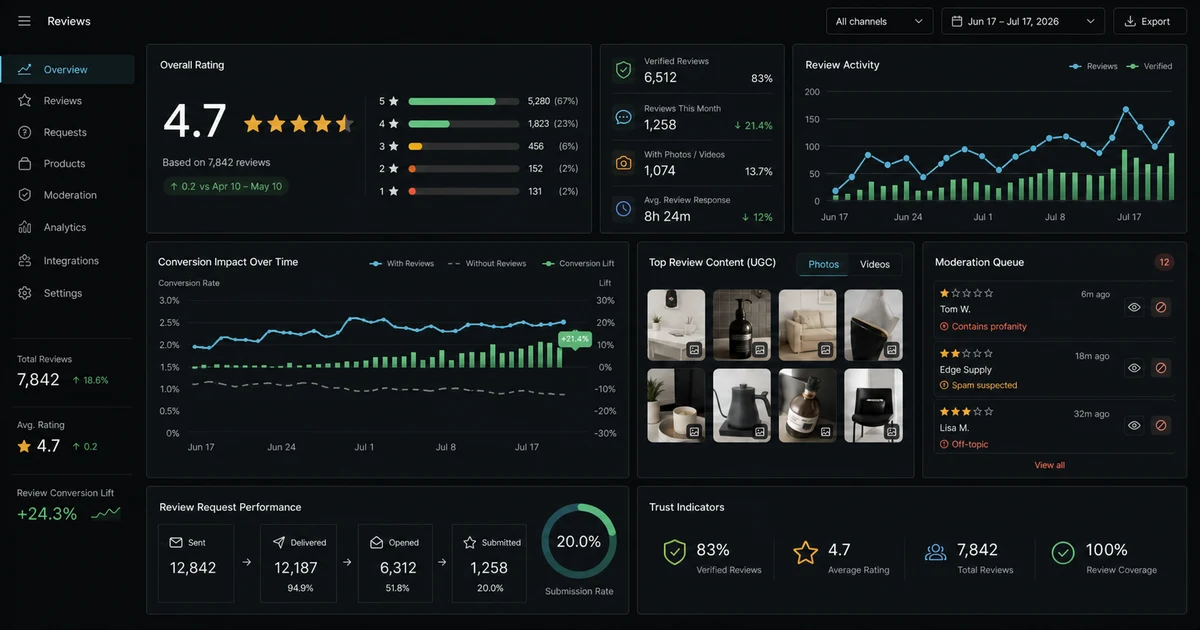
The best Shopify review apps help merchants collect credible product feedback, display useful photo and video UGC, and manage requests without weakening storefront performance or trust. This guide compares 11 platforms across review quality, verification, moderation, SEO, automation, customization, analytics, pricing, and fit for different stages of Shopify growth.
That evidence influences conversion because ecommerce shoppers cannot physically inspect the item. Reviews supply social proof, but quantity alone is not the goal. A page with 2,000 vague five-star ratings can be less persuasive than 60 recent, verified reviews that include fit, use case, photos, limitations, and thoughtful merchant responses.
Review apps also affect SEO. Authentic customer language expands the context available on product pages, while valid structured data can make eligible ratings understandable to search engines. Reviews may also provide evidence that search and AI systems can use when interpreting a product. None of this means installing a widget automatically improves rankings. Duplicate schema, hidden content, slow scripts, copied reviews, or thin product pages can work against the store.
This guide compares 11 Shopify review apps using current official listings, pricing, feature depth, visual UGC, automation, SEO support, customization, performance, analytics, support, scalability, and operational risk. App Store ratings and prices were checked on July 17, 2026. They are snapshots, not guarantees.
The short answer: Choose Judge.me for the strongest overall value, Loox for visual-first social proof, Okendo for a sophisticated DTC community program, Yotpo for broader enterprise syndication, Junip for a clean mobile-first experience, or Growave when reviews must share one retention stack with loyalty and wishlists. The right app is the one that collects credible evidence and displays it without weakening performance or trust.
Why Customer Reviews Matter
Trust psychology and customer confidence
Every purchase contains perceived risk. The shopper may question quality, fit, delivery, returns, compatibility, or whether the product will solve the promised problem. Reviews lower that risk when they come from identifiable, relevant experiences.
The strongest review systems show a believable distribution rather than manufactured perfection. Verified status, dates, customer attributes, media, helpful votes, merchant replies, and transparent moderation help a visitor evaluate the evidence. A mix of praise and constructive criticism can increase confidence because it gives the page informational texture.
Conversion rate and average order value
Reviews support conversion when they answer objections close to the decision. Star summaries near the product title provide a quick signal; detailed reviews, fit data, Q&A, and media further down the page help shoppers validate the choice. Reviews can support AOV when they clarify bundles, complementary products, sizing, or which variant suits a specific use case.
Do not assume a review widget caused every purchase after a visitor clicked it. Measure with controlled tests where possible. At minimum, compare product coverage, widget engagement, conversion by traffic source, return reasons, margin, and review exposure while accounting for product popularity.
Repeat purchases and brand reputation
A review request is also a customer-experience checkpoint. It can surface defects, confusing instructions, fulfillment problems, and unmet expectations before those patterns spread. Responding well shows that the brand listens. The resulting product improvements can strengthen retention more than another discount campaign.
Organic SEO, rich results, and AI visibility
Review text adds first-party customer vocabulary about materials, use cases, comparisons, outcomes, and objections. This can make a page more complete, but reviews do not replace original product descriptions, specifications, policies, or expert content.
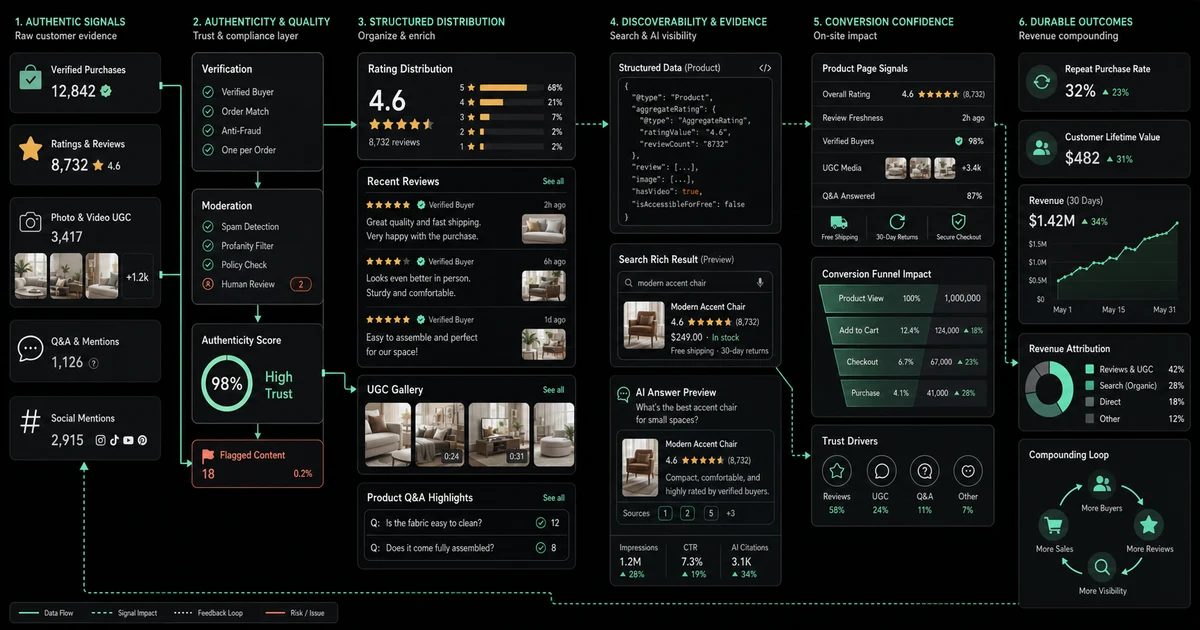
Review apps often add Product, Review, and AggregateRating structured data. Search engines may use valid markup to display rating rich results, but eligibility and display are outside the app's control. The visible rating, review count, product identity, and structured data must agree.
AI search adds another reason to maintain accurate evidence. Detailed, current reviews and merchant answers can help systems understand who a product fits, where it fails, and how real customers describe it. Authenticity, freshness, clear entity relationships, and crawlable content matter more than automatically generated summaries.
Section summary: Reviews work when they reduce uncertainty, improve the product feedback loop, and provide trustworthy customer evidence. More stars are not the strategy; better information is.
How We Selected These Shopify Review Apps
- Ease of use: Setup, migration, theme placement, moderation, team workflow, and day-to-day reporting should be understandable.
- Customization: Widgets must fit the brand, accessibility requirements, page hierarchy, and mobile layout without fragile theme edits.
- SEO features: We assessed rich snippets, product schema, Shop or Google syndication, crawlability, and the risk of duplicate markup.
- Photo and video support: Visual UGC should be easy to submit, moderate, optimize, and display without excessive media weight.
- Requests and automation: Delivery-aware timing, reminders, segments, incentives, email/SMS integrations, and suppression determine collection quality.
- Performance: App blocks, JavaScript, tracking, media loading, layout shift, and widget duplication affect the storefront.
- Analytics: Useful reporting covers requests, submissions, coverage, media, sentiment, engagement, products, and business outcomes.
- Pricing and scalability: We compared free limits, order-based tiers, media limits, add-ons, enterprise features, and likely cost as volume grows.
- Support and reliability: Migrations, theme releases, peak periods, data exports, and storefront incidents make responsive support important.
- Shopify integration: Shopify Flow, customer accounts, Shop sync, checkout, theme app extensions, APIs, markets, and product identifiers all matter.
We did not rank an app only because it has a high average rating. Shopify explains that App Store ratings, distributions, and merchant summaries are useful evaluation inputs, but merchants still need to test compatibility and business fit. Treat the official listing as a starting point, not procurement approval.
Quick Comparison: Best Shopify Review Apps
| App | Best for | Starting price | Free plan | Photo reviews | Video reviews | Google integration | SEO features | Ideal store size |
|---|---|---|---|---|---|---|---|---|
| Judge.me | Best overall value | Free; Awesome $15/mo | Yes | Yes | Yes | Rich snippets; Shopping on paid | JSON-LD and rich snippets | Startup to enterprise |
| Loox | Visual-first DTC brands | Free; Convert $49.99/mo | Yes | Yes | Paid | Shopping on paid | Schema and rich snippets | Startup to established |
| Okendo | Advanced DTC and Plus programs | Free; Essential $19/mo | Yes | Yes | Yes | Google, Shop, TikTok | SEO snippets | Growing to enterprise |
| Yotpo | Enterprise syndication and analytics | Free; Starter $15/mo | Yes | Paid | Paid | Search, Shopping, Seller Ratings | Rich snippets and schema | Growing to enterprise |
| Junip | Mobile-first collection and clean UX | Free; Core $29/mo | Yes | Paid | Paid | Shopping on Growth | Rich snippets | Startup to enterprise |
| Fera | Flexible visual widgets | $9/mo | Trial | Yes | Yes | Search and Shopping | Rich snippets | Startup to mid-market |
| Stamped | Reviews plus loyalty | $23/mo | No | Yes | Yes | Shopping and rich snippets | Product snippets | Growing stores |
| TrustWILL | Multilingual value | Free; Starter $11.99/mo | Yes | Yes | Growth | Shopping on Growth | Google snippet | Startup to mid-market |
| Ali Reviews | Marketplace review importing | Free; Basic $14.95/mo | Yes | Paid | Paid | Rich snippets on Growth | Rich snippets | Dropshipping startups |
| Growave | Reviews inside a retention suite | Free; Entry $15/mo | Yes | Yes | Plan-dependent | Shopping on Growth | Product review SEO | Startup to Plus |
| Rivyo | Low-cost reviews and loyalty options | Free; Starter $9/mo | Yes | Paid | Enterprise | Shopping on Business | Google rich snippets | Startup to Plus |
Google integration refers to the capabilities disclosed on official listings, such as product rich snippets, Google Shopping, or Seller Ratings. These are separate programs and do not guarantee organic stars or placement.
Best Shopify Review Apps in 2026

App 01
Judge.me: Best overall value for Shopify reviews
Best for: Most merchants that want dependable review collection, visual UGC, strong free features, and a predictable paid plan
Overview and best for: Judge.me combines unusually strong free functionality with a simple $15 paid tier. It suits startups, growing brands, international stores, and larger merchants that need reliable reviews without order-volume pricing.
Key features, customization, and automation: Unlimited product and store reviews, photo/video submissions, rating badges, widgets, carousels, imports, QR codes, email and SMS collection, Shop sync, and rich snippets are available. The paid plan adds advanced requests, 130+ integrations, more widgets, referrals, Google Shopping, AI replies, summaries, translations, and deeper CSS control.
SEO and performance: Judge.me supports JSON-LD and rich snippets. Keep one owner for product schema and confirm the theme or another SEO app is not publishing a conflicting aggregate rating. Use only necessary widgets and lazy-load media galleries below the first viewport.
Pros: Exceptional free plan, predictable pricing, large integration ecosystem, visual reviews, broad language support, and strong merchant sentiment. Cons: The interface and widget catalog can feel busy; advanced brand presentation may need CSS; inexpensive access can encourage merchants to enable too many placements.
Pricing: Forever Free includes unlimited reviews and core visual widgets. Awesome is $15 per month with a 15-day trial.
Ideal size and real-world use case: Startup to enterprise. A specialty food brand can request a verified review after delivery, ask about taste and preparation, reward optional media, and feed recurring packaging issues to operations.
Limitations and when not to choose it: Do not choose Judge.me solely because it is inexpensive if the brand needs high-touch enterprise strategy, complex multi-store governance, or a highly bespoke headless presentation.
Expert recommendation: It is the safest default for most merchants. Start with star rating, one product-page widget, a review page, and a delivery-aware request. Add integrations only when the workflow has an owner.

App 02
Loox: Best for visual-first social proof
Best for: Fashion, beauty, home, accessories, and lifestyle brands where customer photos and videos materially reduce purchase uncertainty
Overview and best for: Loox is built around visual reviews. Its polished galleries, carousels, snippets, and social reuse make it a strong choice when customers need to see the product on real people or in real spaces.
Key features, customization, and automation: The free Beginner plan includes review requests, photo incentives, 17+ widgets, customization, schema, social reuse, and Shop syndication. Convert adds video, bundles, referrals, Google/Meta/TikTok syndication, integrations, API access, AI sorting, highlights, summaries, translations, replies, and flagging.
SEO and performance: Loox discloses rich snippets and schema support. Visual galleries can be media-heavy, so compress submissions, constrain dimensions, use thumbnails, and avoid loading multiple carousels above the fold.
Pros: Strong visual merchandising, easy collection, attractive default widgets, useful AI presentation tools, and clear fit for consumer brands. Cons: Important video, syndication, and AI capabilities sit on the $49.99 Convert tier; order-based overages can become material.
Pricing: Beginner is free. Convert starts at $49.99 per month for 300 included orders, with usage-based additions; Unlimited is $299.99.
Ideal size and real-world use case: Startup to established. An apparel merchant can collect size, height, selected variant, a customer photo, and fit notes, then filter the gallery so shoppers see comparable customers.
Limitations and when not to choose it: Avoid Loox when visual content is not central, when low-priced high-volume orders make the cost model unattractive, or when the team needs advanced community data beyond reviews.
Expert recommendation: Choose Loox because visual proof changes the decision, not because its gallery looks impressive. Define media rights, incentives, moderation, and page-weight budgets before launch.

App 03
Okendo: Best for advanced DTC and Shopify Plus programs
Best for: Growing and enterprise brands that need rich customer attributes, visual UGC, connected loyalty or survey programs, integrations, and strategic support
Overview and best for: Okendo connects reviews with loyalty, referrals, quizzes, and surveys. It fits brands that treat customer evidence as structured community data rather than a single product-page widget.
Key features, customization, and automation: Review attributes, product grouping, Q&A, photos, videos, automated email/SMS collection, rewards, moderation, AI summaries and keywords, advanced CSS, reporting, and integrations with Shopify Flow, Klaviyo, Gorgias, Meta, Google, TikTok, and Shop are available across tiers.
SEO and performance: SEO snippets are included from the free plan. Okendo's richer widgets and connected apps increase implementation surface, so control app blocks, event tracking, media, and redundant loyalty or survey tools.
Pros: Excellent data model, mature integrations, strong visual UGC, connected community suite, advanced reporting, and enterprise services. Cons: Meaningful jumps from $19 to $119 and $299; using the full suite requires clear ownership and governance.
Pricing: Free up to 50 orders monthly; Essential $19 up to 200; Growth $119 up to 1,500; Power $299 up to 3,500.
Ideal size and real-world use case: Growing to enterprise. A skincare brand can collect skin type, age range, routine, time used, and media, then let shoppers filter reviews by relevant attributes and use themes in product development.
Limitations and when not to choose it: It is excessive for a small catalog that only needs basic stars and emails. Do not pay for connected community tools without an operating plan for them.
Expert recommendation: Okendo is a strong shortlist candidate for sophisticated DTC and Plus teams. Run a proof of concept on one high-volume product and validate request rate, attribute completion, page speed, data export, and support workflow.

App 04
Yotpo: Best for broad enterprise syndication
Best for: Established brands that value Google and channel distribution, advanced moderation, analytics, and connection to a wider retention ecosystem
Overview and best for: Yotpo Product Reviews is an established platform for reviews, UGC, Google visibility, channel syndication, moderation, and analytics. It is best evaluated as part of a broader retention and distribution architecture.
Key features, customization, and automation: Automated requests, in-mail collection, photos, video, carousels, smart filters, sentiment checks, AI summaries, smart sorting, custom questions, Google Seller Ratings, Shopping Ads, TikTok and Walmart sync, and connections to Yotpo Loyalty are available by tier.
SEO and performance: The listing discloses rich snippets, schema, indexing, lazy loading, and speed tools. Enterprise capability does not remove the need to test actual theme output, JavaScript, media, and duplicated structured data.
Pros: Mature syndication, comprehensive collection and moderation, strong analytics, Google programs, and enterprise headroom. Cons: Pricing scales with order volume; major features are tiered; platform breadth can create operational and contract complexity.
Pricing: Free up to 50 monthly orders. Starter begins at $15 with volume-based pricing. Pro starts at $119 and adds Seller Ratings, custom questions, AI summaries, smart sorting, and enhanced support.
Ideal size and real-world use case: Growing to enterprise. A consumer electronics brand can capture product-specific questions, moderate technical claims, syndicate eligible ratings, and compare recurring complaints with return and support data.
Limitations and when not to choose it: Avoid it when the business needs only a straightforward review widget, lacks resources for procurement and implementation, or cannot justify order-based scaling.
Expert recommendation: Evaluate Yotpo through total cost, export rights, support terms, syndication eligibility, and a real storefront test. Do not select it only because the brand recognizes the vendor.

App 05
Junip: Best mobile-first review experience
Best for: Design-conscious DTC teams that want high-quality mobile submissions, clean storefront widgets, unlimited requests, and a practical path to syndication and APIs
Overview and best for: Junip focuses on low-friction mobile review collection and clean on-site presentation. It is a credible alternative for brands that want a modern product-review layer without a larger loyalty suite.
Key features, customization, and automation: Unlimited orders and requests are available on all tiers. Core adds media, incentives, replies, product grouping, and support. Growth adds Google Shopping, TikTok, Shop, Meta, marketing integrations, search, custom attributes, and filters. Premium adds AI, multi-store management, APIs, and custom apps.
SEO and performance: Rich snippets are included on free. Clean design is helpful, but merchants should still test widget rendering, layout shift, below-the-fold loading, and tracking in their exact theme.
Pros: Strong mobile forms, unlimited request model, clean widgets, useful syndication, and an enterprise API path. Cons: Media requires Core, syndication requires Growth, and AI/API access is positioned at $299.
Pricing: Free; Core $29; Growth $79; Premium $299 per month.
Ideal size and real-world use case: Startup to enterprise. A beauty brand can use a concise mobile form, request a photo after enough product-use time, capture skin type, and feed structured attributes into product-page filters.
Limitations and when not to choose it: Junip may not fit teams that need a bundled loyalty program or advanced enterprise services at lower tiers.
Expert recommendation: Junip is one of the strongest UX-led choices. Test the submission flow on low-end mobile devices and ensure custom questions improve decisions rather than lengthening the form.

App 06
Fera: Best for flexible visual widgets
Best for: Small and mid-market stores that want attractive photo and video reviews, Q&A, imports, incentives, and broad integration access
Overview and best for: Fera offers visual reviews, flexible displays, automated requests, Q&A, rich snippets, marketplace imports, and long trials. It is a practical choice for merchants that want customization without enterprise pricing.
Key features, customization, and automation: Photo/video storage, branded widgets, product groups, custom domains, review incentives, cashback or points, QR codes, imports, syndication, review highlights, AI features, and multi-store sync are tiered by request, order, storage, user, and customization limits.
SEO and performance: Fera discloses SEO-friendly ratings, rich snippets, Google Search, and Shopping support. Media storage and galleries make image optimization and lazy loading important.
Pros: Attractive widgets, flexible collection, marketplace sync, a 60-day trial, reasonable entry pricing, and useful customization. Cons: No permanent free plan; request, order, user, and storage limits require capacity planning.
Pricing: Startup $9 for 100 requests and up to 200 orders; Small $29; Medium $99; Semi-Large $199 monthly.
Ideal size and real-world use case: Startup to mid-market. A furniture merchant can collect assembly difficulty, room photos, delivery experience, and Q&A, then surface media without loading full-resolution assets initially.
Limitations and when not to choose it: Avoid when the store needs unlimited requests at a predictable price or advanced API and multi-region governance not disclosed for the selected tier.
Expert recommendation: Model request and media growth before choosing a plan. Use the trial to test migration, widget accessibility, mobile media upload, and schema output.

App 07
Stamped: Best established reviews-and-loyalty option
Best for: Growing merchants that want product reviews, UGC, Q&A, loyalty, referrals, and Shopify Flow connections in one platform
Overview and best for: Stamped Reviews & Loyalty combines reviews with points, rewards, referrals, and VIP tiers. Its long market history and feature breadth make it relevant to brands consolidating social proof and loyalty.
Key features, customization, and automation: Product and site reviews, photos, videos, Q&A, customizable widgets, email/SMS requests, moderation automation, Smart Insights, Google Shopping, rich snippets, loyalty campaigns, reporting, and integrations with Shopify Flow, Klaviyo, Recharge, Gorgias, Facebook, and Instagram.
SEO and performance: Stamped supports product snippets and rich results. Merchants should test widget latency and verify that legacy theme snippets are removed during upgrades or migration.
Pros: Broad feature set, established ecosystem, loyalty connection, customization, and multiple collection types. Cons: No free plan on the current listing, starting price is higher than several focused competitors, and recent merchant feedback should be reviewed carefully for support and performance patterns.
Pricing: From $23 per month; confirm current tier limits and external charges before installation.
Ideal size and real-world use case: Growing stores. A subscription brand can request reviews after a meaningful usage period, connect recurring-purchase data, and award loyalty value without making the reward conditional on a positive rating.
Limitations and when not to choose it: Do not choose Stamped if reviews are the only requirement and a simpler tool provides better economics. Validate data export and support response before a large migration.
Expert recommendation: Include recent one-, two-, and three-star App Store reviews in due diligence, then test support with a technical question during the trial. Historical reputation is not a substitute for current service quality.

App 08
TrustWILL: Best multilingual value option
Best for: International and budget-conscious stores that need photo/video reviews, translation, imports, visual editing, and round-the-clock multilingual support
Overview and best for: TrustWILL, formerly Trustoo, provides review collection, translation, AI insights, imports, widgets, and visual UGC at accessible prices.
Key features, customization, and automation: Email requests, discounts for photo submissions, QR codes, WhatsApp and marketplace collection, automated translation, branded templates, replies, product groups, Google Shopping, APIs, AI summaries, smart sorting, and 24/7 support are available by tier.
SEO and performance: Google snippets begin on Starter; Shopping sits on Growth. WebP optimization is useful, but test actual widget code, translations, and schema across markets.
Pros: Strong language coverage, useful free plan, accessible pricing, photo and video collection, AI assistance, and responsive support positioning. Cons: Free displays only six reviews per product; video and API access require Growth; order overages can apply.
Pricing: Free; Starter $11.99; Growth $29.99 plus disclosed order overages.
Ideal size and real-world use case: Startup to mid-market. A cross-border accessories brand can collect in local languages, translate for discovery, preserve originals, and route sensitive responses for human review.
Limitations and when not to choose it: Avoid when the organization needs mature enterprise governance, deep custom analytics, or formal multi-store controls beyond the disclosed plan.
Expert recommendation: Translation should never erase nuance. Store original review text, label translations clearly, and review AI summaries for material claims.

App 09
Ali Reviews: Best for marketplace review importing
Best for: Dropshipping and marketplace-sourced catalogs that need careful review importing, translation, collection, and a path toward first-party customer reviews
Overview and best for: Ali Reviews specializes in importing product reviews from AliExpress, Amazon, Temu, eBay, Etsy, and other sources while also collecting new first-party reviews.
Key features, customization, and automation: Bulk AI import, translations, review boxes, badges, carousels, media galleries, Q&A, dynamic discounts, email collection, replies, rich snippets, page-builder integrations, and dedicated support are tiered by source and reviews published per product.
SEO and performance: Google rich snippets start on Growth. Imported content can create duplication, relevance, rights, and trust risk; schema must never imply an imported reviewer bought from the Shopify merchant.
Pros: Strong importing workflow, multiple marketplace sources, translations, visual widgets, free entry, and low paid tiers. Cons: Published-review limits, source restrictions, and substantial authenticity/compliance responsibilities.
Pricing: Free; Basic $14.95; Growth $24.95; Advanced $49.95 monthly.
Ideal size and real-world use case: Dropshipping startups. A merchant can seed decision-relevant supplier feedback with accurate attribution, then progressively prioritize verified reviews from its own fulfilled orders.
Limitations and when not to choose it: Do not use imported reviews when rights or product identity are uncertain, or present third-party marketplace content as first-party verified purchases.
Expert recommendation: Treat imports as a temporary evidence bridge, not the review strategy. Build post-delivery first-party collection immediately and document provenance.

App 10
Growave: Best all-in-one retention suite
Best for: Merchants that want product reviews, loyalty, wishlists, referrals, VIP, POS, and Shopify Plus extensions under one commercial and data model
Overview and best for: Growave bundles reviews with loyalty, wishlists, referrals, memberships, and VIP. It fits stores trying to replace several overlapping apps with one retention platform.
Key features, customization, and automation: Product reviews, request series, wishlist alerts, referrals, loyalty, store credit, POS, Flow, review attributes, Google Shopping, Instagram UGC, checkout/account extensions, headless APIs, B2B, and wallet features expand across tiers.
SEO and performance: Consolidation can reduce duplicated scripts, but an all-in-one suite still needs disciplined module selection. Enable only used features, audit app embeds, and validate review schema.
Pros: Consolidated stack, useful free tier, broad retention capabilities, Shopify Plus and headless support, POS, and integrations. Cons: Large price jump from $15 Entry to $199 Growth and $499 Plus; switching multiple functions later becomes a larger migration.
Pricing: Free up to 200 orders; Entry $15 up to 500; Growth $199 up to 1,500; Plus $499 up to 3,000, with disclosed overages.
Ideal size and real-world use case: Startup to Shopify Plus. An omnichannel apparel brand can connect review attributes, loyalty status, wishlists, POS, and back-in-stock activity in one customer experience.
Limitations and when not to choose it: Avoid if the business already has strong loyalty and wishlist systems or needs best-of-breed review depth without platform coupling.
Expert recommendation: Compare Growave against the combined three-year cost and data complexity of separate apps. Consolidation is valuable only when the integrated workflows are actually used.

App 11
Rivyo: Best low-cost reviews and loyalty path
Best for: Cost-conscious stores that want unlimited core reviews, Google snippets, optional loyalty/referrals, and an inexpensive route to video, APIs, headless, and Plus checkout
Overview and best for: Rivyo provides product and store reviews, visual UGC, automation, AI, rich snippets, loyalty, and referrals at aggressive prices.
Key features, customization, and automation: The free tier includes unlimited reviews, CSV import, requests from 100 monthly orders, replies, analytics, rich snippets, and limited marketplace imports. Higher tiers add photos, Q&A, reminders, incentives, grouping, Google Shopping, moderation, QR collection, unlimited video, AI autopilot, API/headless, checkout placement, and priority support.
SEO and performance: Rich snippets are included free. Checkout review placement and multiple loyalty modules should be tested for relevance and performance rather than enabled automatically.
Pros: Low price, broad feature coverage, Built for Shopify status, strong current rating, headless/API tier, and optional loyalty add-ons. Cons: Some functionality is split into add-ons; marketplace imports and AI require governance; low cost does not remove migration or QA work.
Pricing: Free to install; Starter $9; Business $14; Enterprise $19. Loyalty and referral programs are separate $9 add-ons on the current listing.
Ideal size and real-world use case: Startup to Plus. A mid-volume catalog can collect photo reviews, use product grouping for variants, add rich snippets, and later test API rendering without a large software commitment.
Limitations and when not to choose it: Avoid if procurement requires a larger enterprise services organization, advanced cross-store reporting, or a proven global syndication program.
Expert recommendation: Rivyo deserves a value shortlist, but confirm add-on cost, support scope, export format, and storefront reliability with your own theme and traffic pattern.
Comparison Tables by Use Case
Best free Shopify review apps
| App | Free value | Best next step |
|---|---|---|
| Judge.me | Unlimited reviews, photos, videos, widgets, rich snippets | Upgrade for integrations, AI, customization, and Shopping |
| Junip | Unlimited orders and request emails, mobile forms, widgets, rich snippets | Core for media; Growth for syndication |
| Rivyo | Unlimited reviews, 100 order requests, replies, analytics, rich snippets | Starter for photos; Business for Shopping |
| Okendo | Up to 50 orders, requests, rewards, displays, snippets | Essential for 200 orders; Growth for AI and Q&A |
| Loox | Requests, photo incentives, widgets, schema, Shop sync | Convert for video, AI, integrations, and channel sync |
Best premium review platforms
| App | Premium advantage | Cost risk to monitor |
|---|---|---|
| Okendo | Attributes, community suite, integrations, reporting, service | Order tiers and module adoption |
| Yotpo | Google programs, distribution, analytics, ecosystem | Volume pricing and contract complexity |
| Junip | Clean UX, syndication, unlimited requests, API path | Premium AI/API tier |
| Growave | Reviews, loyalty, wishlist, POS, Plus, headless | Large tier jumps and platform coupling |
| Loox | Visual merchandising, AI presentation, referrals, syndication | Order overages on Convert |
Best photo and video review apps
| Need | Recommended apps | Why |
|---|---|---|
| Visual-first merchandising | Loox, Okendo | Strong galleries, collection, attributes, and AI presentation |
| Clean mobile submission | Junip | Low-friction forms and unlimited requests |
| Low-cost visual UGC | Judge.me, Rivyo, TrustWILL | Strong free or inexpensive media paths |
| Flexible visual widgets | Fera | Media galleries, incentives, Q&A, and customization |
| Enterprise syndication | Yotpo, Okendo | Broader channel and data programs |
Best AI review platforms
| App | AI use | Human responsibility |
|---|---|---|
| Okendo | Summaries, keywords, connected insights | Validate themes and preserve minority feedback |
| Loox | Sorting, highlights, summaries, translations, replies, flagging | Review eligibility, nuance, and translation accuracy |
| Yotpo | Summaries, prompts, sentiment, smart sorting | Control claims and moderation decisions |
| Junip | Sales agent, summaries, integrations | Define source evidence and escalation |
| TrustWILL | Insights, summaries, high-value sorting | Check bias, accuracy, and multilingual meaning |
| Rivyo | AI review autopilot | Govern actions, fraud signals, and publication rules |
Best review apps for Shopify Plus
| Requirement | Strong candidates |
|---|---|
| Advanced DTC community data | Okendo |
| Google and multichannel syndication | Yotpo, Okendo, Junip |
| Headless and APIs | Junip Premium, Growave Plus, Rivyo Enterprise |
| Reviews plus retention suite | Growave, Okendo, Stamped |
| High-value visual merchandising | Loox, Okendo |
Best apps for small businesses
| Priority | Recommended app |
|---|---|
| Maximum free value | Judge.me |
| Mobile-first simplicity | Junip |
| Low paid price | Rivyo or TrustWILL |
| Visual lifestyle products | Loox |
| Marketplace-sourced catalog | Ali Reviews with provenance controls |
Common Review Strategy Mistakes
Buying or manufacturing fake reviews
Fake reviews create consumer-protection, platform, reputation, and long-term data risk. They also teach the business nothing. Never use employees, automated text, or paid contributors to manufacture customer experiences.
Ignoring negative reviews
Deleting every critical review creates an unbelievable profile and hides operational issues. Publish authentic, relevant feedback; respond with care; resolve the problem; and track themes by SKU, batch, carrier, market, and supplier.
Poor request timing
A request sent before delivery is irritating. One sent two days after delivery may be too early for skincare, supplements, furniture, electronics, or subscriptions. Trigger from delivery when possible and use category-specific delays.
Hiding reviews or overloading the page
Do not bury the only review entry point below unrelated content. Also avoid a star badge, floating notification, carousel, gallery, full widget, and pop-up all on one product page. Use a clear rating summary near the decision and one deep evidence section.
Ignoring mobile UX and performance
Test submission, filters, media upload, pagination, keyboard access, and tap targets on real phones. Audit layout shift, JavaScript, request count, image weight, and interaction delay before and after installation.
Missing or duplicated schema
Themes, SEO apps, feeds, and review apps can all publish Product structured data. Choose one coherent source, validate variant behavior, and make sure counts and ratings match visible content.
Rewarding only positive sentiment
An incentive may encourage participation, but it must not depend on a five-star result. Disclose material incentives, apply them consistently, and follow applicable laws and channel policies.
Which Review App Is Right for Your Business?
This is the decision most comparison articles skip. The best review platform depends on the evidence your customer needs, order volume, catalog, team, channels, and maturity.
New Shopify stores under 100 orders per month
Choose Judge.me for maximum free capability, Junip for mobile-first simplicity, or Rivyo for a low-cost upgrade path. Do not buy an enterprise suite before the store has a repeatable delivery and request process. Your first goal is credible coverage across priority products.
Growing DTC brands
Shortlist Okendo, Junip, Loox, and Yotpo. Evaluate custom attributes, Klaviyo integration, UGC rights, product groups, reporting, syndication, and three-year cost. Assign ownership across ecommerce, retention, support, and product teams.
Fashion and apparel stores
Choose Loox when real-customer imagery drives confidence, or Okendo when fit attributes and filters need more structure. Capture size purchased, usual size, height or fit preference only when useful and privacy-appropriate. Make photo upload optional.
Beauty and cosmetics
Choose Okendo, Junip, or Yotpo for attributes, media, segmentation, and mature integrations. Time requests according to expected use. Ask about skin or hair context without encouraging medical claims, and route sensitive adverse experiences to support.
Electronics and technical products
Consider Yotpo, Judge.me, or Fera for Q&A, detailed text, moderation, and broad coverage. Technical shoppers need compatibility, setup, durability, firmware, and support evidence more than an image wall.
Subscription businesses
Choose Okendo, Stamped, Yotpo, or Growave when reviews must connect to loyalty or lifecycle systems. Trigger after enough usage, distinguish first-order feedback from long-term experience, and suppress duplicate asks across renewals.
B2B stores
Use Growave Plus, Rivyo Enterprise, Junip Premium, or a custom implementation when company accounts, approvals, gated products, headless storefronts, or CRM data matter. Consumer-style star pop-ups can be less useful than verified case evidence, Q&A, and account-specific feedback.
Shopify Plus merchants
Run a formal shortlist across Okendo, Yotpo, Junip, Growave, and Rivyo. Require proof for APIs, headless rendering, markets, identity, Shop sync, Google programs, accessibility, incident support, export, data retention, security, and performance. Test on a production-like theme before procurement.
Decision Framework by Business Stage
- Define the customer question. Identify the uncertainty reviews must solve: fit, shade, durability, compatibility, taste, setup, results, or service.
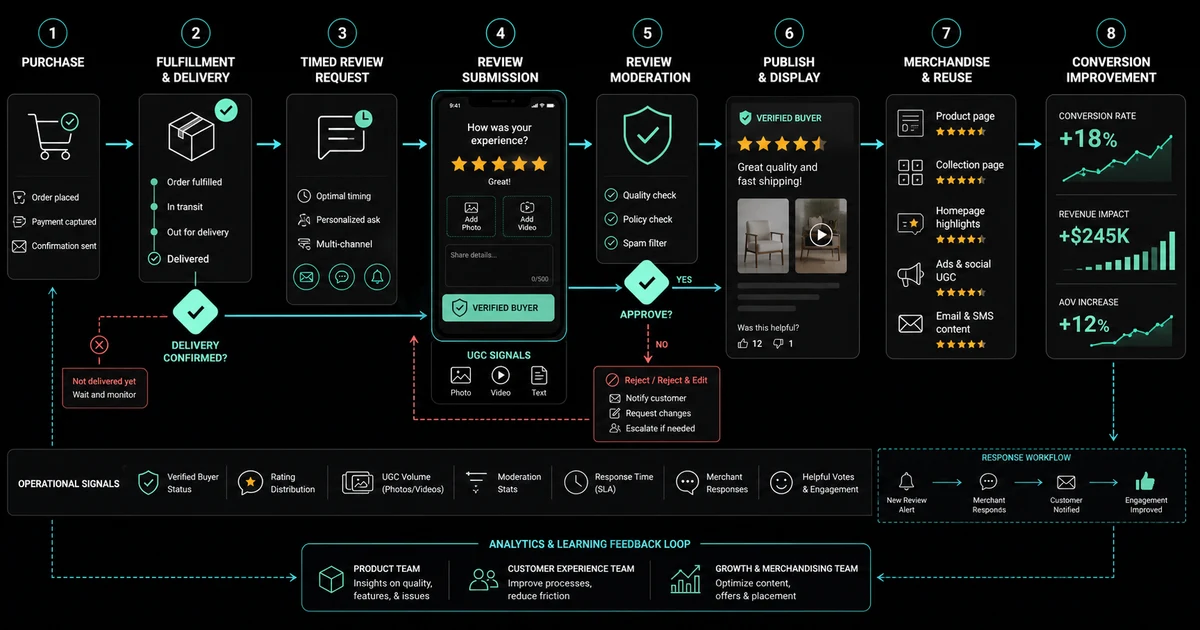
- Map the review lifecycle. Document delivery, timing, channels, consent, reminders, incentives, moderation, response, publication, reuse, and deletion.
- Prioritize evidence formats. Decide whether detailed text, attributes, Q&A, photos, video, or long-term updates matter most.
- Set technical requirements. List theme, markets, Shop sync, Google, email/SMS, Flow, subscriptions, loyalty, POS, headless, APIs, schema, analytics, and accessibility.
- Model three-year cost. Include order growth, requests, SMS, media, overages, implementation, migration, design, testing, and internal ownership.
- Run a proof of concept. Test one representative product and one difficult edge case on desktop and mobile.
- Measure incrementally. Track coverage, request-to-review rate, helpful content, conversion, returns, margin, support themes, and customer sentiment.
Stage recommendations: Startups should favor Judge.me, Junip, or Rivyo. Growing brands should compare Loox, Okendo, Junip, Fera, and Yotpo. International stores should test translation and market display with Judge.me or TrustWILL. Established and Plus teams should use formal procurement and include custom development as an alternative.
Reviews, SEO, and AI Search
Customer language improves page context
Authentic reviews introduce vocabulary that customers actually use. A product described by the brand as a "technical commuter shell" may be described by buyers in terms of rain, cycling, layering, pockets, temperature, and sizing. That context can improve usefulness, but it must remain readable and relevant rather than an unbounded wall of text.
Structured data supports rich-result eligibility
A review app may publish rating schema, but valid implementation requires agreement between the product, visible rating, review count, URL, offers, and markup. Rich results are an eligibility outcome, not an app feature that a vendor can guarantee.
Shop sync is not the same as a CSV migration
Shopify's official Shop product review sync documentation lists Judge.me, Loox, Okendo, Stamped.io, and Yotpo as supported partners. It also explains that partner reviews need verified customer, order, and product identifiers for Shop eligibility, and that CSV-migrated reviews are not eligible for Shop display. This distinction can materially affect a migration decision.
Reviews can support AI-generated answers
AI systems benefit from specific, attributable, current evidence. Review attributes, Q&A, verified status, product identity, and merchant responses create clearer entity relationships than generic praise. AI-generated summaries should point back to real review evidence and retain limitations instead of flattening sentiment.
Freshness affects trust
An old review can remain useful, but a page with no recent activity may not reflect the current product, supplier, packaging, or fulfillment experience. Track recent coverage without pressuring customers or manipulating order.
When Custom Development Is Better
Apps are the right default for most stores because collection, moderation, email delivery, data storage, and integrations are expensive to reproduce. Custom development becomes rational when the standard presentation or data model creates a material limitation.
- Custom review widgets: Render a fast, accessible design that matches unusual product templates, comparison tools, bundles, or editorial layouts.
- Advanced integrations: Connect reviews with subscriptions, ERP, PIM, CRM, warranty, support, returns, loyalty, POS, or proprietary product testing.
- Review migration: Preserve product mappings, variants, groups, media, dates, replies, verification, customer references, and source provenance through a controlled cutover.
- API and headless support: Server-render review summaries, paginate evidence, cache safely, and revalidate without blocking the storefront.
- Custom moderation: Route regulated claims, safety reports, personal data, counterfeit allegations, or product incidents through specialist workflows.
- Performance optimization: Replace redundant widgets, defer media, reduce script scope, eliminate leftover code, and protect Core Web Vitals.
Shopify's official theme app extension documentation explains how app blocks let merchants place dynamic elements such as product reviews through the theme editor without directly editing Liquid templates. Prefer supported app blocks first. Customize when measured requirements exceed what the extension exposes.
AreoTech can combine Shopify development, conversion-focused product templates, Shopify SEO, automation and Flow, performance optimization and maintenance, and custom app integrations. The goal is not custom code for its own sake. It is a review experience that remains credible, fast, and maintainable.
Best Practices for Collecting Reviews
1. Trigger after confirmed delivery and realistic use
Use delivery data where possible. Add enough time for setup, consumption, washing, installation, or visible results. Create category-specific timing instead of one global delay.
2. Keep the first request focused
Ask for an overall rating and one useful text prompt. Add optional attributes or media when they improve another shopper's decision. Long forms reduce completion and encourage rushed answers.
3. Coordinate email and SMS
Do not send the same request from the review app, email platform, Shop, and subscription system. Define channel consent, priority, frequency, reminders, and suppression in one journey map.
4. Incentivize participation, not praise
If permitted, offer the same disclosed benefit regardless of rating. Separate a photo incentive from sentiment and protect the customer's ability to be critical.
5. Moderate through a written policy
Publish authentic positive and negative feedback. Remove spam, personal data, threats, irrelevant content, or prohibited claims consistently. Record the reason for moderation and provide escalation paths.
6. Respond with operational value
Thank the customer, answer the issue, avoid defensive language, and move account-specific support to a private channel. If the review reveals a recurring problem, create an owner and corrective action.
7. Reuse UGC with permission
Clarify media rights and attribution before using a customer's photo or video in ads, email, social content, or landing pages. Keep source, permission, product, and expiry records.
8. Measure coverage and quality
Track reviewed-product coverage, request delivery, submission rate, detailed-text rate, photo/video rate, verified share, freshness, helpful votes, response time, issue themes, and conversion experiments.
Frequently Asked Questions
What is the best Shopify review app in 2026?
Judge.me is the best overall value for most stores. Choose Loox for visual-first brands, Okendo for advanced DTC programs, Yotpo for enterprise syndication, or Junip for mobile-first collection.
What is the best free Shopify review app?
Judge.me has the strongest free feature set. Junip and Rivyo are also credible free options. Compare upgrade requirements, not only the entry price.
Which app is best for photo and video reviews?
Loox is the strongest visual-first platform. Okendo, Junip, Yotpo, Judge.me, Fera, TrustWILL, and Rivyo also support visual UGC at different tiers.
Do review apps improve Shopify SEO?
They can support SEO, but they do not guarantee rankings. Useful customer language, crawlable content, valid structured data, and strong product pages work together.
Can reviews show stars in Google Search?
Eligible pages may receive rating rich results. The markup and visible content must meet search-engine requirements; display is not guaranteed.
Are Google product reviews and store reviews the same?
No. Product ratings, Seller Ratings, Google Customer Reviews, Google Business Profile reviews, Shopping reviews, and organic rich results are different systems.
Can I migrate reviews between apps?
Usually, but migration needs reconciliation. Export before uninstalling, preserve identifiers and verification, migrate media carefully, and compare totals by product.
Can I import Amazon or AliExpress reviews?
Some apps allow it, but permission and provenance matter. Confirm rights, product match, disclosure, source terms, and local law. Never label them as verified Shopify purchases.
Are incentivized reviews acceptable?
Only with careful, neutral rules and disclosure. Never condition a reward on positive sentiment. Obtain legal guidance for relevant markets.
Should negative reviews remain visible?
Authentic, relevant negative reviews generally should remain. Respond constructively and moderate only under a consistent policy.
When should review requests be sent?
After delivery plus enough product-use time. Timing should vary by product category, shipping method, setup, and expected outcome.
Do widgets slow down Shopify?
They can. Limit placements, use app blocks, optimize and lazy-load media, remove duplicate scripts, and test Core Web Vitals.
How many reviews are enough?
There is no universal number. Aim for useful coverage, credible distribution, detail, verified context, media where relevant, and recent activity.
Which review app is best for Shopify Plus?
Okendo, Yotpo, Junip, Growave, and Rivyo belong on the shortlist. The final choice depends on APIs, markets, governance, channels, performance, and cost.
How do I measure review-app ROI?
Measure incremental contribution profit and decision quality. Include coverage, submission, engagement, conversion tests, returns, support insights, fees, incentives, and implementation cost.
Can AI manage reviews automatically?
AI can assist but should not own policy decisions. Review summaries, translations, replies, flags, and sorting for accuracy, privacy, bias, and lost nuance.
What happens after uninstalling a review app?
Widgets usually disappear and code or data may remain. Export first, validate the replacement, then remove old embeds, snippets, scripts, schema, and integrations.
When is custom development better?
Use custom development for material requirements that app blocks cannot meet. Common cases include headless rendering, complex integrations, regulated moderation, multi-store data, and strict performance budgets.
Key Takeaways
- Judge.me is the strongest overall value; Loox leads visual-first merchandising.
- Okendo and Yotpo fit advanced programs, while Junip offers excellent mobile-first UX.
- Growave makes sense when reviews, loyalty, referrals, wishlists, and Plus features should share a stack.
- Review quality, relevance, verification, detail, freshness, and response matter more than raw quantity.
- Product rich snippets, Shopping ratings, Seller Ratings, Shop reviews, and Google Business reviews are different systems.
- Build one delivery-aware request journey and prevent duplicate email/SMS asks.
- Publish authentic criticism, use a documented moderation policy, and never reward only positive sentiment.
- Test app blocks, scripts, media, structured data, accessibility, and Core Web Vitals before full rollout.
- Export and reconcile review data before migration or uninstall.
- Measure incremental profit and product learning, not vendor-attributed revenue alone.
Quick Decision Guide
| If you are... | Recommended platform |
|---|---|
| A startup | Judge.me, Junip, or Rivyo |
| A growing DTC brand | Loox, Junip, or Okendo |
| A luxury brand | Okendo or Loox with custom presentation |
| An international seller | Judge.me or TrustWILL after translation review |
| A subscription business | Okendo, Stamped, Yotpo, or Growave |
| A Shopify Plus merchant | Okendo, Yotpo, Junip, Growave, or Rivyo after proof of concept |
Conclusion
The best Shopify review app is not the platform that produces the largest star count. It is the one that collects credible, decision-relevant customer evidence, protects authenticity, integrates with the operating stack, and renders quickly across the storefront.
Start with the customer question and review lifecycle. Choose timing, prompts, attributes, moderation, responses, rights, structured data, and measurement before comparing feature lists. Then test the smallest platform capable of supporting the next stage of the business.
AreoTech helps merchants with Shopify development, conversion-focused UX, review platform setup and migration, Shopify SEO, Shopify automation, performance optimization, and custom integrations. Explore our case studies, Shopify apps guide, Shopify SEO apps guide, or contact AreoTech for a focused implementation review.