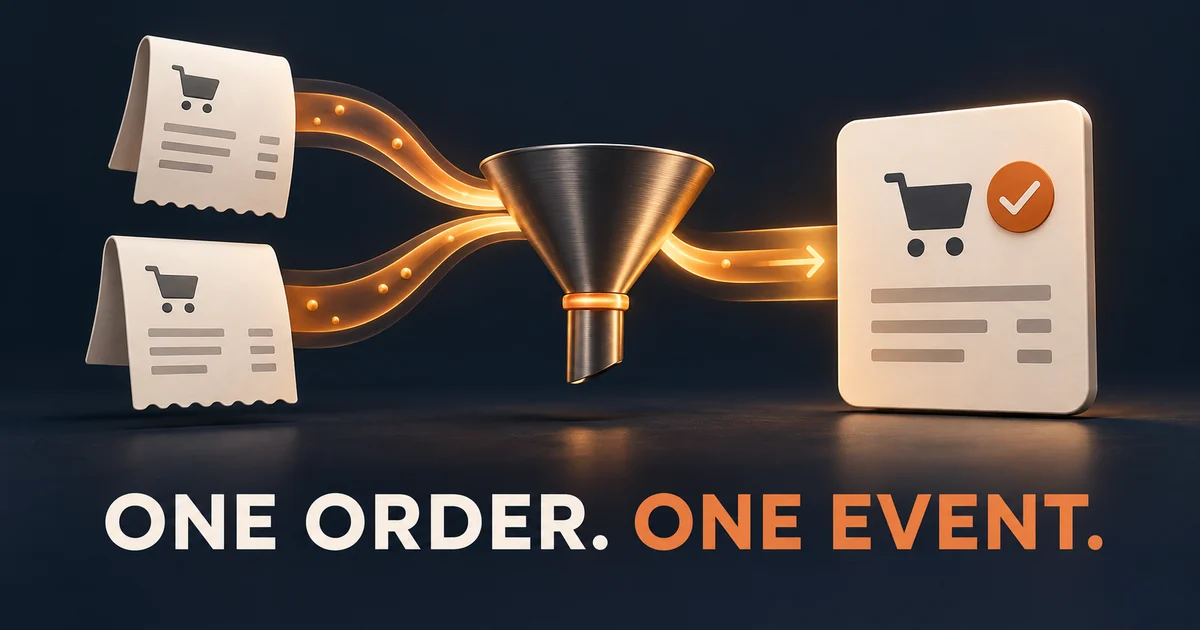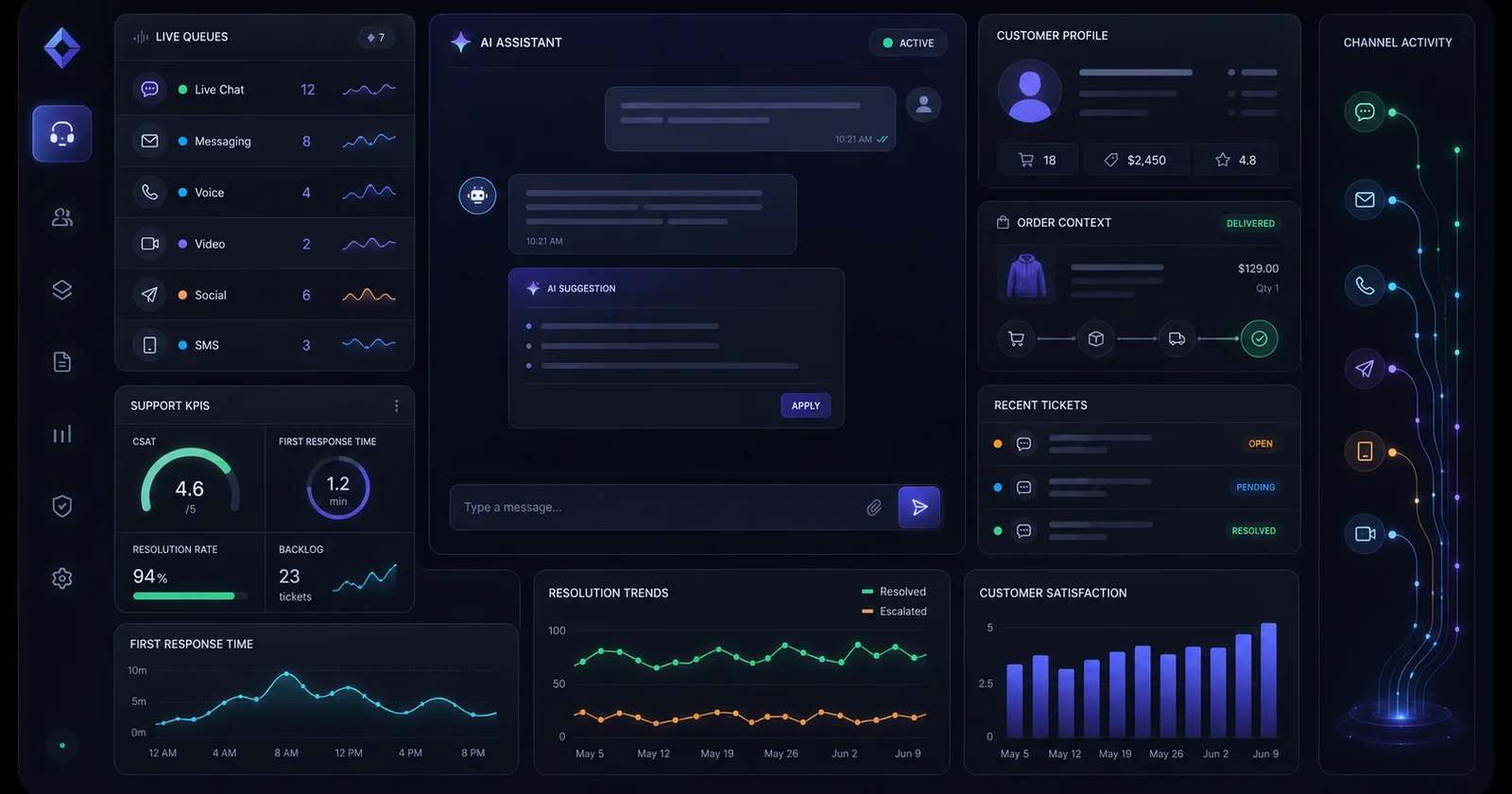
The best Shopify customer support apps connect conversations with customer and order context while matching the merchant's channels, ticket volume, and service model. After comparing 11 platforms, Gorgias leads ecommerce-native help desks, Tidio offers accessible AI chat, Shopify Inbox is the strongest free native starting point, Richpanel emphasizes self-service, and Zendesk fits complex enterprise operations.
Customer support affects revenue before and after purchase. A fast sizing answer can save a sale; a well-handled damaged delivery can preserve a high-value customer. A missed social message, contradictory return answer, or five-handoff refund creates lasting cost.
Email-only support fails with duplicate replies, unclear ownership, disconnected order context, and an unmeasurable backlog. The wrong app adds duplicate widgets, uncontrolled AI, and unexpected fees.
We evaluated implementation, chat, AI, automation, help-desk depth, knowledge, integrations, performance, price, support, scale, and merchant evidence. Pricing was checked on July 18, 2026 against official sources. Confirm the live plan and pilot your own ticket mix.
Short answer: Keep one shared conversation record. Add AI after policies are reliable, limit automation permissions, and measure quality, cost, CSAT, and repeat contacts—not deflection alone.
Understanding Shopify Customer Support
Help desk software turns messages into tickets with an owner, priority, status, and history. A shared inbox supports collaboration; ticket management adds routing, service targets, collision detection, macros, and escalation.
Live chat connects shoppers to people in real time. An AI chatbot answers or acts using approved knowledge and systems. Rules bots follow fixed branches; generative agents handle varied language but need tighter controls.
A knowledge base is a maintained library of policies, instructions, and answers. Self-service lets customers solve a need without opening a ticket—for example, tracking an order or checking a return window. Self-service should reduce effort, not hide the route to a person.
Omnichannel support combines email, web chat, Instagram, Facebook, WhatsApp, SMS, and voice into one operational record. Merely offering many channels is multichannel; keeping context and ownership when a customer moves between them is omnichannel.
Customer history connects conversations with orders, returns, subscriptions, and prior outcomes. CRM integration adds lifecycle, sales, account, and segmentation data. An electronics agent should see the customer's model before recommending a cable.
Measure the operation with consistent definitions:
- First Response Time (FRT): Time until the first meaningful human or accepted automated response.
- Resolution Time: Time from request to a solved outcome, excluding or including waiting periods according to a documented rule.
- Customer Satisfaction (CSAT): Feedback collected after an interaction. Report response rate beside the score.
- Customer Lifetime Value (LTV): Expected contribution from the relationship, not simply historical gross revenue.
- Contact rate: Support conversations per order. This reveals product, fulfillment, and policy problems that ticket totals hide.
A surge in “where is my order?” tickets may reveal vague delivery promises, weak notifications, or carrier exceptions. A good help desk exposes that cause.
How We Selected These Apps
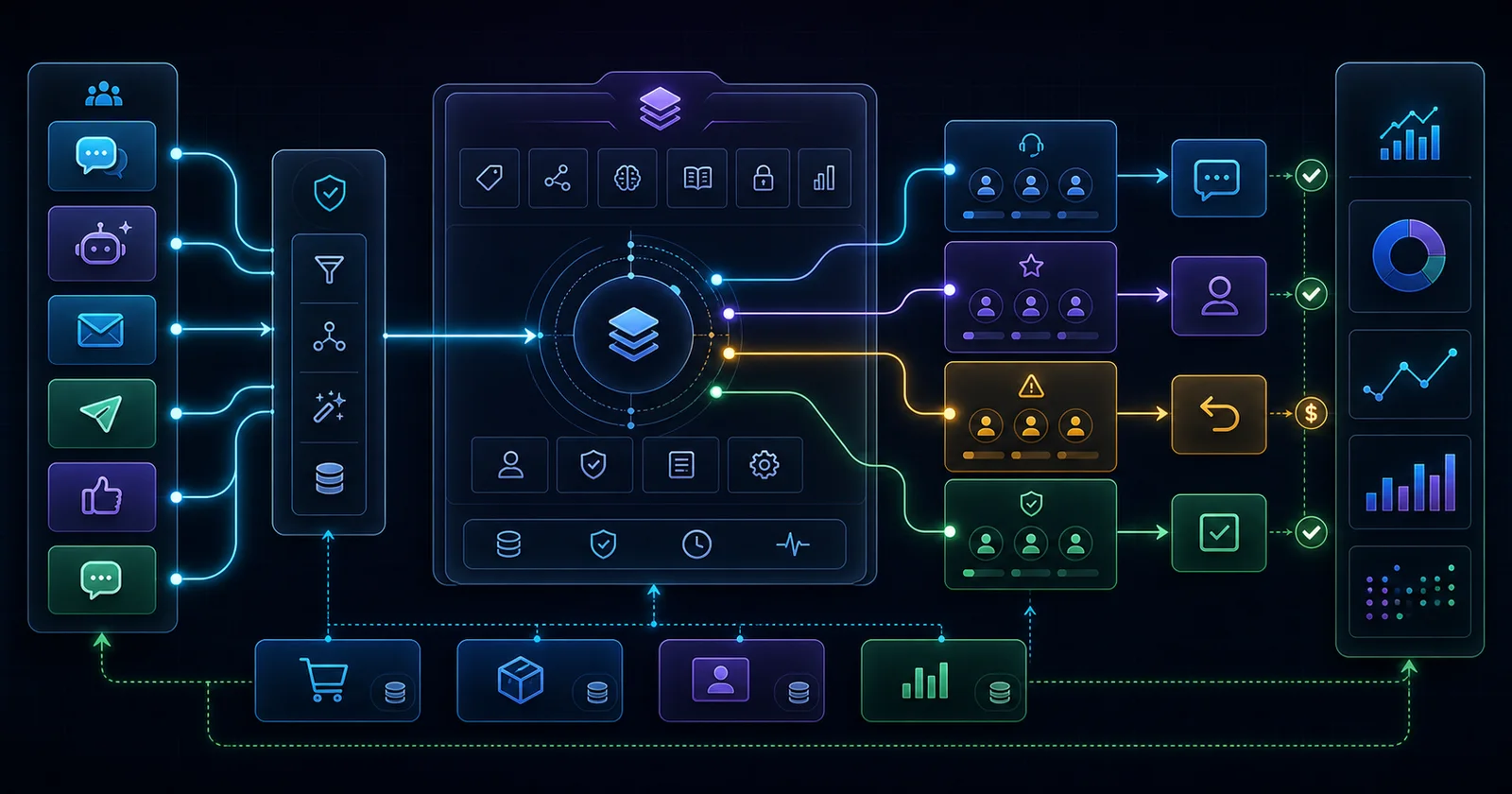
We compared practical operating requirements rather than treating app-store ratings as a complete decision.
- Service capability: Inbox, chat, AI, ticketing, knowledge, self-service, social, voice, SLAs, CSAT, and analytics.
- Shopify depth: Customer/order context, multi-store support, order actions, Flow/APIs, and permissions.
- Automation quality: Rules, routing, workflows, AI handoff, auditability, and human approval.
- Implementation: Migration, widget footprint, mobile UX, authentication, training, and administration.
- Commercial fit: Seats, tickets, AI usage, channels, add-ons, overages, contracts, and support.
- Scale and trust: Roles, SSO, residency, sandboxing, languages, APIs, CRM/ERP, and reputation.
Quick Comparison: Best Shopify Customer Support Apps
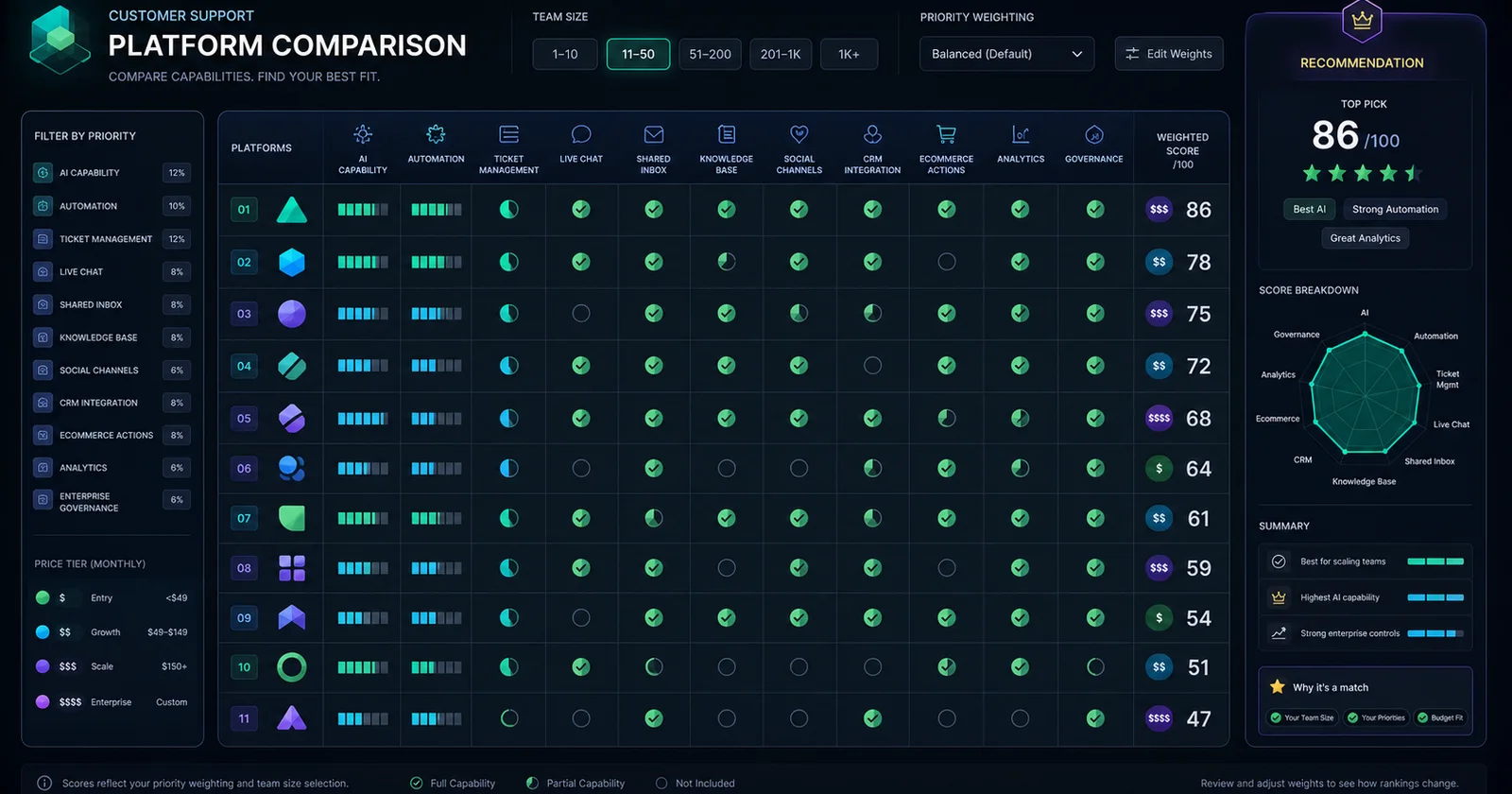
| App | Best for | Free plan | Starting price* | AI chatbot | Live chat | Shared inbox | Knowledge base | Automation | Ideal size |
|---|---|---|---|---|---|---|---|---|---|
| Shopify Inbox | Native sales chat | Yes | Free | Instant answers | Yes | Basic | No | Basic | Startup–small |
| Tidio | Accessible AI chat | Yes | $29/mo | Lyro from $39 | Yes | Yes | Limited | Strong | Startup–growing |
| Gorgias | Ecommerce help desk | No | $10/mo | Add-on | Yes | Yes | Yes | Advanced | Growing–enterprise |
| Re:amaze | Value omnichannel | No | $29/user/mo | Included allowance | Yes | Yes | FAQ | Strong | Small–mid-market |
| Richpanel | Self-service portal | Yes | $29/user/mo | AI assist | Yes | Yes | Self-service | Advanced | Growing–enterprise |
| Help Scout | Human-centered support | Yes | $25/user/mo | AI Answers | Yes | Yes | Yes | Strong | Small–mid-market |
| Freshdesk | Value help desk | No | $19/agent/mo | Included sessions | Via Omni | Yes | Yes | Advanced | Growing–enterprise |
| Zendesk | Enterprise service | No | $19/agent/mo | Usage-based | Suite | Yes | Suite | Advanced | Mid-market–enterprise |
| Intercom | AI-first messaging | No | $29/seat/mo | Fin, $0.99/outcome | Yes | Yes | Yes | Advanced | Growing–enterprise |
| Crisp | Flat-workspace chat | Yes | $45/workspace/mo | Essentials | Yes | Yes | Essentials | Strong | Startup–mid-market |
| Zoho Desk | Zoho ecosystem | Yes | Region-based | Zia/agents | Paid tiers | Yes | Standard | Advanced | Small–enterprise |
*Public USD pricing or official region-dependent pricing checked July 18, 2026. Annual commitments, AI usage, channels, overages, tax, implementation, and add-ons can materially change total cost.
Best Shopify Customer Support Apps by Function
Native Live Chat

Native Live Chat · App 01
Shopify Inbox: Best free native starting point
Best for: Startups and small stores that need lightweight sales chat with native customer, cart, and order context
Shopify Inbox is free sales chat using viewed products, cart contents, and prior orders. Agents can share products and discounts; instant answers handle common questions.
Best for and features: Startups needing simple live chat. Native context and minimal administration are advantages; it lacks full routing, SLAs, broad channels, and public knowledge. Pricing: Free. Ideal size: Startup–small. Automation and AI: Assisted replies and instant answers, not autonomous enterprise service.
Performance, use case, and limits: A solo apparel merchant can answer sizing questions and share a variant. Test launcher loading. Do not use it alone for multiple teams, heavy email, voice, or complex escalation. Expert recommendation: Validate chat demand, then migrate when ownership and reporting become limiting.
AI Chatbots and Conversational Support

AI Chatbots · App 02
Tidio: Best accessible AI chatbot
Best for: Small and growing stores automating common questions while retaining live-chat handoff
Tidio combines live chat, ticketing, social connections, visual Flows, and Lyro AI. Its free plan covers 50 live-chat users and Flows for 100 visitors monthly. Customer Service and Flows start at $29; Lyro starts at $39 for up to 200 conversations.
Best for and features: Small and growing stores automating FAQs, product questions, and order tasks. Fast setup, free entry, Shopify actions, and mobile tools are pros; separate conversation, visitor, AI, and branding allowances complicate cost. Ideal size: Startup–growing. Automation and AI: Lyro uses approved content while Flows handles fixed journeys.
Performance and use case: A skincare brand can answer ingredient questions after hours and hand allergy concerns to a person. Test mobile. Do not choose Tidio for sophisticated SLAs or workforce management. Expert recommendation: Pilot ten common intents and calculate cost per accepted AI resolution.

AI Chatbots · App 03
Intercom and Fin: Best AI-first customer messaging
Best for: Growing and enterprise digital businesses blending support, proactive messaging, knowledge, and AI outcomes
Intercom combines Messenger, inbox, ticketing, reporting, help centers, workflows, and Fin Customer Agent. In 2026, Fin can use a connected Shopify catalog for service and shopping assistance.
Best for and features: Digital businesses blending support, proactive messaging, and AI. Essential starts at $29 per seat, Advanced $85, Expert $132, plus Fin at $0.99 per outcome. Automation, multilingual knowledge, Shopify catalog awareness, and 350-plus integrations are strengths; forecast seats, outcomes, and channels. Ideal size: Growing–enterprise.
Performance and use case: A subscription brand can answer policies, recommend products, and escalate billing exceptions. Control proactive messages. Do not choose it for a simple email queue or unacceptable outcome economics. Expert recommendation: Strong when messaging is a product capability, not just an inbox.
Ecommerce-Native Help Desks

Ecommerce Help Desks · App 04
Gorgias: Best Shopify-focused help desk
Best for: Established DTC and Shopify Plus teams that need ecommerce context, order actions, automation, and broad channels
Gorgias unifies email, chat, social, voice, and SMS around ecommerce customer and order data. It supports macros, rules, self-service, analytics, Shopify Flow, 100-plus integrations, AI Agent, and AI Shopping Assistant.
Best for and features: Established DTC and Plus teams handling order actions. Starter is $10 for three agents and 50 tickets; Basic $60 for 300; Pro $360 for 2,000; Advanced $900 for 5,000, plus overages and automation. Commerce context and unlimited agents on larger plans are pros; usage cost can rise quickly. Ideal size: Growing–enterprise.
Performance and use case: A fashion team can identify a VIP, change an address, and route a return. Audit chat triggers and AI permissions. Do not choose it for complex non-commerce cases or before modeling peaks. Expert recommendation: The default Shopify-centric shortlist if governance and three-year cost pass review.

Ecommerce Help Desks · App 05
Re:amaze: Best-value omnichannel ecommerce suite
Best for: Small and mid-market merchants that want broad channel coverage, order actions, FAQ, and automation in one workspace
Re:amaze brings email, live chat, social, SMS, calls, chatbots, workflows, macros, FAQ, order actions, and AI assistance into one platform. Basic starts at $29 per staff user, Pro $49, Plus $69; a $59 Starter option covers 500 responded conversations.
Best for and features: Small and mid-market merchants wanting broad channels. Unlimited email inboxes and chatbots on Basic are attractive; AI allowances are tiered and per-user cost grows. Pro adds multi-store, SMS/VoIP, and reports; Plus adds roles, shifts, departments, CSAT, and co-browse. Ideal size: Small–mid-market.
Performance and use case: A homeware retailer can combine email, Instagram, chat, order changes, and FAQ. Test widgets and co-browse. Do not choose it for advanced workforce governance. Expert recommendation: A strong Gorgias alternative for channel breadth and small-team operation.

Ecommerce Help Desks · App 06
Richpanel: Best customer self-service portal
Best for: Growing and enterprise brands with repetitive order contacts that can be resolved through secure self-service
Richpanel combines email, chat, social, phone, automation, campaigns, and an ecommerce self-service portal that lets customers manage common order requests. It can also add self-service over Zendesk, Gorgias, Help Scout, or Salesforce.
Best for and features: Growing brands with repetitive order contacts. Free includes three seats and basic reporting; Starter is $29 per user monthly, Pro $99, with lower annual rates and custom Enterprise pricing. Self-service is the major pro; model seat and order-flow economics. Ideal size: Growing–enterprise.
Performance and use case: An accessories brand can let customers solve routine order needs while routing exceptions. Validate identity carefully. Do not choose it if volume cannot justify portal governance. Expert recommendation: Prioritize it for safe order self-service.
Human-Centered Help Desk and Knowledge

Shared Inbox & Knowledge · App 07
Help Scout: Best simple, high-quality shared inbox
Best for: Service-led small and mid-market teams that prioritize usability, maintainable knowledge, and human support
Help Scout pairs a clean shared inbox with live chat, Instagram, Messenger, WhatsApp, Docs knowledge bases, workflows, reporting, and AI. Its official Shopify integration shows customer value and orders and can edit, duplicate, cancel, or refund the most recent order.
Best for and features: Service-led teams favoring usability. Free includes five users, one inbox, and one Docs site; Standard is $25 per user monthly. Easy adoption and knowledge workflows are pros; advanced routing, governance, and AI may require upgrades. Ideal size: Small–mid-market.
Performance and use case: A furniture team can publish assembly guidance beside order context. Test Beacon on mobile. Do not choose it for intricate voice or deep commerce automation. Expert recommendation: Excellent when human service and maintainable knowledge matter most.
General Omnichannel and Enterprise Platforms

Enterprise Platforms · App 08
Freshdesk: Best-value general-purpose help desk
Best for: Growing teams that need routing, SLAs, knowledge, automation, and wider service operations at accessible seat pricing
Freshdesk offers ticketing, shared inbox, portal, knowledge, reporting, routing, SLAs, and Freddy AI. Growth is $19 per agent monthly billed annually, Pro $55, and Enterprise $89. The first 500 Freddy AI Agent sessions are listed as included; extra sessions and Copilot cost more.
Best for and features: Growing teams wanting broad depth at accessible seat pricing. Automation and enterprise controls are pros. Shopify supports multi-store order context, cancellations, and refunds, but 2026 setup uses custom-app credentials, adding work. Ideal size: Growing–enterprise.
Performance and use case: An electronics retailer can route technical tickets and involve external collaborators. Keep its widget lean. Do not expect ecommerce-first polish. Expert recommendation: Shortlist it when service extends beyond ecommerce and technical administration is available.

Enterprise Platforms · App 09
Zendesk: Best complex enterprise service platform
Best for: Multi-brand, international, voice-heavy, or regulated organizations requiring mature governance and routing
Zendesk provides mature ticketing, messaging, live chat, voice, knowledge, routing, analytics, AI agents, integrations, and enterprise governance. Support Team starts at $19 per agent annually; Suite Team is $55 and Suite Professional $115. Enterprise and AI usage require fuller commercial review.
Best for and features: Multi-brand, international, voice-heavy, or regulated operations. Permissions, SLAs, sandboxing, workforce tools, APIs, and marketplace breadth are advantages. Cost and specialist ownership are disadvantages; Shopify workflows may require integration design. Ideal size: Mid-market–enterprise.
Performance and use case: A multinational retailer can route by brand, language, skill, and SLA while connecting CRM and warehouses. Test the storefront widget separately. Do not choose it for a two-person team. Expert recommendation: Best when service is enterprise-wide and Shopify is one connected system.

Omnichannel Messaging · App 10
Crisp: Best flat workspace pricing
Best for: Cost-conscious startup and mid-market teams that want chat, omnichannel messaging, automation, and included seats
Crisp offers website chat, a shared inbox, ecommerce integrations, omnichannel messaging, automation, AI, knowledge, CRM-style profiles, and APIs. Free includes two seats; Mini is $45 per workspace for four, Essentials $95 for ten, and Plus $295 for 20-plus seats.
Best for and features: Cost-conscious teams benefiting from workspace pricing. Chat UX, multilingual tools, channels, and included seats are pros. Knowledge, advanced workflows, and AI require Essentials or Plus; credits add variable cost. Ideal size: Startup–mid-market.
Performance and use case: An international food brand can centralize chat, WhatsApp, Instagram, and translation. Defer the widget and constrain triggers. Do not choose it when Shopify order actions are central. Expert recommendation: Compare workspace cost with per-agent rivals at expected headcount.

CRM & Support Platforms · App 11
Zoho Desk: Best for the Zoho ecosystem
Best for: Small through enterprise businesses already connecting service with Zoho CRM, Analytics, Finance, or approvals
Zoho Desk provides ticketing, social support, knowledge, messaging, automation, Zia AI, telephony, departments, and multilingual help centers. A free edition supports three users; paid prices vary by region, with Express, Standard, Professional, and Enterprise tiers.
Best for and features: Businesses using Zoho CRM, Analytics, or Finance. Ecosystem breadth and automation are pros; commerce depth is less native. Its extension creates tickets from matching orders and shows recent orders. Recent 2026 feedback reports authentication problems; Zoho says it is changing the approach. Ideal size: Small–enterprise.
Performance and use case: A B2B merchant can connect support with CRM and approvals. Do not choose it until a proof verifies Shopify authentication and actions. Expert recommendation: Strong ecosystem candidate, with integration validation as a purchasing gate.
Focused Comparison Tables
Best Free Customer Support Apps
| Need | Best option | Important limit |
|---|---|---|
| Native store chat | Shopify Inbox | Not a complete help desk |
| AI/chat pilot | Tidio | Conversation and visitor allowances |
| Shared inbox and Docs | Help Scout | One inbox and one Docs site |
| Small self-service team | Richpanel | Three seats; advanced features paid |
| Two-person live chat | Crisp | No included AI credits |
| Basic email ticketing | Zoho Desk | Three users; limited channels |
Best AI Chatbots
| Use case | Recommended | Why |
|---|---|---|
| Accessible Shopify AI | Tidio Lyro | Native actions and clear entry tier |
| Ecommerce automation | Gorgias AI Agent | Order context and human handoff |
| AI-first digital service | Intercom Fin | Service, sales, knowledge, and actions |
| General help desk AI | Freshdesk Freddy | Included sessions and operational suite |
Best Live Chat Apps
| Priority | Recommended | Trade-off |
|---|---|---|
| Free and native | Shopify Inbox | Limited ticket operations |
| AI plus live agents | Tidio | Modular usage pricing |
| Flat team pricing | Crisp | Advanced features start at Essentials |
| Ecommerce omnichannel | Re:amaze | Per-user pricing |
Best Help Desk Platforms
| Business context | Recommended |
|---|---|
| Shopify-centric DTC | Gorgias |
| Human-centered service | Help Scout |
| General mid-market operations | Freshdesk |
| Complex enterprise service | Zendesk |
Best CRM Integrations
| CRM architecture | Best fit |
|---|---|
| Ecommerce lifecycle stack | Gorgias with Klaviyo and Shopify |
| Zoho operating suite | Zoho Desk |
| Broad digital customer platform | Intercom |
| Custom enterprise CRM | Zendesk or Freshdesk APIs |
Best Shopify Plus Solutions
| Plus requirement | Best fit |
|---|---|
| High-volume commerce support | Gorgias |
| Self-service order portal | Richpanel |
| Global omnichannel governance | Zendesk |
| AI shopping and service | Intercom Fin |
Best Enterprise Support Platforms
| Requirement | Platform |
|---|---|
| Multi-brand contact center | Zendesk |
| Enterprise ecommerce service | Gorgias |
| AI-led customer messaging | Intercom |
| Value-oriented enterprise desk | Freshdesk |
Common Shopify Customer Support Mistakes
Slow responses: Publish realistic hours, route urgent intents, and staff around demand; an automated receipt is not a meaningful response.
No live chat: Offer chat where product, compatibility, or delivery answers change decisions—not automatically on every page.
Poor automation: Automate a complete, observable step with ownership and an exception path, not merely a tag.
Generic chatbot replies: Ground AI in approved content and test actual customer language.
No knowledge base: Give support content owners and review dates so agents do not rewrite inconsistent answers.
Disconnected data: Define which system owns customer, order, return, subscription, and loyalty state.
Weak follow-up: Verify the promised refund, replacement, or warehouse action; ticket closure is not resolution.
Ignoring analytics: Review quality, repeat contacts, backlog age, CSAT response rate, and contacts per order together.
Decision Framework by Store Type
| Store type | Recommended starting point | Upgrade trigger |
|---|---|---|
| Startup | Shopify Inbox or Tidio | More than one owner or missed requests |
| Growing store | Gorgias, Re:amaze, or Help Scout | Multiple channels and repeat workflows |
| Fashion | Gorgias + fit/returns knowledge | Return volume and social-message growth |
| Beauty | Tidio/Gorgias + governed ingredient content | Advice risk or multilingual expansion |
| Electronics | Freshdesk + technical knowledge | Warranty, repair, and tier-two routing |
| Subscription | Gorgias or Intercom + subscription data | Churn workflows and account actions |
| International | Re:amaze, Crisp, or Zendesk | Languages, regions, SLAs, and brands |
| Shopify Plus | Gorgias or Richpanel | Custom portal, Flow, ERP, and identity needs |
| Enterprise | Zendesk, Intercom, or Freshdesk | Governance and cross-system orchestration |
Make the decision in five steps:
- Export 60–90 days of conversations; group by intent, channel, risk, and handling time.
- Define self-service, AI, human escalation, and system ownership.
- Price identical peak tickets, seats, AI usage, add-ons, and integration work.
- Pilot two options on real policies and common intents; test identity, refunds, abuse, and failure.
- Compare quality, repeats, CSAT, cost, effort, performance, and export before contracting.
Customer Support Stack by Business Size
| Stage | Typical monthly tickets | Team | Recommended ecosystem | Complexity | Move when… |
|---|---|---|---|---|---|
| Startup | Under 500 | 1–2 | Tidio + Shopify Inbox + FAQ page | Low | Ownership, history, or coverage breaks |
| Growing store | 500–3,000 | 2–8 | Gorgias + Klaviyo + Judge.me + AI chatbot | Medium | Routing, cost, or specialist queues strain |
| High-volume brand | 3,000–20,000 | 8–40 | Zendesk + Intercom/Fin + CRM + automation | High | Multi-brand, regions, or proprietary actions emerge |
| Plus enterprise | 20,000+ | 30+ | Custom AI assistant + Gorgias/Zendesk + ERP + Flow + portal | Enterprise | Architecture is redesigned continuously |
These are planning ranges. Technical products can generate fewer but harder tickets than fashion. Move when the system cannot maintain ownership, quality, governance, and acceptable cost.
Custom development wins when agents repeatedly bridge one data gap, customers need unavailable secure self-service, or overlapping subscriptions cost more than one governed integration. Shopify automation can connect service outcomes to fulfillment; Shopify AI solutions should include evaluation and human escalation.
When Custom Customer Experience Development Is Better
Custom work becomes appropriate when service is differentiated or tightly connected to private systems.
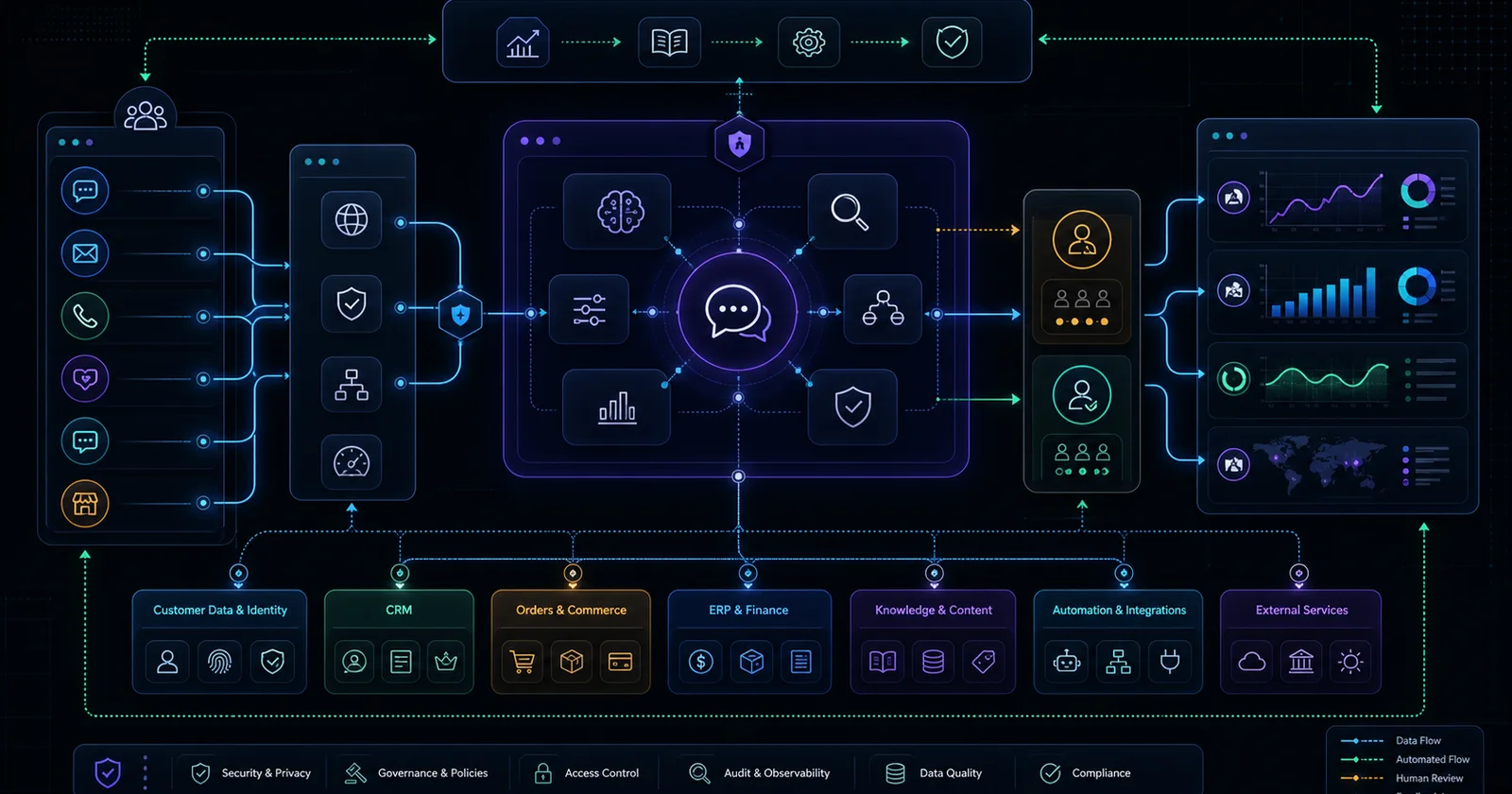
- Private AI assistants: Proprietary knowledge, controlled retrieval, regional rules, or private models.
- CRM and ERP integration: Real-time warranty, fulfillment, returns, repair, inventory, or account status.
- Customer portals: Authenticated orders, claims, subscriptions, B2B permissions, and approvals.
- Custom help centers: Product troubleshooting, multilingual content, search, and personalization.
- APIs and dashboards: Governed actions, quality review, contact drivers, and reporting.
- Shopify Flow: Tasks, escalations, notifications, and post-resolution follow-up.
- Headless CX: Consistent support across custom web, mobile, kiosk, or account surfaces.
AreoTech's Shopify development team maps service journeys, builds apps and APIs, connects CRM/ERP systems, and implements controlled AI. The right project may be a small integration, not a replacement. Review ecommerce work or use the contact page.
For adjacent planning, compare Shopify AI apps, Shopify automation workflows, and our guide to Shopify upsell and CRO apps. Shopify Plus and custom app development can unify these layers when separate tools create conflicting customer journeys.
Customer Support Best Practices
Be proactive. Put delivery, sizing, compatibility, and returns where customers decide. Target genuine exceptions instead of showing indiscriminate pop-ups.
Automate certainty; escalate judgment. Bots can track orders or explain policies. People should handle safety, payment disputes, ambiguous warranties, high-value exceptions, and emotion.
Operate knowledge continuously. Assign owners and review dates, analyze failed searches, and update changes. One approved source should guide customers, AI, and agents.
Use human review. Start in suggestion mode, test with real tickets, measure unsupported statements and repeats, then expand autonomy by intent.
Segment service deliberately. Route by language, product, account tier, risk, and complexity without making standard customers feel deliberately ignored. Priority should reflect business promise and customer need.
Balance KPIs. Pair FRT with resolution and reopens; AI containment with quality and CSAT; productivity with escalation outcomes.
Close the operational loop. Support data should improve product descriptions, packaging, carrier choices, onboarding, and policies. The cheapest ticket is the one a corrected experience prevents.
Frequently Asked Questions
What is the best Shopify customer support app in 2026?
Gorgias is the strongest ecommerce-native choice for established brands. Tidio leads accessible AI, Zendesk fits enterprise service, and Shopify Inbox is the free native starting point.
What is the best free customer support app for Shopify?
Shopify Inbox is the best free native option. Other free tiers limit conversations, seats, channels, automation, or orders.
Does Shopify have built-in customer support software?
Yes: Shopify Inbox provides free storefront messaging. It has customer context and reply assistance, but is not a complete omnichannel help desk.
Which Shopify app has the best AI chatbot?
It depends on scale. Tidio Lyro suits smaller stores, Gorgias AI Agent ecommerce teams, and Intercom Fin AI-first digital service.
Is Gorgias better than Zendesk for Shopify?
Gorgias usually wins Shopify-centric support; Zendesk wins complex enterprise service. Compare commerce actions against governance, voice, and routing.
Can an AI chatbot cancel or refund a Shopify order?
Some can. Require identity checks, eligibility rules, value limits, logs, and human approval for risky actions.
How much does Shopify customer support software cost?
It ranges from free to thousands monthly. Calculate seats, tickets, AI usage, channels, overages, integrations, and implementation.
When should a store move from email to a help desk?
Move when ownership breaks down. Duplicate replies, missed messages, fragmented history, and unmeasurable response time are clear signals.
What support metrics should Shopify merchants track?
Track FRT, resolution time, backlog age, reopens, CSAT, contacts per order, AI quality, and cost. Add repeat purchasing to connect service with retention.
Can Shopify support apps slow down a store?
Yes, widgets can affect performance. Test mobile, defer scripts, reduce triggers, and remove duplicate tools. Our Shopify maintenance service can audit overhead.
What is omnichannel customer support?
It preserves context across channels in one record. Channels should share ownership, history, routing, and reporting.
Do I need a knowledge base if I have AI?
Yes. Maintained knowledge enables self-service and grounds AI; a model cannot repair contradictory policy.
How should I implement an AI support agent safely?
Begin with low-risk intents and limited actions. Test real tickets, define escalation, review transcripts, and expand after quality thresholds are met.
Which customer support app is best for Shopify Plus?
Gorgias fits commerce-led Plus teams; Zendesk and Intercom fit broader enterprise operations. Richpanel fits authenticated order self-service.
When is a custom Shopify support solution better?
Choose custom when apps cannot represent secure data, identity, portals, ERP/CRM actions, B2B permissions, or headless experiences. Build only the differentiated layer.
Key Takeaways and Decision Matrix
- Start with Shopify Inbox for native chat, Tidio for accessible AI, Gorgias for ecommerce help desk, Richpanel for self-service, and Help Scout for knowledge-led service.
- Choose Freshdesk for general operations, Zendesk for enterprise, Intercom for AI-first messaging, Crisp for workspace economics, and Zoho Desk for a verified Zoho stack.
- A help desk cannot repair unclear policies, inaccurate orders, weak fulfillment communication, or ownerless escalation.
- Model normal and peak cost; AI usage and ticket overages can exceed the headline subscription.
- Pilot real conversations with controlled permissions before migrating every channel.
| Business size | Operational complexity | Primary goal | Recommended direction |
|---|---|---|---|
| Solo/startup | Low | Answer shoppers quickly | Shopify Inbox or Tidio |
| Small team | Low–medium | Shared ownership and knowledge | Help Scout, Re:amaze, or Crisp |
| Growing brand | Medium | Ecommerce automation | Gorgias or Richpanel |
| Mid-market | Medium–high | Routing, SLAs, multiple teams | Freshdesk, Gorgias, or Intercom |
| Shopify Plus | High | Commerce actions and self-service | Gorgias/Richpanel + Flow/integrations |
| Enterprise | Very high | Global governance and connected service | Zendesk/Intercom + custom architecture |
Conclusion
The best platform is the one your team can operate consistently: one customer history, reliable ownership, approved knowledge, safe automation, human escalation, and analytics that expose contact causes.
Start with the smallest stack solving a measured problem. Prove quality, effort, cost, and retention before adding automation or custom architecture.
If you need Shopify development, Shopify Plus architecture, AI customer support, automation, CRM integration, a custom AI chatbot, customer portals, or API development, contact AreoTech for an implementation-focused assessment. AreoTech can also support custom Shopify app development, performance optimization and maintenance, and the integration work that turns a help desk into a reliable customer experience system.