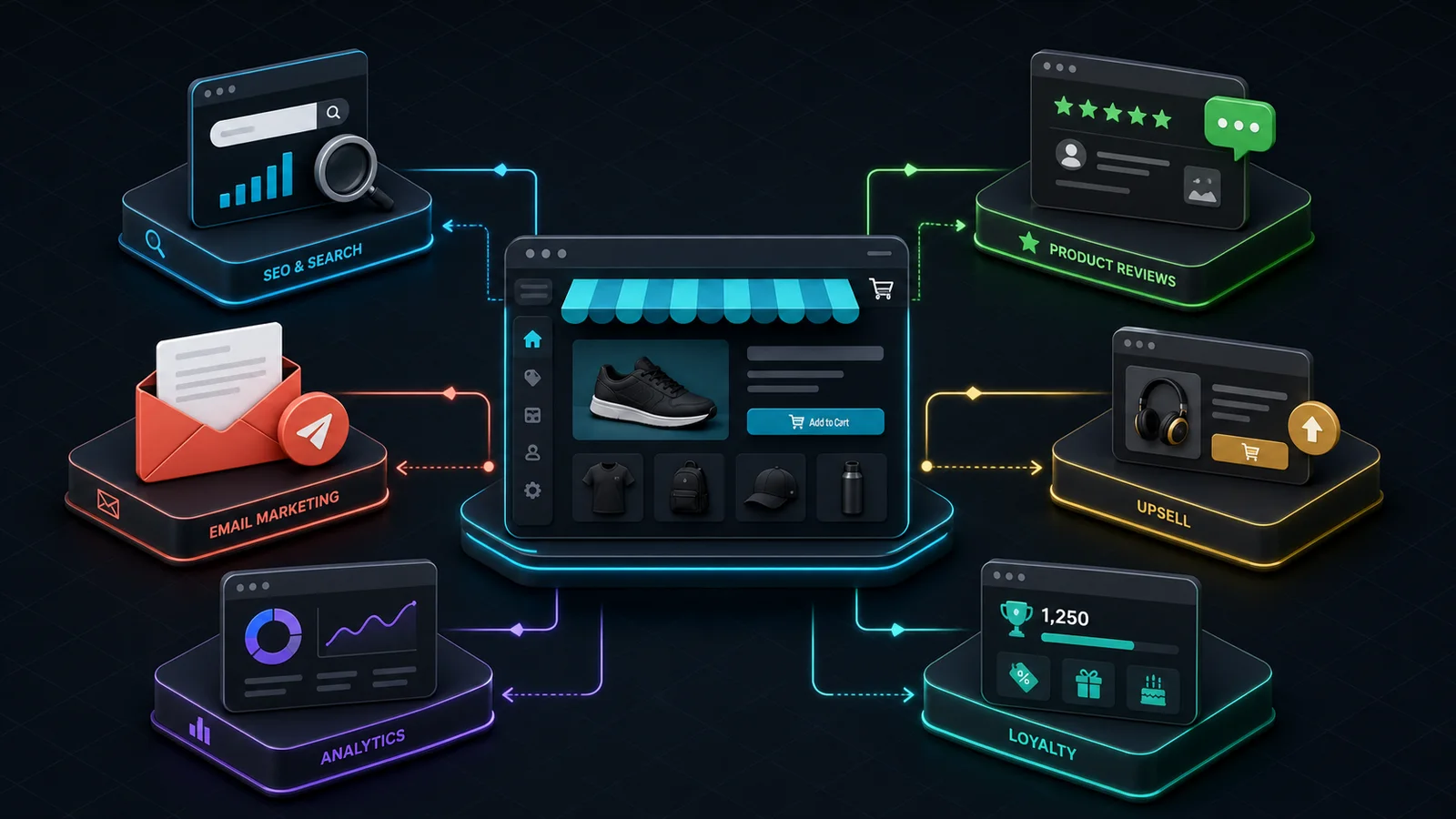
The best Shopify AI apps are the ones that improve a specific commercial outcome without weakening customer trust, site performance, or data control. For most merchants, that means starting with Shopify Magic and Sidekick, then adding one specialist platform: Tidio or Gorgias for support, Rebuy or Nosto for personalization, Klaviyo for lifecycle marketing, Boost or Athos for discovery, and MESA for cross-system automation.
AI is changing ecommerce because it can interpret language, images, behavior, and operational signals at a scale that manual teams cannot match. A good system can help a shopper find a compatible part, draft a support response using live order context, recommend the next product, identify an at-risk customer, or route a refund exception before an employee opens a spreadsheet.
However, an AI feature is not the same as an AI-first product. A conventional app may add a text generator to an existing workflow. An AI-first platform uses models, feedback, and business context throughout the decision loop. Neither category is automatically better. A small, reliable AI feature inside Shopify may create more value than a sophisticated platform the team never configures correctly.
The most common implementation mistake is buying a tool before defining the decision it should improve. Merchants then automate inaccurate catalog data, publish unsupported claims, let two apps personalize the same placement, or measure vendor-attributed revenue instead of incremental gross profit. AI does not repair a weak workflow; it makes that workflow run faster.
This guide evaluates 15 current platforms across business impact, AI depth, Shopify integration, automation, performance, price, support, scale, security, merchant evidence, innovation, and realistic ROI. Prices and availability were checked on July 18, 2026 using official Shopify App Store listings and vendor pages. Plans, usage limits, and feature access change, so confirm the live offer and run a controlled pilot before committing.
Short answer: Use Shopify Magic and Sidekick first. Choose Tidio for accessible AI chat, Gorgias for ecommerce helpdesk automation, Rebuy for Shopify-native recommendations, Nosto for enterprise personalization, Klaviyo for lifecycle marketing, Predis.ai for social production, SEOWILL for assisted SEO operations, Photoroom for catalog imagery, Boost for an accessible search upgrade, Algolia for developer-led search, Athos for enterprise discovery, Octane AI for guided selling, Jasper for governed brand content, and MESA for workflow orchestration.
Understanding AI in Shopify
AI is an umbrella term. Merchants make better buying decisions when they understand which capability is doing the work.
Generative AI creates new text, images, code, or structured outputs from instructions and context. In Shopify, it can draft a product description from attributes, generate a campaign variation, remove an image background, or summarize customer feedback. Generation is probabilistic, so the output must be checked against source data.
Machine learning finds patterns in historical examples and improves a prediction or ranking. A recommendation model may learn that customers who buy a running shoe often add a certain sock, while accounting for availability and recent behavior. Machine learning is broader than generative AI and often works without producing words.
Predictive analytics estimates a future outcome such as purchase probability, customer lifetime value, churn risk, demand, or next order date. A beauty brand could create a replenishment campaign when the predicted reorder window for a serum approaches. Predictions are decision aids, not facts.
Recommendation engines rank products for a shopper, page, cart, or context. Collaborative filtering uses patterns across people; content-based models use product attributes; hybrid systems combine both with rules such as margin, stock, compatibility, or exclusions. The business test is incremental profit—not the number of recommendation impressions.
Conversational AI interprets and responds in natural language through chat, email, voice, or messaging. A strong Shopify implementation can answer a sizing question, retrieve an order, initiate a return, recommend a product, and hand the full context to a person when confidence is low.
AI automation combines a model decision with an action. Classifying a support ticket is AI; tagging the customer, creating a return task, notifying a warehouse, and recording the result is automation. Production systems need permissions, retries, audit logs, and a recovery path.
AI search attempts to understand shopper intent rather than match only literal keywords. It can connect “waterproof jacket for humid hiking” to suitable products even if the exact phrase is absent. Search quality still depends on complete product attributes, synonyms, inventory, analytics, and merchandising rules.
AI merchandising decides how products should be ordered, boosted, buried, or grouped across search and collections. A useful system balances relevance with business constraints. Blindly boosting high-margin items can reduce conversion if they are less appropriate for the shopper.
Natural language processing (NLP) extracts meaning from written or spoken language. Ecommerce uses include sentiment analysis, intent classification, attribute extraction, translation support, review summarization, and routing “my parcel arrived damaged” differently from “where is my parcel?”
Computer vision interprets images and video. It can remove backgrounds, generate product scenes, detect image quality issues, support visual search, or help match a foundation shade. Generated visuals must not misrepresent fit, color, material, scale, included accessories, or product function.
The practical distinction is simple: generative AI creates, predictive AI estimates, recommendation and search models rank, conversational AI interacts, and automation changes something in the business. The best Shopify AI software often combines several of these capabilities.
How We Selected These Apps
We organized the shortlist by business function rather than publishing a generic ranking. Each platform was assessed against the following criteria:
- Business impact: Does it influence revenue, margin, service quality, speed, or operating cost?
- AI capability: Is AI central to the outcome, and can the merchant understand or constrain it?
- Ease of implementation: Can a competent team reach value without an excessive integration project?
- Shopify integration: Does it use the right catalog, customer, order, checkout, theme, and automation context?
- Automation: Can an insight trigger a governed action, or does it only create suggestions?
- Performance: What storefront scripts, widgets, index replacements, pixels, or network calls are introduced?
- Pricing: Are subscription, usage, contact, ticket, search, GMV, credit, and service costs understandable?
- Customer support: Is onboarding appropriate for the operational risk and plan level?
- Scalability: Can it handle larger catalogs, traffic peaks, regions, languages, teams, and permissions?
- Security: Are permissions, data handling, subprocessors, access controls, and enterprise options reviewable?
- Merchant reviews: Do current reviews reveal recurring support, billing, reliability, or usability patterns?
- Innovation: Does the platform solve a meaningful commerce problem rather than add an AI label?
- ROI: Can impact be tested against a baseline and expressed as incremental gross profit or cost saved?
No platform earned a recommendation merely because it uses a large language model. We favored tools with a clear ecommerce job, operational controls, credible Shopify connectivity, and a measurable feedback loop.
Quick Comparison: Best Shopify AI Apps for 2026
| App | Primary use case | Starting price* | Free plan | AI features | Automation | Shopify integration | Best for | Ideal business size |
|---|---|---|---|---|---|---|---|---|
| Shopify Magic + Sidekick | Native content and admin assistance | Included | Yes** | Text, media, insights, assistant | Medium | Native | First AI layer | All sizes |
| Jasper | Governed brand content | $69/mo | No | Brand voice, agents, generation | Medium | Manual/API | Content teams | Growing–enterprise |
| Tidio + Lyro | Chat and support | Free; Lyro $39/mo | Yes | Conversational AI, reply assist | Strong | Native actions | Accessible AI support | Startup–mid-market |
| Gorgias | Ecommerce helpdesk and AI agent | $10/mo + AI usage | No | AI resolution, recommendations, actions | Advanced | Deep | Established support teams | Growing–enterprise |
| Rebuy | Recommendations and upsells | $25/mo | Limited | Recommendations, search, personalization | Advanced | Deep | AOV and merchandising | Growing–enterprise |
| Nosto | Commerce personalization | Quote | No | Search, recommendations, segmentation | Advanced | Deep | Unified enterprise experience | Mid-market–enterprise |
| Klaviyo | Lifecycle marketing | Free; email $20/mo | Yes | Predictive analytics, content, segments | Advanced | Deep | Email, SMS, retention | Startup–enterprise |
| Predis.ai | Social content and publishing | $32/mo | No | Images, video, ads, captions | Strong | Product-led | Lean social teams | Startup–mid-market |
| SEOWILL | SEO operations and AI blogs | Free | Yes | Content, metadata, audits | Strong | Native | Assisted Shopify SEO | Startup–mid-market |
| Photoroom | Product image production | Free | Yes | Backgrounds, virtual models, bulk edits | Strong | Catalog import/export | Catalog visual consistency | Startup–mid-market |
| Boost AI Search | Search, filters, recommendations | $29/mo | No | Semantic search, personalization | Advanced | Deep | Accessible discovery upgrade | Small–enterprise |
| Algolia | Developer-led AI search | Usage-based | Limited allowance | AI ranking, synonyms, categorization | Advanced | App/API | Complex headless search | Mid-market–enterprise |
| Athos (formerly Searchspring) | Unified discovery and merchandising | Quote | No | Search, personalization, AI insights | Advanced | Deep | Merchandising-led brands | Mid-market–enterprise |
| Octane AI | Quizzes and guided selling | $50/mo | No | Quiz copy, image analysis, recommendations | Strong | Deep | Beauty, wellness, considered purchases | Growing–enterprise |
| MESA | Workflow automation | $12/mo | No | Natural-language build, AI agents/workflows | Advanced | Deep | Cross-app operations | Startup–enterprise |
*Public USD pricing checked July 18, 2026. Quote-based, usage-based, and “free to install” products may require a paid external contract. **Shopify Magic has no separate fee, but operating a store still requires an eligible Shopify subscription and feature availability varies.
Best Shopify AI Apps by Business Function

Native AI 01
Shopify Magic and Sidekick: Best native AI foundation
Best for: Every Shopify merchant that wants content, media, analysis, and admin assistance before adding specialist AI software
Shopify Magic and Sidekick are the best starting point because they work inside the Shopify context merchants already use. Magic covers text and media generation, messaging assistance, segmentation, review summaries, and other features; Sidekick is the conversational commerce assistant for admin tasks and analysis.
Best for and key features: Every merchant should evaluate the native layer before paying for a duplicate content tool. Useful capabilities include product and page copy, email drafting, image background work, theme assistance, segment creation, store-context answers, and administrative support. The AI capability is broad generative assistance rather than a specialist recommendation or helpdesk engine.
Pricing, automation, and performance: Shopify states that Magic experiences are available without an additional charge across subscription plans, although features vary. Because most work happens in the admin, storefront impact is generally low. Automation depth is moderate: it accelerates tasks, but Shopify Flow or another orchestration layer is still needed for event-driven workflows.
Pros: Native context, low adoption friction, no extra app subscription, and limited storefront overhead. Cons: Feature availability varies, specialist controls are lighter, and generated output still needs review. Ideal size: Any size, especially startups and lean teams.
Real-world use case: A merchant can ask Sidekick to identify a weak-selling collection, draft a campaign direction, use Magic to create product copy variations, and have a merchandiser approve the final changes.
Limitations and when not to choose it: Do not treat native AI as a replacement for an enterprise helpdesk, search engine, experimentation platform, or governed content operation. Expert recommendation: Establish brand prompts, approval rules, and baseline metrics with Magic first; buy a specialist app only where the native layer cannot reach the target outcome.

AI Platform 02
Jasper: Best for governed brand content
Best for: Growing and enterprise content teams producing on-brand product, campaign, and lifecycle content across channels
Jasper is a marketing-focused generative AI platform for teams that need reusable brand voice, knowledge, audiences, campaign production, and governed content workflows across channels. It is included because many Shopify content teams use it around the store, not because it is a one-click Shopify catalog app.
Best for and key features: Growing and enterprise content teams producing product narratives, landing pages, ads, lifecycle campaigns, localization drafts, and content briefs. Key features include brand voice, knowledge assets, audiences, marketing agents, Canvas, browser extensions, and API access on Business plans.
Pricing, automation, and performance: Pro is $69 per month per seat monthly or $59 billed annually; Business is custom-priced and adds deeper governance and API access. Shopify integration is light on Pro—usually copy/paste, extension, Zapier/Make, or a reviewed import—and stronger only with a custom API workflow. It adds no storefront script unless a separate integration does so.
Pros: Strong brand controls and multi-channel marketing workflow. Cons: No native Shopify catalog publishing workflow, a higher cost than native Magic, and the risk of scaling repetitive content. Ideal size: Growing brands through enterprise.
Real-world use case: A global homeware brand can turn an approved product fact sheet into a PDP narrative, paid-social variants, email copy, and retailer descriptions while keeping voice guidance consistent.
Limitations and when not to choose it: Do not choose Jasper solely to write occasional descriptions; Shopify Magic may be sufficient. Expert recommendation: Use Jasper when governance and cross-channel reuse—not raw word volume—justify a dedicated content system.

App 03
Tidio with Lyro AI: Best accessible AI chatbot
Best for: Startups and growing stores that want AI support, live chat, ticketing, and Shopify actions without a full enterprise helpdesk
Tidio Live Chat and Lyro AI combines chat, ticketing, visual flows, an AI reply assistant, and a conversational AI agent that can use website content and perform native Shopify actions.
Best for and key features: Startups and growing stores that want faster answers without implementing a full ecommerce helpdesk. Lyro can answer common questions, handle conversational tasks, use Shopify context, and escalate to people; Tidio also provides live chat, ticketing, automation flows, and analytics.
Pricing, automation, and performance: A free plan covers limited live chat and flows. Customer Service and Flows start at $29 per month; Lyro starts at $39 per month for 200 AI conversations. The widget is customer-facing, so measure loading behavior, interaction delay, and duplicate tracking. Automation is strong for common questions and lead capture but lighter than a complex helpdesk action framework.
Pros: Accessible pricing, quick launch, combined live chat and AI, and a current 4.7 App Store rating at verification. Cons: Conversation limits and separate modules can complicate cost; knowledge quality determines answer quality. Ideal size: Startup to mid-market.
Real-world use case: A footwear store can answer delivery, care, and sizing questions immediately, collect an email when a shopper needs follow-up, and transfer an exchange exception to a person with the conversation attached.
Limitations and when not to choose it: Avoid it as the sole service platform if you need sophisticated omnichannel routing, deep subscription edits, complex returns, or enterprise quality controls. Expert recommendation: It is the strongest low-friction AI chatbot Shopify merchants should pilot before moving to a heavier support stack.

App 04
Gorgias AI Agent: Best ecommerce AI helpdesk
Best for: Established DTC and Shopify Plus teams that need omnichannel support, commerce actions, automation, and reliable human escalation
Gorgias is an ecommerce helpdesk with an AI Agent that works across support and pre-purchase conversations. It brings customer, order, product, and channel context together so automation can do more than generate a polite answer.
Best for and key features: Established DTC brands with meaningful ticket volume. Features include email, chat, social and optional voice/SMS channels, macros, rules, help center, Shopify order actions, AI answers, returns and refunds, order or subscription changes, product recommendations, and human escalation.
Pricing, automation, and performance: The App Store helpdesk starts at $10 per month, while practical plans scale by tickets. Gorgias pricing lists AI Agent interactions separately—generally $1 per resolved interaction monthly or $0.90 on annual plans, with overages and helpdesk ticket treatment to model. The storefront chat widget and related tracking require performance testing.
Pros: Deep Shopify context, outcome-oriented automation, ecommerce actions, and a unified agent workspace. Cons: Ticket and AI-resolution pricing needs careful modeling; setup and knowledge governance are more demanding than a basic chatbot. Ideal size: Growing brand to enterprise.
Real-world use case: A subscription skincare brand can let AI track orders, explain routines, recommend a complementary product, initiate eligible returns, and route adverse-reaction messages directly to a trained human queue.
Limitations and when not to choose it: It is expensive for a very low-volume store and unsafe to deploy broadly without escalation policies. Expert recommendation: Choose Gorgias when service data and commerce actions belong in one operational system, then expand automation by intent after reviewing resolution quality.

App 05
Rebuy Personalization Engine: Best Shopify-native recommendations
Best for: Growing and enterprise merchants optimizing recommendations, cart, checkout, post-purchase offers, search, and merchandising
Rebuy Personalization Engine personalizes cart, checkout, post-purchase, product discovery, collections, and offers through recommendations, merchandising, flows, and experimentation.
Best for and key features: Shopify brands with sufficient traffic and order volume to test AOV, conversion, and repeat-purchase improvements. Key tools include Smart Cart, AI recommendations, checkout and post-purchase offers, personalized search, collection merchandising, re-order pages, flows, and A/B testing.
Pricing, automation, and performance: Paid packages start at $25 per month and scale with order volume and selected capabilities; Rebuy Monetize and development-store options have separate terms. Integration is deep across theme, cart, checkout, customer accounts, Markets, inventory, and Shopify Flow. Because the app can touch multiple purchase surfaces, script weight and interaction stability need disciplined QA.
Pros: Broad Shopify-specific personalization and experimentation across the funnel. Cons: Revenue attribution can overstate incrementality, order-based pricing rises with scale, and overlapping cart or upsell apps create conflicts. Ideal size: Growing to enterprise.
Real-world use case: A nutrition brand can recommend a shaker on the PDP, a compatible flavor in cart, a one-click subscription after purchase, and suppress suggestions for products already owned.
Limitations and when not to choose it: A low-traffic store may lack enough data to learn or test reliably. Expert recommendation: Give Rebuy exclusive ownership of defined placements, create a holdout, and optimize for incremental gross profit after discount and return cost.

App 06
Nosto: Best enterprise personalization platform
Best for: Mid-market and enterprise brands unifying search, recommendations, merchandising, audience insights, and content personalization
Nosto AI Search and Discovery is an enterprise commerce experience platform spanning search, recommendations, merchandising, segmentation, and content personalization.
Best for and key features: Mid-market and enterprise brands that want one personalization layer across many shopper touchpoints, regions, and campaigns. Capabilities include AI search, personalized recommendations, audience insights, merchandising, bundles, behavioral analytics, multi-language, multi-currency, and custom rules.
Pricing, automation, and performance: The app is free to install, but a paid Nosto account is required and pricing is quote-based. Implementation can replace or influence search, collection, recommendation, and content surfaces; performance and fallback behavior must be tested at peak traffic. Automation is advanced, with human merchandising controls layered over model decisions.
Pros: Broad experience orchestration and enterprise depth. Cons: Quote-based cost, implementation complexity, and a larger data footprint than a single-purpose app. Ideal size: Mid-market to enterprise.
Real-world use case: An international fashion retailer can personalize category ranking by region and behavior, recommend weather-relevant products, and keep global exclusions for stock, markdown, and campaign rules.
Limitations and when not to choose it: Do not buy an enterprise personalization suite when the real problem is poor product data or a broken navigation structure. Expert recommendation: Choose Nosto when the business can fund experimentation, merchandising ownership, and multi-market governance—not only software access.

App 07
Klaviyo: Best AI lifecycle marketing platform
Best for: Shopify merchants using customer and catalog data to personalize email, SMS, WhatsApp, push, forms, and automated retention journeys
Klaviyo Email Marketing and SMS is the strongest lifecycle platform in this guide. It combines Shopify events and catalog data with segmentation, predictive analytics, product recommendations, content assistance, send optimization, and automated flows across email, SMS, WhatsApp, push, forms, and customer experiences.
Best for and key features: Merchants that want retention and customer data in one marketing system. AI features include campaign generation, predictive customer measures, natural-language segmentation, product recommendations, send-time optimization, deliverability assistance, and newer agent-led workflows.
Pricing, automation, and performance: The free plan supports up to 250 email contacts and limited SMS credits. Email starts at $20 per month for 251–500 contacts; SMS starts at $15 for a listed credit tier and grows with usage. Shopify integration is deep and near-real-time. Forms, tracking, and on-site customer features add scripts, so audit consent, event duplication, and Core Web Vitals.
Pros: Strong data activation, mature flows, broad channels, and excellent segmentation depth. Cons: Cost grows with active profiles and messages; poor list hygiene and excessive flows can make the platform expensive and noisy. Ideal size: Startup to enterprise.
Real-world use case: A coffee brand can predict replenishment windows, segment high-value subscribers, recommend the next roast, adjust send time, and suppress customers with an open support issue.
Limitations and when not to choose it: It is not a substitute for a warehouse, CDP strategy, or human campaign planning. Expert recommendation: Build a small set of high-value flows first, maintain consent and profile hygiene, and measure contribution margin per recipient.

App 08
Predis.ai: Best for AI social content production
Best for: Lean ecommerce marketing teams creating and scheduling product-led social images, videos, ads, and captions across channels
Predis Social Media Auto Post creates images, product videos, UGC-style videos, ads, captions, and scheduled social posts using Shopify product inputs and brand assets.
Best for and key features: Lean marketing teams that need consistent social production across Instagram, Facebook, TikTok, YouTube, Pinterest, X, and Google Business Profile. It supports templates, competitor analysis, editing, scheduling, product-led creative, and automatic publishing on eligible plans.
Pricing, automation, and performance: Core starts at $32 per month with one store and credits; Rise starts at $79 and adds more stores, credits, and automatic posting. Most work happens off-store, so storefront impact is minimal. Automation depth is strong for production and distribution, while strategic planning and product truth remain human responsibilities.
Pros: One workflow from product data to creative and publishing. Cons: Credit consumption can be unpredictable, generated visuals may misrepresent products, and high-volume output can dilute brand quality. Ideal size: Startup to mid-market.
Real-world use case: A small accessories brand can turn a new Shopify collection into channel-specific teaser posts, short product videos, captions, and a reviewed two-week publishing calendar.
Limitations and when not to choose it: Do not use it for regulated claims, accurate demonstrations, or “UGC” that could deceive shoppers about a real customer endorsement. Expert recommendation: Treat it as a production assistant with a visual fact-check and approval queue, not an autonomous social strategist.

App 09
SEOWILL (formerly SEOAnt): Best assisted Shopify SEO workflow
Best for: Small and growing merchants that need technical audits, metadata, image optimization, structured data, and reviewed AI content drafts
SEOWILL AI SEO and AI Blog Post, formerly SEOAnt, combines Shopify SEO audits, metadata and alt-text assistance, structured data, broken-link workflows, image optimization, keyword tools, and AI blog production.
Best for and key features: Small and growing merchants that need an operational SEO checklist inside Shopify. It can surface technical issues, bulk-edit metadata, create structured data, generate draft content, compress images, track rankings on higher tiers, and assist with newer AI-search files and workflows.
Pricing, automation, and performance: The free plan includes limited audits, image work, and AI credits. Pro is $29.99 per month; Premium is $59.99. Automation is strong for repetitive metadata and maintenance. Speed features and injected schema must be tested because duplicate structured data or aggressive script changes can create new problems.
Pros: Broad features, a useful free entry point, Built for Shopify status, and a large merchant-review base. Cons: No app can guarantee rankings, bulk AI content can become thin, and automatic schema may conflict with the theme. Ideal size: Startup to mid-market.
Real-world use case: A home-goods merchant can find missing titles and alt text, repair broken URLs, compress oversized images, and use AI to draft a buying guide that an expert editor finishes.
Limitations and when not to choose it: Avoid one-click publication of hundreds of AI pages and do not use llms.txt as a substitute for crawlable, useful content and valid structured data. Expert recommendation: Use SEOWILL as an audit and workflow layer under a real Shopify SEO strategy.

App 10
Photoroom AI Listing Assistant: Best for catalog image production
Best for: Startup and mid-market catalog teams that need consistent backgrounds, virtual models, bulk image edits, and direct Shopify publishing
Photoroom AI Listing Assistant connects to the product catalog so merchants can generate and edit visuals in bulk, then publish changes back without a manual download-and-upload loop.
Best for and key features: Small and growing catalogs that need clean backgrounds, consistent shadows, virtual models, format optimization, alt text, file naming, and batch edits. The AI works on product imagery and listing quality rather than broader campaign design.
Pricing, automation, and performance: The Shopify listing is currently free. Catalog import, bulk editing, and export provide meaningful automation. Publishing smaller, correctly sized assets can improve performance, but generated high-resolution files can hurt it; preserve originals and control compression.
Pros: Direct catalog workflow, strong visual editing heritage, and no listed app fee. Cons: Generated models or scenes can distort fit, proportions, texture, color, and scale; the Shopify app’s review base is still smaller than mature operational apps. Ideal size: Startup to mid-market.
Real-world use case: A jewelry brand can convert inconsistent supplier photos into a coherent neutral-background catalog, create approved lifestyle variants, and export optimized assets back to the correct products.
Limitations and when not to choose it: Do not replace evidence-critical photography for color-sensitive, technical, medical, food, or fit-dependent products without validation. Expert recommendation: Use AI for background, cleanup, and controlled variants while keeping a verified master image for product truth.

App 11
Boost AI Search and Filter: Best accessible AI search upgrade
Best for: Merchants with growing catalogs that need intent-aware search, advanced filters, merchandising, recommendations, and discovery analytics
Boost AI Search and Filter is the best accessible specialist search upgrade in this guide. It combines AI-assisted search, filters, merchandising, product recommendations, bundles, and discovery analytics in a no-code Shopify-oriented product.
Best for and key features: Merchants with a growing catalog, important filters, and measurable search traffic. It supports typo tolerance, intent-aware search, synonyms, personalized search on higher plans, filters by variants and metafields, product boosts, recommendations, bundles, back-in-stock, and merchandising campaigns.
Pricing, automation, and performance: Launch starts at $29 per month and scales up to $159 for stores under the stated GMV band. Convert starts at $299; Accelerate starts at $699 and adds deeper personalization. Pricing is based on online GMV. Because Boost replaces high-traffic search and collection interfaces, test index freshness, JavaScript behavior, accessibility, and no-results fallbacks.
Pros: Strong Shopify fit, approachable setup, rich merchandising, and a large current review base. Cons: GMV-based price can rise faster than search value, lower tiers have sync and campaign limits, and advanced personalization is premium. Ideal size: Small store to enterprise.
Real-world use case: An auto-parts retailer can provide make/model filters, tolerate SKU and spelling variations, boost in-stock compatible parts, and analyze queries that produce no useful result.
Limitations and when not to choose it: A tiny catalog may be served well by the free Shopify Search and Discovery app. Expert recommendation: Choose Boost when search is a commercial channel and the merchandising team wants control without owning a custom search stack.

App 12
Algolia AI Search and Discovery: Best developer-led search infrastructure
Best for: Mid-market, enterprise, and headless teams that need high-performance APIs, custom ranking, personalization, and large-catalog control
Algolia AI Search and Discovery is a high-performance search platform for teams that need API-level control over indexing, ranking, rules, personalization, and headless experiences.
Best for and key features: Mid-market, enterprise, and headless merchants with developers, large catalogs, complex queries, or strict latency requirements. Features include instant search, typo tolerance, query suggestions, rules, AI synonyms and ranking, categorization, personalization, and distributed infrastructure.
Pricing, automation, and performance: The Shopify listing includes 10,000 monthly searches and 100,000 records in its usage structure, followed by per-search and per-record charges; advanced AI capabilities sit in higher usage tiers. Algolia can be extremely fast, but the storefront implementation, index design, caching, analytics, and rendering determine the experience.
Pros: Speed, APIs, developer flexibility, headless suitability, and scale. Cons: Implementation ownership is substantial, usage costs need modeling, and the Shopify App Store rating is mixed. Ideal size: Mid-market to enterprise with engineering support.
Real-world use case: A global electronics catalog can index product specifications, regional availability, documentation, compatibility, and localized terms into a fast headless search interface.
Limitations and when not to choose it: Do not choose Algolia if the team expects a merchandiser-only install with no developer maintenance. Expert recommendation: It is a search infrastructure decision, not merely an app subscription; require relevance evaluation, observability, and a cost ceiling.

App 13
Athos (formerly Searchspring): Best unified enterprise discovery
Best for: Mid-market and Shopify Plus merchandising teams unifying search, browse, recommendations, personalization, and commercial analytics
Athos Unified Discovery, the current Shopify App Store identity for the platform formerly known as Searchspring, unifies site search, browse, merchandising, recommendations, personalization, and discovery analytics.
Best for and key features: Mid-market and Shopify Plus brands with dedicated merchandising teams. Features include AI search, contextual personalization, dynamic merchandising rules, recommendations, AI insights, conversion analytics, filter usage, custom ranking, and integrations with systems such as Klaviyo and Yotpo.
Pricing, automation, and performance: The app is free to install, but Athos is sold as paid external tiered offerings with quote-based pricing. It can control product listing and search experiences, so implementation, index delta updates, peak resilience, accessibility, and theme integration are critical. Automation is advanced but should preserve manual business rules and campaign control.
Pros: Unified discovery, strong merchandising control, onboarding-led implementation, and enterprise fit. Cons: Quote-based cost, longer rollout, contractual considerations, and a relatively small App Store review set. Ideal size: Mid-market to enterprise.
Real-world use case: A fashion retailer can rank collections using availability, margin, launch priority, shopper affinity, and campaign rules while maintaining one discovery analytics view.
Limitations and when not to choose it: It is excessive for a small catalog without a merchandiser or experimentation capacity. Expert recommendation: Shortlist Athos when search, category merchandising, and personalization must operate as one commercial system; evaluate it under both its current and former Searchspring name during procurement.

App 14
Octane AI: Best for quizzes and guided selling
Best for: Beauty, wellness, gifts, supplements, and considered purchases where zero-party data should drive product recommendations
Octane AI Advanced Quiz Maker builds quizzes and guided funnels that collect zero-party data and translate answers into personalized product recommendations and marketing profiles.
Best for and key features: Beauty, skincare, supplements, gifts, specialty food, and considered purchases where shoppers need help choosing. It supports logic branching, AI-assisted quiz content, image analysis for eligible use cases, personalized results, Shopify and Klaviyo sync, pop-ups, analytics, and A/B testing on higher tiers.
Pricing, automation, and performance: Basic starts at $50 per month for limited quizzes and credits; Plus starts at $200, Enterprise at $500, and Unlimited at $2,000. The quiz is customer-facing, so optimize its assets, mobile usability, accessibility, and placement. Automation is strong when answers flow into segments and follow-up journeys.
Pros: Converts preference data into guided selling and lifecycle personalization. Cons: Credit and engagement pricing, setup effort, and the risk of a long quiz that reduces completion. Ideal size: Growing to enterprise.
Real-world use case: A skincare brand can ask about skin type, sensitivity, goals, routine, and ingredient preferences, then recommend a compatible routine and send the answers into Klaviyo for education flows.
Limitations and when not to choose it: Do not use a quiz to make medical diagnoses or unsupported efficacy claims. Expert recommendation: Keep the first version short, show why each question matters, and measure incremental conversion plus return rate—not completion alone.

App 15
MESA Workflow Automation: Best cross-app AI automation layer
Best for: Merchants connecting Shopify events with apps, APIs, ERP and CRM systems, data stores, schedules, and governed operational workflows
MESA Workflow Automation connects Shopify events with apps, APIs, ERP and CRM systems, files, email, data stores, schedules, and AI-assisted workflow building.
Best for and key features: Merchants that have outgrown simple single-app rules but do not yet need a fully custom integration platform. MESA supports natural-language workflow creation, conditional logic, custom triggers, scheduled tasks, API calls, data transformation, multi-store processes, and many ecommerce integrations.
Pricing, automation, and performance: Basic is $12 per month for 500 automations; Flex is $29 for 10,000; Pro is $99 for 50,000; Unlimited is $299. Work is primarily back-office, so storefront impact is usually low. Operational performance depends on task limits, external APIs, retries, idempotency, and failure alerts.
Pros: Excellent automation value, approachable support, deep workflow flexibility, and a strong current App Store rating. Cons: Complex workflows can become undocumented software, and AI-generated logic still requires testing. Ideal size: Startup to enterprise, depending on process risk.
Real-world use case: A B2B merchant can classify incoming orders, enrich company data, route orders by credit status, create an ERP record, notify an account manager, and place exceptions into a review queue.
Limitations and when not to choose it: Avoid using a no-code workflow as an unmonitored replacement for a mission-critical order or financial integration. Expert recommendation: Use MESA for reversible orchestration, document every owner and fallback, and move high-risk proprietary logic into a tested custom service when necessary.
Comparison Tables by Use Case
Best Free AI Apps for Shopify
| Tool | Free position | Best use | Important limit |
|---|---|---|---|
| Shopify Magic + Sidekick | Included without separate fee | Admin, content, media, analysis | Feature availability varies |
| Shopify Search & Discovery | Free app | Basic search, filters, recommendations | Limited advanced merchandising controls |
| Shopify Flow | Free on eligible Shopify plans | Event-driven Shopify automation | HTTP/custom partner capabilities vary by plan |
| Klaviyo | Free to 250 email contacts | Early lifecycle marketing | Contact and send limits |
| Tidio | Limited free plan | Live chat and simple flows | Lyro AI is a paid module |
| SEOWILL | Free plan | SEO audit and limited AI work | Credit and bulk limits |
| Photoroom | Free Shopify listing | Catalog imagery | Validate generated accuracy and access scope |
Best AI Marketing Apps
| Need | Best choice | Why |
|---|---|---|
| Lifecycle email and SMS | Klaviyo | Predictive data, segments, recommendations, flows |
| Social content and publishing | Predis.ai | Product-led creative plus scheduling |
| On-site AOV growth | Rebuy | Recommendations across cart, checkout, and post-purchase |
| Guided lead capture | Octane AI | Zero-party data connected to recommendations |
| Governed campaign content | Jasper | Brand voice and multi-channel marketing workflows |
Best AI Chatbots
| Tool | Best for | Human handoff | Commerce actions | Cost model |
|---|---|---|---|---|
| Tidio Lyro | Small and growing teams | Yes | Native Shopify actions | Conversation tiers |
| Gorgias AI Agent | Established ecommerce support | Advanced | Strong | Helpdesk tickets + resolved AI interactions |
| Shopify Inbox + Magic | Simple native messaging | Yes | Native context | Included/free app ecosystem |
| Custom private assistant | Proprietary or regulated workflows | Designed to requirement | Custom | Build + model + operations |
Best AI SEO Tools
| Tool | Strength | Trade-off |
|---|---|---|
| SEOWILL | Shopify audit, metadata, images, schema, content workflow | Automation needs expert review |
| Shopify Magic | Drafting product and editorial content | Not a full technical SEO platform |
| Jasper | Brand-governed content system | No native Shopify catalog workflow on Pro |
| Photoroom | Image consistency, optimization, alt-text workflows | Visual truth must be validated |
| Custom SEO data pipeline | Large catalogs and proprietary attributes | Requires engineering and governance |
Best AI Product Content Tools
| Tool | Best output | Best for |
|---|---|---|
| Shopify Magic | Product descriptions inside admin | Most merchants |
| Jasper | Reusable on-brand campaign and product systems | Content teams |
| SEOWILL | SEO-assisted page and blog drafts | Small SEO teams |
| Predis.ai | Social creative derived from products | Social teams |
| Photoroom | Product imagery and listing visuals | Catalog teams |
Best AI Recommendation Engines
| Tool | Recommendation context | Best fit |
|---|---|---|
| Rebuy | PDP, cart, checkout, post-purchase, search | Shopify-focused DTC |
| Nosto | Search, browse, content, audience, recommendations | Enterprise personalization |
| Octane AI | Quiz answers and zero-party data | Guided selling |
| Boost | Search, collection, recommendations, bundles | Accessible discovery stack |
| Athos | Unified search, merchandising, personalization | Merchandising-led enterprise |
Best AI Apps for Shopify Plus
| Requirement | Recommended shortlist |
|---|---|
| Ecommerce service automation | Gorgias |
| Full-funnel personalization | Nosto, Rebuy |
| Enterprise discovery | Athos, Algolia, Boost Accelerate |
| Lifecycle marketing | Klaviyo |
| Guided selling | Octane AI |
| Cross-system workflows | MESA, Shopify Flow, custom apps |
| Proprietary AI experience | Custom OpenAI, Anthropic, or Gemini integration |
Best AI Apps for Small Businesses
| Priority | Recommended starting point |
|---|---|
| General productivity | Shopify Magic + Sidekick |
| Customer chat | Tidio free, then Lyro |
| Email retention | Klaviyo free tier |
| Search and filters | Shopify Search & Discovery; Boost when justified |
| SEO maintenance | SEOWILL free tier |
| Product imagery | Photoroom |
| Simple workflow automation | Shopify Flow; MESA Basic for cross-app needs |
Common Shopify AI Mistakes
Using AI without human review
Human review is not a ceremonial approval click. Assign reviewers by risk: merchandising checks recommendations, support checks policies and escalation, legal checks regulated claims, and catalog owners verify product facts. Sample low-risk output and review every high-risk action.
Publishing inaccurate AI content
A fluent description can still invent materials, dimensions, certifications, compatibility, availability, or warranties. Generate from structured source fields, require citations to internal product facts where possible, and block publication when required attributes are missing.
Ignoring brand voice
A brand voice document should contain positive examples, forbidden phrases, terminology, reading level, regional conventions, and channel-specific rules. “Sound premium” is not an operational instruction. Evaluate outputs against a stable rubric.
Automating a poor workflow
If the return policy is confusing, automating it produces faster confusion. Map the current path, remove unnecessary steps, define exceptions, and only then add AI. Automation should make accountability more visible, not hide it.
Overusing AI chatbots
Do not force a shopper through repeated bot loops to reach a person. Display escalation clearly, preserve conversation context, and send sensitive intents directly to trained agents. Track reopen rate and customer effort, not only deflection.
Neglecting data privacy
Review what each app can read and edit, what data enters a model, whether it is retained, who the subprocessors are, and where information is transferred. Minimize customer data, redact unnecessary fields, enforce least privilege, and complete regional legal review.
Ignoring analytics
Vendor dashboards often use broad attribution windows. Define a baseline, holdout, and business metric before launch. A recommendation that claims revenue may have appeared on an order that would have happened anyway.
Choosing overlapping tools
Two chat widgets, two recommendation engines, three analytics pixels, and several content generators create duplicate scripts, inconsistent decisions, and unclear ownership. Build a capability map and give each customer surface and business decision one primary owner.
Decision Framework: Choose AI by Business Model
Use the operating constraint and data maturity—not company fashion—to select the next tool.
- Startup: Use Shopify Magic, Sidekick, Search & Discovery, Flow, and a free marketing tier. Add Tidio or MESA only when a repetitive task has measurable volume.
- Growing brand: Prioritize one conversion tool and one efficiency tool. A common combination is Rebuy plus Klaviyo, with Tidio or Gorgias depending on ticket volume.
- Fashion store: Improve filters, size and fit data, visual consistency, merchandising, and regional availability. Consider Boost or Athos, Photoroom with strict visual review, Klaviyo, and Rebuy or Nosto.
- Beauty brand: Guided selling and education matter. Consider Octane AI, Klaviyo, Gorgias or Tidio, and Rebuy. Never let a quiz or chatbot make an unsupported diagnosis.
- Electronics store: Search must understand specifications, model numbers, and compatibility. Choose Boost for an accessible implementation or Algolia/Athos for complex catalogs; ground support answers in verified compatibility data.
- International brand: Evaluate language quality, Markets, currencies, consent, regional data transfer, and local catalog availability. Nosto, Klaviyo, Athos, and Algolia are stronger candidates when configured per market.
- B2B business: Focus on account context, quotes, terms, reorders, approval, ERP data, and sales handoff. MESA, Shopify Flow, Gorgias, and custom assistants usually matter more than consumer-style creative tools.
- Shopify Plus: Use enterprise platforms where traffic and operating complexity justify them, but preserve Shopify-native capabilities. Flow, Gorgias, Rebuy/Nosto, Klaviyo, and Athos/Algolia are common layers.
- Enterprise: Begin with data contracts, identity, consent, evaluation, observability, and ownership. The right answer is often a hybrid: packaged tools for commodity capabilities and custom AI for differentiated decisions.
AI Stack Recommendations by Business Size
Individual app comparisons are useful, but merchants operate a stack. These combinations minimize overlap and assign a clear job to each layer.
Startup: Fewer than 100 orders per month
Recommended stack: Shopify Magic + Sidekick + Shopify Search & Discovery + Shopify Flow + Tidio free or Lyro when ticket volume justifies it.
This stack keeps fixed cost low. Use native AI for copy and admin assistance, native discovery for basic filters and recommendations, Flow for simple operational rules, and Tidio for chat. Add Klaviyo’s free tier if repeat purchase matters. Do not install a premium recommendation engine until traffic supports a valid experiment.
Growing brand: 100–1,000 orders per month
Recommended stack: Rebuy + Klaviyo + Tidio Lyro or Gorgias + Boost + MESA.
Rebuy owns onsite recommendations, Klaviyo owns lifecycle messaging, one support system owns conversations, Boost owns search, and MESA owns cross-app workflows. This is powerful but should be phased: service or retention first, then personalization, then discovery. Review every storefront script before adding the next tool.
Mid-market: 1,000–10,000 orders per month
Recommended stack: Gorgias + Klaviyo + Rebuy or Nosto + Boost or Athos + MESA/Flow + a governed content system.
At this stage, ownership matters more than feature count. Choose one personalization platform and one discovery platform unless a documented boundary exists. Add Jasper only if content governance and cross-channel scale justify it. Build a warehouse and finance exception layer outside generative tools.
Shopify Plus enterprise
Recommended stack: Nosto or a custom recommendation engine + Gorgias + Klaviyo + Athos or Algolia + Shopify Flow + ERP/CRM integration + a governed AI analytics layer.
Enterprise architecture should isolate customer-facing model decisions from systems of record. Use APIs and event contracts for orders, inventory, customer identity, consent, and catalog data. Add custom OpenAI, Anthropic, or Gemini services only where proprietary knowledge or workflow creates strategic value.
High-volume or regulated enterprise
Recommended stack: Private retrieval-based assistant + custom evaluation and audit service + approved model providers + Shopify Flow/custom apps + ERP, PIM, CRM, WMS, and BI integrations.
Packaged apps can still serve email, search, or support, but sensitive decisions need stronger controls. Require data minimization, role-based access, model and prompt versioning, red-team tests, incident response, and an explicit human decision owner.
Real AI Use Cases for Shopify
AI-generated product descriptions
Generate a draft from approved attributes, then have a category expert verify claims and improve buying guidance. Benefits include faster catalog launches, better attribute coverage, and fewer blank pages. Measure editing time, defect rate, organic entrances, and PDP conversion—not word count.
AI-powered customer support
Answer repetitive order, shipping, policy, and product questions, while automating safe actions. Benefits can include shorter first-response time, lower cost per resolution, and 24/7 coverage. Track containment, escalation, reopen rate, customer satisfaction, refund error, and cost per truly resolved conversation.
AI email personalization
Use behavior, predicted reorder timing, product affinity, and customer value to choose message, product, channel, and send time. Benefits include higher revenue per recipient and fewer irrelevant sends. Use holdouts and measure margin after discounts, unsubscribe, and SMS cost.
AI product recommendations
Rank products by shopper context, catalog relationships, and business rules. Benefits can include higher product discovery and basket size. Measure incremental AOV and gross profit with a control, while monitoring diversity, out-of-stock exposure, returns, and discount dependency.
Predictive inventory planning
Forecast demand using sales, stockouts, promotions, lead times, seasonality, and commercial plans. Benefits include fewer stockouts and less cash trapped in excess inventory. This requires a specialist planning platform or custom model beyond the primary apps reviewed here. Track forecast error, bias, service level, aged stock, and working capital.
AI merchandising
Reorder search and collection results using relevance, availability, margin, lifecycle, campaign, and customer signals. Benefits include faster merchandising and better discovery. Maintain hard exclusions and audit why critical products moved.
Visual search
Let shoppers submit or select an image to find visually similar products. Benefits are strongest in fashion, furniture, decor, and accessories where language is imprecise. Measure search-to-product click, conversion, and false-match rate; make filters and text search available as fallbacks.
Fraud detection
Use Shopify’s risk signals and specialist systems to prioritize order review, identify unusual behavior, and reduce manual checks. Benefits can include fewer chargebacks and faster release of good orders. AI should support a documented review process rather than silently cancel high-value orders based on an opaque score.
Marketing automation
Generate variants, classify audiences, trigger journeys, and adapt messages from customer events. Benefits include faster campaign production and more relevant lifecycle programs. Cap frequency, respect consent, and prevent service problems from triggering promotional messages.
Customer segmentation
Translate natural-language business questions into segments or predict value and churn risk. Benefits include quicker analysis and targeted offers. Validate that segments are large enough to act on and do not rely on sensitive or unlawfully inferred characteristics.
Dynamic pricing
Models can recommend prices based on demand, stock, competition, season, and elasticity. The measurable benefit is improved contribution margin or sell-through, but the risks are substantial: customer trust, channel conflict, legal constraints, and unstable feedback loops. Start with recommendations and approval, not autonomous individual-level price changes.
When Custom AI Development Is Better
An app is the right choice when a standard workflow solves the problem. Custom development becomes rational when the intelligence or integration is part of the merchant’s operating advantage.
Custom AI assistants can combine catalog, policy, order, inventory, supplier, and internal knowledge with permission-aware tools. They are valuable when a general chatbot cannot distinguish public shopper information from employee-only procedures.
Private AI chatbots are appropriate for sensitive B2B, regulated, or high-value workflows. “Private” should mean defined data boundaries, retention, access, and provider contracts—not merely a custom chat color.
Custom recommendation engines are useful when compatibility, subscription cadence, negotiated pricing, regional stock, bundles, or proprietary product relationships cannot be expressed in a packaged engine.
AI workflow automation can classify a case, retrieve facts, propose an action, request approval, call Shopify or an external system, and record evidence. The engineering challenge is usually permissions, state, retries, and reconciliation—not the prompt.
Custom GPT and model integrations may use the OpenAI API, Anthropic API, or Google Gemini API behind a merchant-owned application. Provider selection should consider quality, latency, tool use, regional availability, cost, data terms, observability, and fallback requirements.
ERP and CRM integrations need explicit ownership for customer, company, product, price, inventory, order, fulfillment, return, and consent fields. AI can enrich or classify data, but the integration still needs deterministic contracts and reconciliation.
Headless AI experiences can combine custom search, streaming assistants, visual discovery, and personalized content in a Hydrogen or other storefront. They require server-side controls, caching, graceful degradation, accessibility, and protection against exposing private tools.
Shopify Flow automation is often the safest action layer for store events. Flow is available as a free app on Basic, Grow, Advanced, and Plus, while features such as sending HTTP requests have plan requirements. Use Flow for auditable triggers and approvals; use custom services when execution exceeds Flow’s time, data, or reliability model.
AreoTech approaches Shopify AI development, Shopify automation, and custom Shopify app development as systems engineering. A useful first deliverable is a decision map: what the model may read, what it may recommend, what it may change, when a person must approve, and how the team recovers from a bad action.
Custom is not automatically superior. It introduces model cost, security review, API changes, prompt and evaluation maintenance, monitoring, and support. Keep commodity email, chat, search, and image work in proven products where they fit. Build only the differentiated layer.
Best Practices for Implementing AI
1. Define one measurable decision
“Use AI” is not a project. “Reduce repetitive order-status handling cost by 30% without lowering customer satisfaction” is. Establish the baseline, owner, guardrail, and review date before installation.
2. Keep human oversight proportional to risk
Low-risk caption drafts can use sampling. Refunds, product safety, health claims, pricing, account changes, and high-value orders need approval or strict deterministic rules. Record who owns the final outcome.
3. Build a brand and knowledge source
Store approved facts, policies, terminology, examples, and effective dates in maintained sources. Do not expect the model to infer the current warranty from an old blog post. Separate public knowledge from employee-only procedures.
4. Apply privacy and security controls
Review app permissions before installation, use least privilege, remove dormant access, configure single sign-on where available, document subprocessors, and minimize personal data. Never place API keys or sensitive data directly in prompts or client-side code.
5. Engineer prompts as versioned instructions
Good prompt engineering defines role, allowed sources, output format, uncertainty behavior, prohibited actions, examples, and escalation. Version prompts, test changes against a fixed scenario set, and roll back when quality declines.
6. Monitor performance and quality
For customer-facing tools, watch Core Web Vitals, widget errors, index freshness, API latency, fallback behavior, and accessibility. For model quality, monitor factuality, escalation accuracy, unsafe actions, recommendation diversity, and segment drift.
7. Optimize total cost
Track cost by resolved ticket, published asset, search, generated campaign, workflow run, and incremental order—not only the monthly invoice. Cache reusable results, use smaller models for classification, control active profiles, and stop generating variants nobody tests.
8. Design the workflow around exceptions
The happy path is easy. Document partial refunds, split shipments, changed addresses, expired promotions, missing data, model timeout, API rate limit, duplicate event, and human override. Every automation needs a failure queue and owner.
9. Establish AI governance
Maintain an inventory of AI systems, data access, owners, vendors, purposes, model or feature changes, evaluations, incidents, and retirement plans. Review high-risk systems with legal, security, operations, and domain experts.
10. Measure ROI with a credible comparison
Use A/B tests, holdouts, staggered rollouts, or matched periods where possible. Calculate incremental gross profit plus validated labor savings, then subtract subscription, usage, implementation, maintenance, discount, and return costs. Vendor-attributed revenue is a clue, not proof.
Frequently Asked Questions
What is the best Shopify AI app in 2026?
There is no single best app for every store. Shopify Magic and Sidekick are the best starting point; Tidio or Gorgias lead support at different scales; Rebuy leads Shopify-focused recommendations; Klaviyo leads lifecycle marketing; Boost is the most accessible discovery upgrade; and MESA leads flexible Shopify automation.
Does Shopify have built-in AI?
Yes. Shopify Magic provides AI across content, media, messaging, segmentation, and other workflows, while Sidekick is an AI commerce assistant. Availability can vary by feature, language, region, and plan.
Are Shopify Magic and Sidekick free?
They have no separate feature fee according to Shopify. You still need a Shopify subscription, and not every capability is available in every context.
What is the best AI chatbot for Shopify?
Tidio Lyro is best for accessible adoption; Gorgias AI Agent is best for established ecommerce support operations. Choose based on ticket volume, actions, channels, escalation, and total resolved-conversation cost.
What is the best AI recommendation app?
Rebuy is the strongest Shopify-specific recommendation platform. Nosto is stronger for enterprise-wide personalization, while Octane AI is better when guided questions should drive the recommendation.
What is the best Shopify AI marketing app?
Klaviyo is the best overall lifecycle-marketing choice. Predis.ai is better for social production, Rebuy for onsite offers, and Jasper for governed campaign content.
What is the best free Shopify AI app?
Start with Shopify Magic, Sidekick, Search & Discovery, and Flow. Klaviyo, Tidio, SEOWILL, and Photoroom also have useful free entry points, but limits matter.
Can AI write Shopify product descriptions?
Yes, but a human must verify every factual claim. Generate from structured attributes and block publication when required material, measurement, compatibility, or compliance data is missing.
Will AI content hurt SEO?
Not simply because AI helped create it. Inaccurate, repetitive, thin, or unhelpful content can perform poorly. Useful original information, clean structure, product truth, internal links, and valid structured data still matter.
Do AI apps slow down Shopify?
Customer-facing apps can. Search replacements, quizzes, recommendations, pop-ups, chat widgets, and pixels should be tested before and after launch. Back-office generation and automation usually have less direct storefront impact.
How much do Shopify AI apps cost?
The range is from no separate fee to thousands per month. Model contacts, tickets, AI resolutions, orders, GMV, searches, credits, onboarding, engineering, and ongoing governance.
How many AI apps should I install?
As few as possible. Give each business decision and storefront placement one owner. Add another app only when it solves a distinct problem and the existing stack cannot.
How do I calculate AI ROI?
Measure incremental gross profit and validated cost savings against total cost. Use a holdout where possible and include subscription, usage, implementation, discounts, returns, and employee time.
Is customer data safe in Shopify AI apps?
It can be, but safety is configuration- and vendor-specific. Review permissions, retention, subprocessors, training terms, regional transfers, encryption, access control, and deletion procedures.
Can an AI chatbot replace the support team?
It should replace repetitive work, not accountability. Keep human escalation for exceptions, disputes, safety, complex returns, high-value situations, and emotionally sensitive conversations.
Which AI apps are best for Shopify Plus?
Gorgias, Rebuy, Nosto, Klaviyo, Athos, Algolia, and MESA are strong candidates. Plus merchants should also use Shopify Flow and consider custom AI where proprietary workflows justify it.
Can AI predict Shopify inventory?
Yes, through specialist forecasting tools or custom models. Validate stockout correction, promotions, seasonality, lead times, forecast bias, planner overrides, and purchasing controls.
What data should we prepare?
Prepare accurate catalog attributes, current policies, consent, event tracking, historical outcomes, brand rules, and a source-of-truth map. AI quality cannot exceed the trustworthiness of its operational context for long.
When is custom AI better?
Choose custom development when proprietary knowledge, private data, differentiated recommendations, or unusual ERP/CRM workflows are strategic. Do not rebuild commodity capabilities without a clear advantage.
How long does implementation take?
A focused pilot can take days; a production system can take weeks or months. Data cleanup, evaluation, security, workflow design, monitoring, and staff adoption usually take longer than connecting the model.
Key Takeaways
- Start with Shopify Magic and Sidekick before paying for overlapping generative features.
- Select by business function: support, recommendations, marketing, search, content, images, or automation.
- Tidio fits accessible AI chat; Gorgias fits mature ecommerce service operations.
- Rebuy is the leading Shopify-focused recommendation choice; Nosto fits enterprise personalization.
- Klaviyo is the strongest lifecycle-marketing platform; Boost is the most approachable specialist search upgrade.
- Jasper is a governed marketing content system, not a native Shopify publishing app.
- Searchspring is now represented in the App Store as Athos Unified Discovery.
- “Free to install” does not necessarily mean free to operate.
- Test storefront performance, accessibility, and fallback behavior for every customer-facing app.
- Measure incremental gross profit, resolution quality, and labor saved—not vendor-attributed revenue alone.
- Keep one owner per customer surface and avoid overlapping AI tools.
- Use custom development for proprietary intelligence and integration, not for commodity features.
Quick Decision Guide
| If you are... | Recommended AI category |
|---|---|
| Startup | Native Shopify AI, basic chat, lifecycle email |
| Growing brand | Recommendations, lifecycle marketing, support automation |
| Enterprise | Unified personalization, discovery, governed content, custom AI |
| International store | Multi-language discovery, regional personalization, consent-aware marketing |
| Shopify Plus merchant | Enterprise support, personalization, Flow, ERP/API integration |
| High-volume retailer | AI search, merchandising, service automation, predictive operations |
| B2B company | Private assistants, workflow automation, CRM/ERP integration |
Suggested Internal Reading
- Explore Shopify AI development and implementation for assistants, recommendation systems, and governed model integrations.
- Review Shopify development and conversion optimization for storefront work around AI-powered experiences.
- Use Shopify automation for Flow, MESA, operational routing, and cross-app workflows.
- Consider custom Shopify app and API development for proprietary integrations and admin tools.
- Review Shopify Plus development for enterprise architecture, checkout, B2B, and multi-store programs.
- Protect Core Web Vitals with Shopify performance optimization and maintenance.
- Strengthen content and technical foundations with Shopify SEO.
- Improve AI-powered customer journeys through Shopify CRO and store design.
- Read the Shopify automation workflows guide before connecting operational actions.
- Compare adjacent revenue tools in the best Shopify apps for increasing sales guide.
- Browse relevant ecommerce case studies for implementation patterns.
Conclusion
The best Shopify AI stack is not the one with the most apps. It is the smallest set of systems that makes customer decisions easier, repetitive work cheaper, and business actions more reliable.
Begin with native Shopify AI. Add one specialist tool where the business case is clear. Give every recommendation block, chatbot, segment, workflow, and generated asset an owner. Test against a baseline, review exceptions, and remove tools that cannot demonstrate value.
For a startup, that may mean Magic, Sidekick, Flow, Search & Discovery, and Tidio. For a growing brand, it may mean Rebuy, Klaviyo, Gorgias, Boost, and MESA. For Shopify Plus, the right architecture may combine enterprise platforms with a private recommendation or assistant layer connected to ERP, CRM, and analytics systems.
If you need help with Shopify AI development, AI automation, Shopify development, custom AI integrations, Shopify Plus development, AI chatbots, AI workflow automation, or API integrations, contact AreoTech. We can help evaluate the stack, design a safe implementation, build the custom layer, and measure whether it improves the business.