The best Shopify B2B apps help merchants manage wholesale pricing, company accounts, quotes, purchase orders, and repeat ordering without creating conflicting sources of truth. After comparing 10 options, Shopify B2B is the strongest native foundation, SparkLayer leads complete customer portals, BSS B2B Wholesale Pricing offers strong value, SA Request a Quote handles RFQs, and OrderEase fits ERP-led operations.
Shopify has become a serious B2B ecommerce platform because it combines a familiar storefront, company accounts, catalogs, quantity rules, volume pricing, payment terms, self-service ordering, checkout controls, APIs, and a large application ecosystem. Importantly, core Shopify B2B features are now available across paid plans; Shopify Plus adds deeper company-specific catalog and payment capabilities.
The hard part is operational design. A distributor may need 80 contract price lists, three warehouses, sales-rep territories, and SAP PO validation. A small food wholesaler may only need approved accounts, case quantities, net 30, and a quick-order grid. Choosing the wrong app creates duplicated prices, checkout mismatches, manual credit decisions, unreliable inventory, and orders that staff must repair before fulfillment.
We evaluated B2B depth, implementation, Shopify integration, Plus compatibility, automation, performance, scale, pricing, support, APIs, ERP compatibility, and merchant reputation. Pricing and availability were checked on July 18, 2026. Confirm the official listing and test your theme, catalog, markets, and integrations.
Short answer: Start with Shopify's native B2B model. Add one primary commerce app only when it closes a defined gap, then specialist tools for quoting, quick order, sales reps, or ERP orchestration. Avoid stacking multiple apps that each believe they own pricing.
Understanding Shopify B2B
Wholesale ecommerce lets one business buy from another online. Unlike B2C, the buyer often represents a company, expects negotiated prices, orders by case or pallet, uses a PO number, and pays after approval rather than immediately by card.
Customer-specific pricing means two approved buyers can see different prices for the same SKU. A hotel group might pay $42 per case under contract while an independent retailer pays $48. In Shopify, pricing can be managed through B2B catalogs or app-defined customer groups and rules.
Wholesale catalogs control which products and prices a business buyer can access. Volume discounts add quantity-based breaks—for example, $10 each at 12 units and $8.75 at 48. A catalog answers “what may this company buy?” while a volume rule answers “what happens at this quantity?”
Company accounts connect individual buyers to a business and its locations. Each location may need its own address, tax treatment, payment terms, catalog, and contacts. This is more durable than using one customer tag to represent an entire national account.
Net payment terms define when payment is due. Shopify supports net 7 through net 90, due-on-fulfillment, and selected draft-order arrangements. Terms are not credit management by themselves: someone still needs to approve limits, monitor exposure, reconcile payments, and handle overdue accounts.
Purchase orders have two meanings. A customer's PO number is a reference attached to the sales order. A merchant purchase order is sent to a supplier to replenish inventory. Most B2B portal apps address the first; inventory and ERP systems usually manage the second.
Sales representatives need controlled access to assigned accounts, prices, order history, and commissions. They should not share an admin login. Private storefronts hide products, prices, or the entire buying experience until a company is approved.
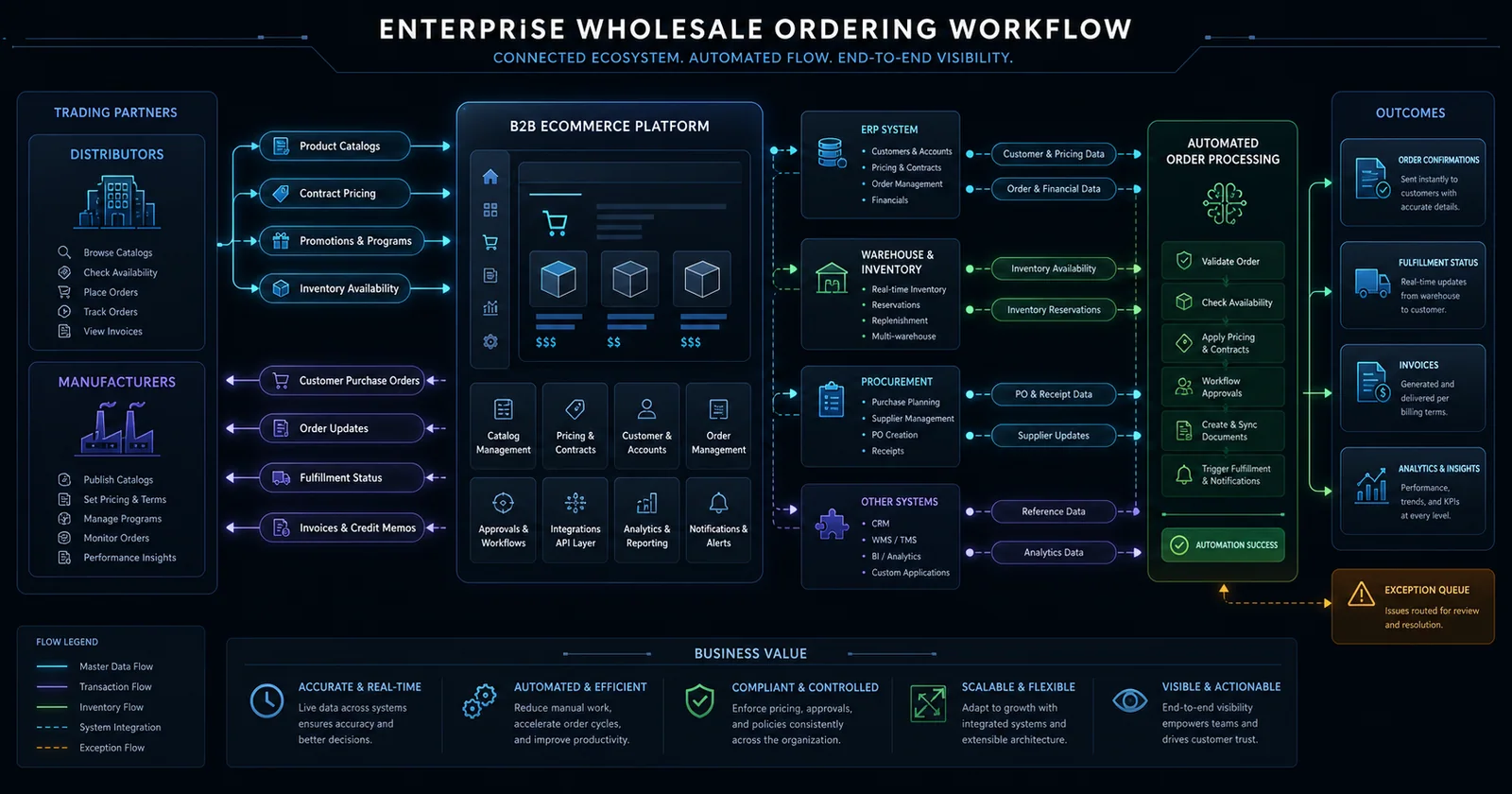
B2B checkout applies the correct company context, pricing, delivery, payment method, terms, tax status, and PO reference. A quote or submitted order may become a draft for review. For example, an industrial supplier can let a branch buyer build a 200-line cart, enter PO ATL-48291, submit it for seller approval, and invoice on net 30 after checking credit.
How We Selected These Apps
We ranked operational fit, not marketing claims.
- B2B functionality: Companies, pricing, catalogs, forms, tax, net terms, quotes, quick order, reordering, reps, and permissions.
- Implementation and integration: Theme impact, app blocks, checkout behavior, customer-account support, migration effort, and coexistence with native Shopify B2B.
- Automation and scale: Approval rules, draft orders, Flow, bulk imports, multi-market operation, order limits, error recovery, and peak-volume capacity.
- Performance: Storefront scripts, quick-order rendering, price resolution, API latency, and whether operational sync sits outside the customer request path.
- Commercial fit: Public price, usage limits, extra reps, onboarding, support, sandbox access, and implementation cost.
- Architecture: APIs, webhooks, ERP and accounting compatibility, auditability, permissions, data ownership, and Shopify Plus support.
- Evidence: Current Shopify App Store presence, review history, recent support signals, official documentation, and a clear ongoing product focus.
Quick Comparison: Best Shopify B2B Apps
| App | Best for | Free plan | Starting price* | Wholesale pricing | Quotes | Customer PO / terms | Plus support | Ideal size |
|---|---|---|---|---|---|---|---|---|
| Shopify B2B | Native company commerce | Included | Shopify plan | Yes | Draft-led | Yes | Native | Any–enterprise |
| SparkLayer | Complete buyer portal | Yes | $49/mo | Advanced | Pro | Yes | Yes | Growing–mid-market |
| BSS B2B Wholesale Pricing | Feature-to-cost value | Yes | $29/mo | Advanced | Via companion app | Net terms | Yes | Small–mid-market |
| Sami B2B Wholesale Pricing | Affordable all-in-one launch | Yes | $19.90/mo | Advanced | Via SA app | Net terms | Yes | Startup–mid-market |
| B2B Wholesale Hub | Mature tagged-customer pricing | No | $39/mo | Advanced | No | Net terms | Yes | Small–mid-market |
| Wholesale Gorilla | Simple blended wholesale | No | $34.95/mo | Advanced | No | Net terms | Yes | Small–mid-market |
| SA Request a Quote | RFQ and price negotiation | Yes | $16.99/mo | Quoted price | Yes | Plus tier | Yes | Small–enterprise |
| WSH Order Form & ReOrder | Bulk ordering and reorders | Dev only | $15.99/mo | Via integration | No | No | Yes | Small–mid-market |
| Velocity | Sales reps and territories | No | $25/rep/mo | Uses store pricing | Draft/invoice | Yes | Yes | Growing–enterprise |
| OrderEase | ERP-led order orchestration | No | From $17/day | ERP-led | Workflow-led | Yes/EDI | Yes | Mid-market–enterprise |
*Standard public USD pricing checked July 18, 2026; taxes, Shopify subscription, onboarding, usage, add-ons, integrations, and temporary promotions are excluded. “Free for development stores” is not a live-store free plan.
The 10 Best Shopify B2B Apps for 2026

Native B2B 01
Shopify B2B: Best native wholesale foundation
Best for: Merchants that want company accounts, catalogs, payment terms, purchase-order references, and B2B checkout on Shopify's core commerce model
Shopify B2B provides companies and locations, catalogs, customer accounts, quantity rules, volume pricing, payment terms, PO numbers, draft review, tax controls, Flow, APIs, and a B2B-aware checkout. Most core features now work on paid plans. Plus adds unlimited B2B market catalogs, direct catalog assignment to specific companies or locations, deposits, partial payments, and other advanced controls.
Pros: One product, customer, order, inventory, and checkout model; no separate pricing script; strong API foundation. Cons: Exact negotiated-price scale, buyer permissions, quoting, rep workflows, and ERP rules may still need apps or development. Pricing is included with the applicable Shopify plan. Ideal size: Any to enterprise.
Performance and use case: Native catalogs avoid much theme-side price manipulation. A manufacturer can run a blended store, give regional dealers market catalogs, assign net 30, and review selected orders as drafts. Plus can assign a contract catalog directly to a national account location.
Do not choose it alone when buyers need rich quote negotiation, sales-rep commissions, a highly customized dashboard, EDI, or ERP-first validation. Expert recommendation: Treat Shopify's company, catalog, and order objects as the canonical commerce layer wherever possible, then extend gaps instead of recreating B2B in tags.

App 02
SparkLayer B2B & Wholesale: Best complete buyer portal
Best for: Growing wholesalers that prioritize polished self-service ordering, account teams, sales agents, price lists, and repeat purchasing
SparkLayer adds a polished self-service portal, unlimited price lists on paid plans, quick order, reordering, registration approval, company teams, net terms, shopping lists, sales agents, invoices, multi-currency, and integrations. Quoting, accounting connections, workflows, and API access arrive on Pro.
Pricing: Free supports three price lists and five monthly orders. Starter is $49 for 50 orders and one sales agent; Growth is $149; Pro is $299 for 150 orders and five agents. Confirm higher-volume terms. Ideal size: Growing to mid-market.
Pros: Broad buyer and rep experience, focused B2B support, strong reviews, and clear upgrade path. Cons: Key quote/API features require Pro, and order/agent limits can raise total cost.
Performance and use case: A furniture brand can let approved retailers search, order by SKU, download invoices, create buyer teams, and let reps order for accounts. Validate portal JavaScript, price hydration, and mobile quick-order performance against a full catalog.
Do not choose it for a five-order pilot already covered by native Shopify, or when ERP/EDI must be the operational brain. Expert recommendation: Best shortlist for growing brands that value buyer UX and sales-team tools more than the lowest subscription.
App 03
BSS B2B Wholesale Pricing: Best feature-to-cost value
Best for: Small and mid-market merchants that need flexible price lists, quantity rules, registration, tax controls, net terms, and API options
BSS B2B Wholesale Pricing combines customer and variant pricing, quantity breaks, registration approval, auto-tagging, tax display and exemption, order limits, shipping rules, net terms, multi-currency, POS, imports, and public APIs.
Pricing: A limited free plan covers basic price and registration. Essential is $29, Advanced $49, and Platinum $99 with conditional forms, customer price lists, bulk pricing exchange, and ERP API use. Ideal size: Small to mid-market.
Pros: Exceptional breadth per dollar, mature review base, Built for Shopify status, and a companion quote/quick-order app. Cons: Broad rule sets require governance; pairing suite apps increases configuration and regression testing.
Performance and use case: A parts wholesaler can approve garages, enforce pack increments and minimums, display tax-exclusive pricing, and import contract prices. Test price resolution across product cards, search, cart drawers, discounts, Markets, POS, and checkout.
Do not choose it if native company catalogs already meet the requirement or your ERP must calculate every price in real time. Expert recommendation: The strongest value shortlist for a non-enterprise merchant with genuinely varied pricing and tax rules.

App 04
Sami B2B Wholesale Pricing: Best affordable all-in-one launch
Best for: Startups and growing blended stores validating wholesale pricing, account approval, quick order, tax controls, and net terms
Sami B2B Wholesale Pricing offers customer, product, variant, market, and quantity pricing; registration and approval; quick order; tax controls; custom shipping; order limits; draft orders; net terms; invoicing; and POS support.
Pricing: Free up to $500 in wholesale revenue; Starter is $19.90 up to $5,000; Growth $39.90 up to $20,000; Enterprise $89.90 for unlimited wholesale revenue. Ideal size: Startup to mid-market.
Pros: Low-risk launch, broad feature coverage, strong review history, multiple languages, and Built for Shopify. Cons: Revenue-based tiers can make cost move independently of complexity; advanced portal, ERP, and rep needs may outgrow it.
Performance and use case: A specialty food producer can approve retailers, sell in case increments, show trade pricing, apply invoice payment, and offer fast reorders without creating a second store. Measure theme impact wherever price and cart UI are injected.
Do not choose it because “free” sounds permanent; model the tier at expected wholesale revenue. Expert recommendation: Ideal for validating a blended wholesale program before committing to a more expensive portal architecture.

App 05
B2B Wholesale Hub: Best mature customer-group pricing
Best for: Small and mid-market blended stores whose wholesale segmentation maps cleanly to tagged customer groups
B2B Wholesale Hub, formerly Wholesale Club, applies percentage discounts or variant-level prices to tagged groups in a blended store. It includes registration, quick order, manual entry, Markets support, net terms, volume discounts, minimums, product locking, POS, Flow, and customer accounts.
Pricing: Basic is $39, Professional $69, and Premium $99 per month. Custom-price, net-term, volume, and minimum-order capabilities begin on Professional. Ideal size: Small to mid-market.
Pros: Long operating history, mature merchant reputation, clear tagged-customer model, and broad compatibility. Cons: The simplest mental model can become limiting when one company has many locations, buyers, and overlapping contracts.
Performance and use case: A gift brand can keep one retail store while approved boutiques receive group prices and a quick-order form. Test automatic discounts with cart drawers, POS, subscription products, bundles, and every active promotion.
Do not choose it for complex company hierarchies or ERP-mastered contract pricing. Expert recommendation: A dependable choice for small and mid-market merchants whose wholesale segmentation maps cleanly to customer groups.

App 06
Wholesale Gorilla: Best for a simple blended store
Best for: Retail brands adding an approachable wholesale program with trade pricing, product access, ordering rules, and account terms
Wholesale Gorilla provides unlimited price rules and groups, registration, manual orders, quick order, custom wholesale shipping, product hiding, discount codes, order limits, CSV pricing, volume discounts, page locks, and payment terms.
Pricing: Lite is $34.95, Advanced $69.95, and Premium $149.95 per month. Advanced contains practical operating features; Premium adds volume pricing, stronger locking, terms, and form controls. Ideal size: Small to mid-market.
Pros: Approachable setup, wholesale-focused support, and useful controls without a separate storefront. Cons: Important capabilities are distributed across tiers, and it is less suitable for deeply integrated company structures or enterprise orchestration.
Performance and use case: A skincare brand can approve salons, hide professional-only products, set trade shipping rules, and accept account orders. Because pricing and visibility touch the theme, test cached pages, search results, cart state, and logged-out leakage.
Do not choose it when direct company catalog assignment, buyer roles, or real-time ERP price validation is mandatory. Expert recommendation: Shortlist alongside Wholesale Hub; choose based on a proof of concept with your theme and exact tier requirements, not feature-count comparisons.

App 07
SA Request a Quote, Hide Price: Best focused RFQ workflow
Best for: Manufacturers and industrial suppliers that need hidden prices, specification capture, quote negotiation, and quote-to-order conversion
SA Request a Quote lets buyers build an RFQ from product, collection, or cart pages, propose prices, add notes or files, hide prices, and convert approved quotes to orders. Its Plus tier understands B2B company data, catalogs, and payment terms.
Pricing: Free supports basic requests. Premium is $16.99, Pro $36.99 with quote-to-order, export, file upload, PDF, and Zapier; the Shopify Plus Supreme tier is $96.99. Ideal size: Small to enterprise.
Pros: Focused workflow, strong merchant reputation, multilingual forms, and substantially cheaper than buying a complete portal only for quoting. Cons: Approval, versioning, margin authority, expiry, and ERP synchronization still require process design.
Performance and use case: An equipment supplier can hide configured-machine prices, collect specifications, negotiate, then send an order-ready quote. Load the RFQ interface only on relevant templates and verify conversion analytics.
Do not choose it when every item has a published contract price and buyers never negotiate. Expert recommendation: Best specialist add-on for manufacturers and industrial suppliers; define who may discount and when a revised quote requires approval.

App 08
WSH Order Form & ReOrder: Best bulk order form
Best for: Repeat wholesale buyers who know their SKUs and need a fast searchable product matrix, quantity controls, and one-click reordering
WSH Order Form & ReOrder creates a searchable single-page product matrix with variants, SKUs, barcodes, inventory, min/max quantities, increments, customer visibility, bulk import/export, and one-click reorder. It can integrate with Wholesale Helper's pricing tools.
Pricing: Free only for development and trial stores. Live plans are $15.99 Basic, $19.99 Professional, and $24.99 Enterprise. Ideal size: Small to mid-market.
Pros: Focused, affordable, Built for Shopify, strong reviews, and useful for repeat buyers who know SKUs. Cons: It is an ordering interface, not a complete pricing, company, terms, quoting, or ERP system.
Performance and use case: A distributor with 300 replenishment SKUs can let stores build a mixed order in one screen rather than opening 40 product pages. Paginate, filter, and test the grid on mid-range mobile devices; do not render thousands of variants at once.
Do not choose it as your B2B architecture. Expert recommendation: Add it when ordering speed is the measured bottleneck and your core pricing source is already trustworthy.

App 09
Velocity: Best sales-representative portal
Best for: Growing distributors with field teams that need assigned accounts, mobile ordering, territory controls, order attribution, and commissions
Velocity gives reps a dedicated mobile portal to onboard customers, scan items, place orders, track status, and see commissions. Managers can restrict account visibility, link orders from every channel, define commissions, and—on Premium—map North American territories and team hierarchies.
Pricing: Basic is $25 per sales rep monthly; Premium is $50 per rep. Total cost scales with headcount. Ideal size: Growing to enterprise.
Pros: Keeps representatives out of Shopify admin, supports field ordering, ties orders to reps, and provides clear commission workflows. Cons: A newer app with a smaller review base; territory mapping is limited to the US and Canada; it does not replace catalog, ERP, or credit systems.
Performance and use case: A beverage distributor can assign accounts by territory and let reps scan samples into an order at a trade visit. The storefront impact is limited, but permissions, order attribution, refunds, split credit, and offline behavior need acceptance tests.
Do not choose it for self-service-only wholesale or global territories without confirming fit. Expert recommendation: Evaluate with real reps and commission edge cases before rollout.

Order Platform 10
OrderEase: Best ERP-led order orchestration
Best for: Mid-market and enterprise manufacturers or distributors coordinating portal, ecommerce, EDI, rep, and emailed purchase-order demand
OrderEase for Shopify connects portal, ecommerce, marketplace, EDI, sales-rep, and emailed-PO demand with ERP-driven customers, pricing, inventory, validation, routing, and fulfillment. It is broader B2B order-management software, not a lightweight theme app.
Pricing: Official pricing starts at $17 per day. Final cost depends on channels, volume, EDI, ERP connections, modules, and implementation; advanced setup can carry fixed fees. Ideal size: Mid-market to enterprise.
Pros: Strong manufacturer/distributor model, ERP source-of-truth orientation, PO digitization, multi-channel normalization, and complex validation. Cons: Longer discovery, higher total cost, and more change management than a storefront app; public merchant-review evidence is not directly comparable with App Store apps.
Performance and use case: A building-materials distributor can ingest emailed POs, portal orders, and Shopify orders, validate contract price and availability against its ERP, then route clean orders to fulfillment. Keep resilient queues and status visibility outside the shopper's synchronous request wherever possible.
Do not choose it for simple wholesale discounts or low order volume. Expert recommendation: Shortlist when manual order repair, EDI, and ERP inconsistency are already material operating costs.
Best Apps by B2B Requirement
| Requirement | Best choices | Why |
|---|---|---|
| Best free B2B apps | Shopify B2B, SparkLayer, BSS, Sami | Native foundation or limited validation tiers |
| Wholesale pricing | Shopify B2B, BSS, Sami, Wholesale Hub | Native catalogs through flexible group and rule engines |
| Quote requests | SA Request a Quote, SparkLayer Pro, BSS Order/Quote | Focused RFQ through portal-level negotiation |
| Purchase orders | Shopify B2B, OrderEase, SparkLayer | PO references, account terms, emailed POs, and order workflow |
| Shopify Plus | Shopify B2B, SparkLayer, SA Request a Quote | Company catalogs, advanced checkout/payment and portal extensions |
| Manufacturers | OrderEase, SA Request a Quote, SparkLayer | ERP truth, specifications/quotes, and dealer self-service |
| Distributors | OrderEase, Velocity, WSH Order Form | Multi-channel order control, rep selling, and fast replenishment |
Common B2B Ecommerce Mistakes
- Using B2C pricing logic: One percentage discount cannot represent contract dates, customer exceptions, case packs, freight, and margins. Document price precedence before configuration.
- Keeping ordering manual: Email and phone orders feel personal until staff rekey 200 lines. Preserve assisted selling, but capture structured orders once.
- Skipping segmentation: Separate prospects, approved buyers, companies, locations, credit status, markets, and sales ownership. A single
wholesaletag is rarely enough at scale. - Building a poor ordering experience: B2B buyers value SKU search, inventory context, saved lists, quick reorder, and accurate totals more than decorative landing pages.
- Weak approvals: Define approval for accounts, credit, discounts, quotes, exceptions, and refunds. Log who changed what and why.
- Ignoring ERP ownership: Decide which system owns customers, products, prices, inventory, tax, credit, orders, fulfillment, and returns. Two writers create sync loops.
- Trusting inventory without reconciliation: Test reservations, backorders, bundles, transfers, cancellations, partial fulfillment, and latency. “Real time” is not a data-ownership rule.
- Poor onboarding: Give buyers approved contacts, terms, catalogs, addresses, tax status, instructions, and a first-order test. A technically live portal can still fail adoption.
B2B Tech Stacks by Business Type
| Business type | Recommended stack | Upgrade trigger |
|---|---|---|
| Small wholesaler | Shopify B2B + Sami or BSS + SA Request a Quote + native inventory | Manual price exceptions or order rekeying grows |
| Growing manufacturer | Shopify B2B/SparkLayer + SA RFQ + ERP integration + PO workflow | Contract, configuration, or plant rules diverge |
| Distributor | SparkLayer + WSH quick order + Velocity + WMS/ERP | Multiple warehouses, EDI, or territory complexity |
| International seller | Shopify Markets/B2B catalogs + BSS or SparkLayer + tax integration | More currencies, entities, catalogs, and local terms |
| Industrial supplier | Private catalog + RFQ + PO validation + ERP availability | Specifications and approval chains require a custom portal |
| Shopify Plus | Native Shopify B2B + company catalogs + Flow + Functions + targeted apps | Packaged UX or integration rules become the constraint |
| Enterprise | Shopify Plus + custom portal + ERP/CRM/PIM/WMS + iPaaS + observability | Treat as an architecture program, not an app install |
This is the practical decision framework: small merchants should minimize systems; manufacturers should prioritize quote and ERP truth; distributors should optimize repeat ordering and rep control; international sellers must validate currency, tax, and catalog behavior; enterprise teams should invest in integration reliability and governance.
For a broader operational stack, compare our guides to Shopify inventory management apps, Shopify automation workflows, and Shopify AI apps.
When Custom Shopify B2B Development Is Better
Custom development is justified when the business rule is both differentiating and difficult to express safely with packaged apps. Typical cases include custom wholesale portals; customer-specific dashboards; ERP and CRM integration; private APIs; multi-stage account, quote, order, or credit approvals; formula and contract pricing engines; Shopify Functions for discounts, delivery, payment, or validation; headless commerce; product configuration; and private B2B storefronts.
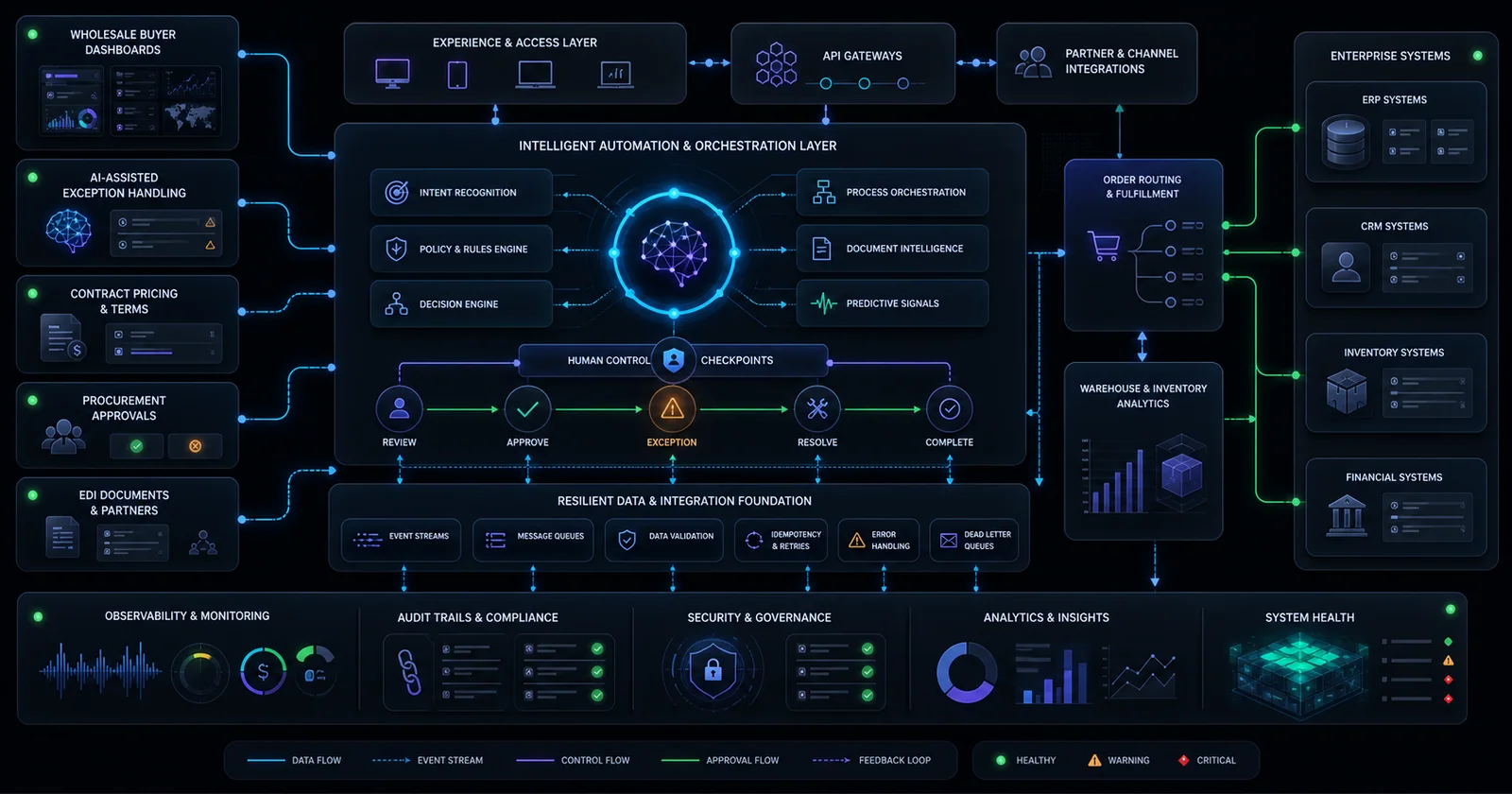
For example, an industrial manufacturer may need the buyer to select a facility, upload a specification, see only certified components, route the cart through engineering approval, validate contract price in Dynamics 365, reserve stock by warehouse, and return an ERP sales-order number. Combining six storefront apps can be more fragile than one governed integration and a custom account experience.
Custom does not mean rewriting Shopify. Keep native commerce objects wherever they fit, build around the exception, and require queues, idempotency, audit logs, replay tools, monitoring, and clear system ownership.
AreoTech's Shopify development team helps merchants map B2B processes, evaluate Shopify Plus, build private apps and APIs, connect ERP/CRM systems, and implement Shopify automation. A useful engagement starts with discovery and a proof of concept—not an assumption that custom code is automatically better. Review relevant ecommerce work or discuss the architecture through the contact page.
Frequently Asked Questions
What is the best Shopify B2B app in 2026?
Shopify B2B is the best native base; SparkLayer is the best complete portal. Choose BSS for value, SA Request a Quote for RFQs, Velocity for reps, and OrderEase for ERP-led operations.
Does Shopify have built-in B2B features?
Yes. Paid plans support companies, catalogs, terms, self-service ordering, and automation. Plus adds unlimited B2B market catalogs, direct company/location assignments, and advanced payment features.
Do I need Shopify Plus for B2B?
No. Start on a standard paid plan if its catalog and payment limits fit. Move to Plus for deeper company-specific control, scale, checkout extensibility, and enterprise governance.
Which app is best for wholesale pricing?
BSS offers the best price-to-capability balance. Sami is a budget-friendly alternative, Wholesale Hub is mature for tagged groups, and native Plus catalogs are strongest for company-location assignment.
Which app is best for quote requests?
SA Request a Quote is the best focused option. SparkLayer Pro is better when quoting belongs inside a complete portal; BSS's companion quote app adds quick and CSV ordering.
Can Shopify customers order using purchase orders?
Yes. Capture the buyer's PO number, use draft review or manual payment, and apply account terms. Add validation when a PO must match an ERP or government format.
What is a customer PO versus a supplier purchase order?
A customer PO references your sales order; a supplier PO replenishes your inventory. They require different workflows and often different software.
Can Shopify offer net 30 terms?
Yes. Shopify B2B supports net 30 and other term lengths. Add a credit policy, limits, aging, collections, and accounting reconciliation around the feature.
Can B2B and B2C share one Shopify store?
Yes. A blended store reduces duplicated data, but every price, discount, search, cart, checkout, and email must be tested in retail and company contexts.
What is the best free Shopify B2B app?
Start with native Shopify B2B. SparkLayer, BSS, and Sami have useful free validation tiers, but their limits generally require an upgrade as wholesale grows.
Which app is best for manufacturers?
OrderEase is best for ERP-led order processing; SparkLayer for dealer experience. Add SA Request a Quote when specifications or negotiated prices precede an order.
Which app is best for distributors?
Choose according to the bottleneck. Use WSH for replenishment, Velocity for field reps, SparkLayer for portal UX, or OrderEase for ERP/EDI orchestration.
Do B2B apps slow down Shopify?
They can. Test theme scripts, account detection, price rendering, catalog grids, and cart recalculation using realistic products, buyers, markets, and mobile devices. Our Shopify maintenance and performance service can help audit app overhead.
Can Shopify B2B integrate with an ERP?
Yes. Use a connector, integration platform, or custom app, but define field ownership and failure recovery first. An API connection without an operating contract is not an integration strategy.
When should I build a custom B2B portal?
Build custom when standard apps cannot represent high-value workflows safely. Contract pricing, product configuration, layered approvals, unusual roles, ERP validation, or a differentiated dashboard are common triggers.
Key Takeaways and Decision Matrix
| Business size | Complexity | Start with | Add when needed |
|---|---|---|---|
| Small | Low | Shopify B2B + Sami/BSS | SA Quote or WSH quick order |
| Growing | Moderate | SparkLayer or BSS | Velocity, accounting, inventory sync |
| Mid-market | High | Shopify B2B/Plus + SparkLayer | ERP connector, RFQ, custom Functions |
| Enterprise | Very high | Shopify Plus + governed architecture | Custom portal, OrderEase/EDI, APIs, observability |
The winning stack has one price authority, one inventory authority, explicit company and location identities, a fast repeat-order experience, governed approvals, and observable integrations. Validate with real customer accounts and full order lifecycles before migration.
Conclusion
The best Shopify wholesale app is not universal. Shopify B2B provides the native base; specialist apps should solve defined gaps in pricing, portals, quoting, bulk ordering, sales representation, or ERP operations.
Choose the smallest stack that supports the next growth stage. Price software, implementation, data cleanup, integrations, support, and internal ownership—not only the app fee.
If your roadmap includes Shopify B2B development, Shopify Plus architecture, ERP integrations, custom Shopify apps, API development, wholesale storefronts, performance optimization, or enterprise automation, contact AreoTech for an implementation-focused assessment.