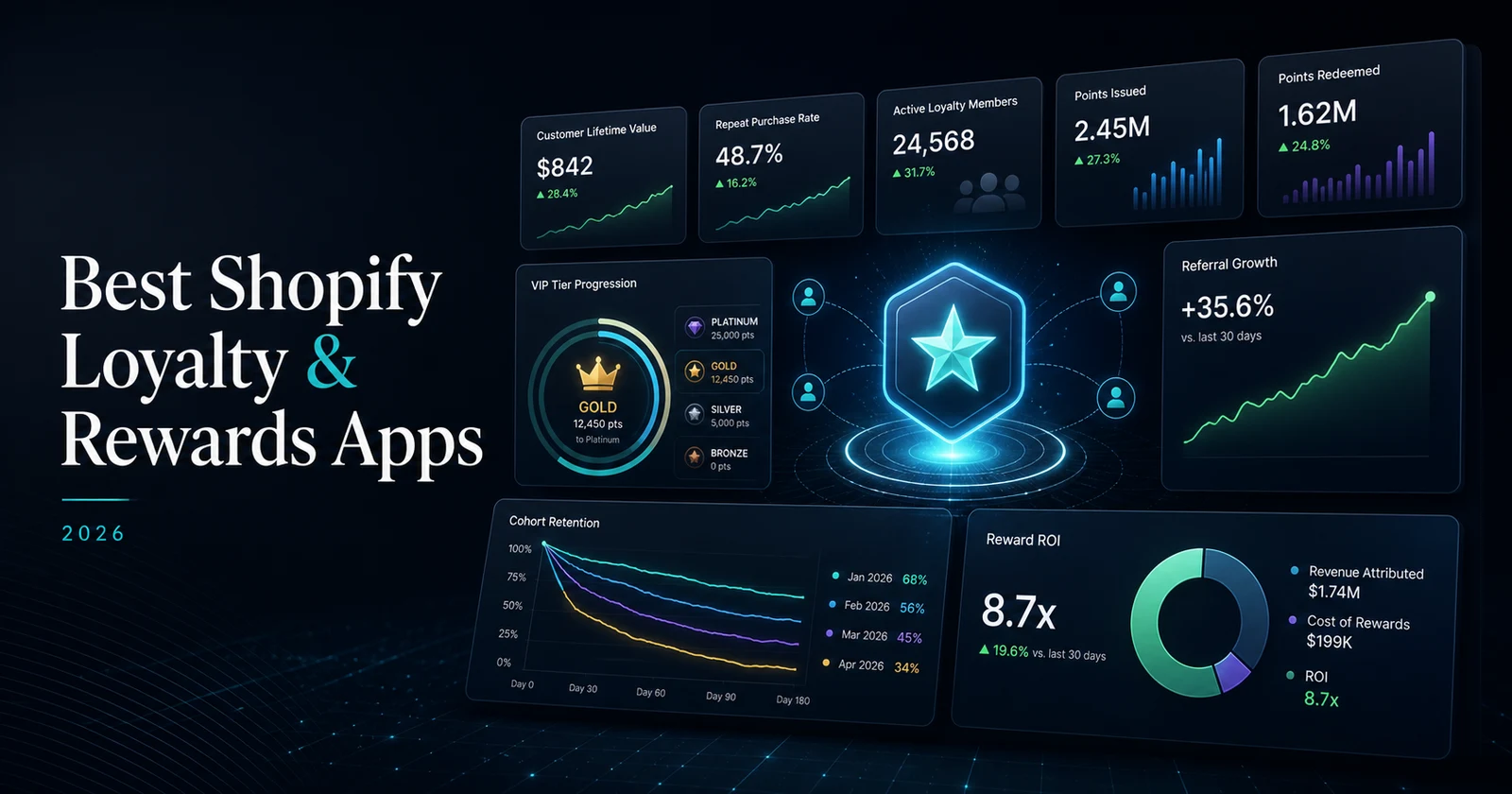
The best Shopify loyalty apps create profitable incremental behavior rather than simply distributing more points or discounts. After comparing 11 platforms, Smile.io is the strongest all-around choice, LoyaltyLion suits mature analytics-led retention programs, Yotpo fits enterprise ecosystems, Rivo offers a modern Shopify-native toolkit, and BON or Joy provide strong value for smaller stores.
Retaining a satisfied customer often requires less marginal spend than acquiring a stranger because the brand already has trust, permission, purchase history, and product context. That does not mean every repeat order is profitable or every retained customer is valuable. The economics depend on contribution margin, service cost, discounting, purchase frequency, returns, and the likelihood that the customer would have purchased without an incentive.
Customer lifetime value (LTV) turns those behaviors into an economic view of the relationship. A useful LTV model uses contribution margin after product, fulfillment, payment, return, support, and reward costs—not gross sales. Loyalty succeeds when it improves that value enough to cover software, incentives, messaging, implementation, and operational overhead.
Programs fail when strategy begins with “one point per dollar.” Rewards are too weak to matter, too generous to sustain, difficult to understand, unavailable on the products customers want, or invisible between purchases. Some programs subsidize customers who were already loyal while doing nothing for customers at risk of leaving.
This guide evaluates 11 leading platforms by reward flexibility, referrals, VIP tiers, automation, analytics, customization, integrations, Shopify fit, performance, support, price, and scale. Pricing and availability were verified from official sources on July 18, 2026. Plans change, so confirm current limits and contract terms before purchase.
Short answer: Choose Smile for a balanced program; LoyaltyLion for data-led retention; Yotpo for enterprise ecosystem depth; Rivo for modern Shopify extensibility; Growave for an all-in-one retention stack; BON or Joy for value; Gameball for gamification; Rise.ai for store credit; Marsello for omnichannel CRM; and ReferralCandy when referrals are the primary growth loop.
Understanding Loyalty Programs
Points-based rewards give customers a branded currency for purchases or selected actions. A beauty store might award 5 points per dollar and offer a free product at 1,000 points. Points create flexibility, but the exchange rate must remain understandable. If customers cannot estimate what 600 points are worth, the balance feels decorative.
Tiered VIP programs unlock increasing benefits when customers meet spend, point, order, or engagement thresholds. Effective tiers create status and progress. A fashion brand might offer early-access launches at Silver, complimentary alterations at Gold, and private styling at Platinum. If the only benefit is a slightly larger coupon, tiers become an expensive discount ladder.
Referral programs reward an advocate, a referred friend, or both after a qualified event. The event should usually be a completed, non-fraudulent purchase rather than a link click or account creation. Compare total reward and platform success fees with your acceptable customer acquisition cost.
Cashback returns part of a purchase as future value. “Earn 5% back” is easy to understand and can encourage another order. It also makes the economic cost transparent, so margin exclusions and expiration policy need careful design.
Store credit is a monetary balance that can unify cashback, refunds, compensation, gifting, and loyalty. It is intuitive and useful across service workflows. Unlike points, credit may carry specific accounting, gift-card, consumer-protection, and expiration requirements depending on jurisdiction.
Membership rewards exchange a recurring or one-time membership fee for ongoing benefits such as shipping, exclusive pricing, service, access, or monthly credit. The value proposition must work even when a member does not buy immediately; otherwise it is simply a subscription discount.
Gamification uses challenges, streaks, badges, progress, surprise, or leaderboards to make engagement more motivating. It works best when the mechanics fit the brand and customer. A collectibles community may enjoy challenges; a luxury buyer may find a spinning wheel cheapening.
Birthday rewards create a personal reason to return, but they need consent, date collection, lead time, and an appropriate window. A reward sent at midnight and expiring the same day is operationally easy but customer-hostile.
Purchase milestones recognize meaningful progress: a third order, one-year anniversary, fifth subscription renewal, or cumulative spend. Milestones are often more emotionally credible than paying customers for low-value social actions.
The core metrics are equally important:
- Customer lifetime value (LTV): Expected contribution from a customer relationship after variable costs. Use cohort data and a defined time horizon.
- Repeat purchase rate: The percentage of customers who place another order within the measurement window. Define whether cancellations and fully refunded orders count.
- Purchase frequency: Average number of purchases per customer over a period.
- Referral rate: The share of eligible customers who generate at least one referral, or referrals per eligible customer. State the denominator.
- Redemption rate: The share of issued rewards or points that customers redeem. Low redemption may mean low value or poor communication—not “free profit.”
- Incremental lift: The change caused by the program beyond what would have happened naturally. This is the metric most dashboards cannot prove without a thoughtful test.
For example, if VIP members spend twice as much as non-members, the program did not necessarily double spending. High-value customers are more likely to qualify for VIP status in the first place. Compare similar pre-program cohorts, hold out a test group where practical, and track behavior before and after qualification.
How We Selected These Shopify Loyalty Apps
This is a commercial buyer's guide, not a review-count contest. Each platform was evaluated against the work a retention team performs after launch.
- Rewards flexibility: Points, discounts, products, shipping, store credit, access, experiences, exclusions, limits, and custom actions.
- Referral features: Advocate and friend incentives, attribution, post-purchase prompts, fraud protection, cash or credit, and qualified conversion rules.
- VIP tiers: Spend or point qualification, rolling or calendar periods, downgrade logic, multipliers, experiential benefits, and tier communication.
- Automation: Bonus campaigns, expiration reminders, milestone triggers, win-back flows, Shopify Flow, email/SMS events, webhooks, and APIs.
- Analytics: Enrollment, activity, redemption, attributed revenue, repeat behavior, LTV, cohorts, referrals, liability, exports, and testability.
- Customization: Loyalty pages, account and checkout extensions, POS, mobile, multilingual content, headless support, brand controls, and developer tools.
- Operational fit: Returns, cancellations, chargebacks, merged customers, guest checkout, subscriptions, B2B, multiple stores, Markets, and migration.
- Pricing: Base fee, order thresholds, overages, success fees, add-ons, integrations, implementation, support, and multi-store cost.
- Merchant evidence: Recent review patterns, support experience, product maturity, Built for Shopify status, and response to operational problems.
- Performance: Theme app extensions, script loading, signed-in state, widgets, account pages, and storefront Core Web Vitals.
No platform received a higher rank for merely mentioning AI. A useful recommendation must help the merchant make a better decision, expose the action taken, and allow the team to measure incremental profit.
Quick Comparison: Best Shopify Loyalty & Rewards Apps
| App | Best for | Starting price* | Free plan | Points program | Referral program | VIP tiers | Analytics | Automation | Ideal business size |
|---|---|---|---|---|---|---|---|---|---|
| Smile.io | Best overall | Free; paid from $15/mo | Yes | Yes | Yes | Growth plan | Strong | Strong | Startup–enterprise |
| LoyaltyLion | Data-led retention | Free; paid from $199/mo | Yes | Yes | Yes | Classic/custom | Advanced | Advanced | Growing–enterprise |
| Yotpo Loyalty | Enterprise ecosystem | Free; paid from $199/mo | Yes | Yes | Yes | Yes | Advanced | Advanced | Growing–enterprise |
| Rivo | Modern Shopify-native loyalty | Free; paid from $15/mo | Yes | Yes | Scale plan | Scale plan | Strong | Strong | Startup–enterprise |
| Growave | All-in-one retention stack | Free; paid from $15/mo | Yes | Yes | Entry plan | Growth plan | Strong | Strong | Startup–enterprise |
| BON Loyalty | Budget and multilingual programs | Free; paid from $15/mo | Yes | Yes | Yes | Growth plan | Good | Good | Startup–mid-market |
| Joy Loyalty | Flexible value and B2B tiers | Free; paid from $29/mo | Yes | Yes | Yes | Advanced plan | Strong | Strong | Startup–enterprise |
| Gameball | Gamification | Free; paid from $34/mo | Yes | Yes | Yes | Starter plan | Strong | Strong | Startup–mid-market |
| Rise.ai | Store credit and cashback | $19.99/mo | No | Limited | Yes | Spend-based workflows | Good | Strong | Small–enterprise |
| Marsello | Omnichannel loyalty and CRM | $60/mo | No | Yes | Basic | $120 plan | Strong | Strong | Growing–mid-market |
| ReferralCandy | Referral-first acquisition | $39/mo + success fee | No | No | Advanced | Tiered referral rewards | Referral-focused | Advanced | Startup–enterprise |
*USD public list pricing checked July 18, 2026. Order overages, referral success fees, add-ons, implementation, messaging, reward costs, integrations, and enterprise contracts can materially change total cost.
The 11 Best Shopify Loyalty & Rewards Apps for 2026

App 01
Smile: Loyalty Program Rewards: Best overall Shopify loyalty app
Best for: Merchants that want a polished, scalable points, referrals, and VIP platform with approachable entry pricing
Smile.io offers the most balanced path from a first points program to a sophisticated VIP ecosystem. It combines a strong merchant interface, mature integrations, multilingual support, Shopify POS, reporting, and an accessible free plan.
Best for: Most Shopify merchants that want a recognizable, easy-to-operate loyalty core without starting at enterprise pricing.
Key features and pricing: The free plan includes points, rewards, referrals, 15-plus earn or redeem actions, branding, 20-plus languages, POS, and up to 200 monthly orders. Essential is $15 for 500 orders; Standard is $79 for 1,000; Growth is $199 for 2,500 and adds VIP tiers, expiration, benchmarking, deeper reports, and Shopify Plus checkout redemption. Overages apply on Growth.
Automation, referrals, VIP, and analytics: Smile supports Flow-triggered rewards, Klaviyo integrations, bonus events, on-site nudges, referral incentives, loyalty segments, ROI and CLV insight, and tier progression on eligible plans. Its analytics are strong for program operation, but causal lift still requires merchant-designed testing.
Performance and scale: Built for Shopify is a positive signal. Still test the launcher, dedicated page, product points, checkout, account, and POS journeys. Enterprise merchants should confirm API, multi-store, SLA, migration, and data-export requirements.
Pros: Easy launch, mature ecosystem, attractive free and low-cost tiers, good international support. Cons: The capabilities most mature brands need sit on higher plans; order-volume overages can raise cost.
Use case: A coffee brand can reward purchases and subscriptions, promote double-points weekends, let members refer friends, and graduate frequent buyers into early-access VIP tiers.
Do not choose Smile if the program requires highly proprietary ledger logic or enterprise functionality unavailable in the contracted tier. Expert recommendation: It belongs on almost every shortlist; validate Growth-tier economics at forecast order volume.

App 02
LoyaltyLion Loyalty Program: Best for data-led retention strategy
Best for: Growing and enterprise brands that need segmentation, predictive insight, VIP design, deep CRM integration, and strategic support
LoyaltyLion positions loyalty as a retention system rather than a coupon widget. Its strengths include behavioral rules, dynamic tiers, RFM and customer segments, repeat-purchase reporting, LTV insight, loyalty flows, and a deep ecommerce integration ecosystem.
Best for: Brands with a CRM team capable of acting on segments, experimentation, and customer lifecycle data.
Key features and pricing: A free plan supports up to 400 monthly orders with basic points, rewards, branding, analytics, segments, and notifications. Classic is publicly listed from $199 for 500 monthly orders and includes a loyalty page, rules, integrations, onboarding, VIP tiers, POS, attributed revenue, and Klaviyo flows. Advanced and Plus use custom pricing.
Automation, referrals, VIP, and analytics: LoyaltyLion supports purchase, review, referral, subscription, and engagement rewards; rolling or calendar tiers; advanced Klaviyo events; conditional flows; bonus campaigns; predictive revenue insight; and more than 100 integrations on its official pricing page. Multilingual and advanced tier capabilities vary by plan.
Performance and scale: The platform can embed across product, account, checkout, POS, and loyalty pages. Test every surface and confirm which team owns messaging. Recent reviews show both strong onboarding experiences and support complaints, so enterprise buyers should document escalation and SLA expectations.
Pros: Strategic depth, strong segmentation, mature analytics, CRM integration, and enterprise path. Cons: Cost rises quickly, public pricing becomes custom, and value depends on an active retention team.
Use case: A beauty brand can identify customers at risk after purchase two, trigger a personalized points challenge through Klaviyo, and use VIP status to protect high-value cohorts from generic discounting.
Do not choose LoyaltyLion for a set-and-forget widget or when the team will not use its data. Expert recommendation: Choose it when loyalty is a managed CRM channel with clear analytical ownership.

App 03
Yotpo: Loyalty Rewards Program: Best for enterprise ecosystem depth
Best for: Established brands that need flexible campaigns, VIP tiers, advanced reporting, Shopify Plus surfaces, and Yotpo ecosystem alignment
Yotpo Loyalty & Referrals supports more than 20 listed campaign types, flexible earning and rewards, VIP tiers, referrals, segmentation, checkout redemption, POS, Shopify Flow, webhooks, and integrations with Klaviyo, Recharge, Gorgias, and Yotpo products.
Best for: Established and Shopify Plus brands that want a configurable platform and may already use the wider Yotpo stack.
Key features and pricing: The free plan is available below 100 monthly orders and includes purchase points, discounts, referrals, reporting, and support. Pro starts at $199 and can add per-order charges above included volume; it adds a rewards page, more campaigns and rewards, checkout redemption, webhooks, and integrations. Higher-volume and advanced configurations require official pricing confirmation.
Automation, referrals, VIP, and analytics: Campaign rules can reward purchases, goals, social engagement, referrals, and custom behaviors. Segments can use balance, referral activity, and other loyalty data. Advanced dashboards track engagement and program revenue, but the merchant must still separate attributed from incremental sales.
Performance and scale: Yotpo can operate across storefront, customer accounts, checkout, POS, CRM, and subscriptions. Consolidation can reduce vendors, but it can also deepen ecosystem dependency. Test data portability, service response, theme footprint, and cross-product pricing.
Pros: Flexible enterprise features, broad campaigns, strong integrations, mature Plus use cases. Cons: Price and order fees can become substantial; configuration and support experience deserve contract scrutiny.
Use case: A global skincare company can run market-specific campaigns, reward subscription milestones, segment high-balance members, and offer checkout redemption to Plus customers.
Do not choose Yotpo solely to consolidate logos in the stack. Expert recommendation: Compare it with LoyaltyLion using the same three-year cost and integration scenario.
App 04
Rivo: Loyalty Program, Rewards: Best modern Shopify-native platform
Best for: Brands that value Shopify-native extensions, frequent product development, developer tooling, and a clean path from startup to Plus
Rivo is a Built for Shopify loyalty, rewards, referral, and customer-account platform with a modern extension-first approach and higher-tier developer tooling.
Best for: Shopify-first teams that care about current platform architecture, customization, support, and future account or checkout experiences.
Key features and pricing: Free supports 200 monthly orders, points, earn and redeem actions, branding, and automated email. Essential is $15 for 500 orders with a loyalty/referral page, theme extensions, prompts, two integrations, POS, and support. Scale starts at $49 at 500 orders and adds VIP, expiration, analytics, bonus campaigns, and referrals. Plus is $499 for 2,500 orders with custom integrations, advanced analytics, developer toolkit, and checkout extensions.
Automation, referrals, VIP, and analytics: Rivo supports automated email, bonus campaigns, referral programs, expiration, Shopify integrations, and custom events on higher plans. Scale uses order-based pricing, so model normal and peak months.
Performance and scale: Theme and checkout extensions can be cleaner than legacy script injection, but custom CSS, fonts, account components, and integrations still need performance review. Plus merchants should validate toolkit coverage and API limits with a prototype.
Pros: Modern architecture, competitive pricing, clear upgrade path, active product positioning, 24/7 support. Cons: Scale pricing increases with orders; advanced analytics and developer tools require Plus.
Use case: A fashion brand can embed potential points on product pages, run VIP early-access campaigns, use referrals, and customize account and checkout experiences as it grows.
Do not choose Rivo if a required legacy integration or enterprise control is missing. Expert recommendation: It is the strongest challenger to Smile for Shopify-native brands.

App 05
Growave: Loyalty & Wishlist: Best all-in-one retention stack
Best for: Merchants that want loyalty, referrals, reviews, wishlists, VIP, and retention touchpoints in one platform
Growave combines loyalty, referrals, reviews, wishlists, VIP tiers, store credit, POS, wallet passes, UGC, and back-in-stock engagement. Its value is consolidation rather than loyalty specialization alone.
Best for: Stores that would otherwise buy separate loyalty, reviews, and wishlist apps and can benefit from shared customer data.
Key features and pricing: Free includes loyalty points, reviews, wishlist, imports and exports, and 200 orders per month. Entry is $15 for 500 orders and adds advanced rewards, referrals, fraud protection, nudges, POS, Flow, and one integration. Growth is $199 for 1,500 orders and adds VIP tiers, store credit, account extensions, gift cards, deeper customization, and UGC. Plus is $499 for 3,000 orders with checkout extensions, APIs/SDK, headless support, B2B, and unlimited integrations. Overage charges apply.
Automation, referrals, VIP, and analytics: Growave can connect wishlist, review, referral, and loyalty behavior into email and on-site actions. That creates useful context but requires a clear messaging calendar so customers are not over-contacted.
Performance and scale: Consolidation may remove redundant scripts, yet enabling every module can still add storefront work. Measure the combined implementation, migration, and page performance against best-of-breed alternatives.
Pros: Broad value, many languages, Plus and headless options, shared retention data. Cons: Teams may compromise on specialist depth; add-on order economics grow with volume.
Use case: A fashion store can reward reviews, restore wishlist demand, offer VIP tiers, capture referrals, and use wallet passes online and in POS.
Do not choose Growave if reviews or loyalty requires a specialist feature it cannot match. Expert recommendation: Evaluate it as a stack-consolidation decision, not just an app subscription.

App 06
BON Loyalty Program & Rewards: Best budget multilingual loyalty app
Best for: Startups and mid-market merchants that need points, referrals, translations, POS, and VIP tiers at accessible pricing
BON Loyalty combines points, anti-cheat referrals, birthday and anniversary rewards, expiration, POS, multilingual display, analytics, and VIP or B2B tiers at competitive public prices.
Best for: Cost-conscious merchants and international stores that want broad loyalty features without enterprise base fees.
Key features and pricing: Free supports 150 monthly orders with points, referrals, automated messages, discounts, product exclusions, and Shopify Plus checkout redemption. Starter is $15 for 300 orders; Basic is $29 for 500 and adds POS, bonus events, multilingual display, analytics, Flow, and integrations. Growth is $129 with unlimited monthly orders and adds VIP, B2B tiers, streaks, check-ins, anniversaries, and product-page points. API and SDK are enterprise arrangements.
Automation, referrals, VIP, and analytics: Automated point and referral emails, expiration reminders, limited-time multipliers, fraud controls, and integration triggers cover the core lifecycle. Analytics are useful operationally but less central than LoyaltyLion's advanced retention positioning.
Performance and scale: The lightweight price does not remove the need to test widget, page, checkout, and language behavior. Enterprise merchants should confirm support, security, API, migration, and SLA requirements rather than extrapolating from the Growth plan.
Pros: Excellent feature-to-price ratio, unlimited orders on Growth, multilingual capabilities, high current merchant rating. Cons: Advanced developer access is not self-serve; strategic analytics are less deep than premium suites.
Use case: A multilingual home-accessories store can reward purchases, birthdays, referrals, and streaks while displaying the program in local languages.
Do not choose BON when enterprise governance or a specific integration is mandatory and unverified. Expert recommendation: One of the best value shortlists for international SMBs.

App 07
Joy Loyalty Program & Rewards: Best flexible value for B2B and memberships
Best for: Merchants that want broad loyalty touchpoints, paid memberships, B2B tiers, wallet passes, and developer options
Joy Loyalty offers points, referrals, VIP and B2B tiers, paid membership, cashback, social rewards, POS, wallet passes, account and checkout experiences, Flow triggers, APIs, and headless support across its plan ladder.
Best for: Brands that need more than a conventional DTC points program, especially B2B tiers, memberships, or flexible touchpoints.
Key features and pricing: Free includes core points, referrals with fraud prevention, branding, messages, and 250 monthly orders. Essential is $29 for 500 orders plus overages and adds expiration, page, integrations, Flow, and reports. Advanced is $129 for 2,000 orders plus overages and adds VIP/B2B tiers, custom rules, bonus events, cart redemption, POS, wallet passes, and paid memberships. Ultimate is $499 for 7,000 orders and adds checkout extensions, developer toolkit, REST API, headless support, onboarding, and SLA.
Automation, referrals, VIP, and analytics: More than 20 listed Flow triggers, social engagement, referral fraud controls, multipliers, memberships, and tier rules create considerable flexibility. Establish governance so earning actions do not inflate points without commercial value.
Performance and scale: Thirty-plus possible touchpoints can create an excellent connected experience or excessive interface noise. Enable only the surfaces that solve a documented customer need.
Pros: Strong value, B2B and membership capability, modern extensions, clear developer tier. Cons: Order overages and feature complexity; advanced use requires disciplined configuration.
Use case: A wholesale beauty supplier can assign B2B tiers, reward education and repeat purchasing, provide wallet passes, and run a paid pro membership.
Do not choose Joy if the team wants the simplest possible program. Expert recommendation: Shortlist it when nonstandard tier or membership models matter.

App 08
Gameball: AI Loyalty & Games: Best for gamified loyalty
Best for: Community-led and lifestyle brands that can use challenges, streaks, badges, leaderboards, and targeted game mechanics authentically
Gameball goes beyond points with challenges, badges, streaks, leaderboards, spin wheels, slot-style campaigns, RFM segments, referrals, and VIP tiers.
Best for: Brands whose customers enjoy progress, community status, collection, or playful interaction.
Key features and pricing: Free supports up to 100 monthly rewarded customers and includes points, campaigns, referrals, emails, POS, and Flow. Starter is $34 for up to 1,000 monthly orders with five tiers, expiration, review rewards, targeting, games, multilingual UI, and chat. Pro is $159 and adds all earning actions, unlimited tiers, advanced branding, checkout embeds, and RFM segments. API access is listed as a $199 add-on.
Automation, referrals, VIP, and analytics: Targeted campaigns and RFM segmentation allow different challenges by customer value and recency. Referral and reward campaigns are built in. Measure whether games create incremental purchases or merely attract reward-seeking behavior.
Performance and scale: Interactive widgets and game components deserve mobile, accessibility, and loading tests. Recent reviews are mostly positive but include setup/support complaints, so validate domain configuration and escalation during trial.
Pros: Distinctive engagement model, accessible pricing, strong targeting, POS and Flow. Cons: Gamification can conflict with premium brand tone; API costs extra.
Use case: A gaming merchandise store can reward collection milestones, review completion, referral wins, and purchase streaks with badges and tier access.
Do not choose Gameball for a restrained luxury experience or if games have no strategic role. Expert recommendation: Use gamification selectively; progress should reinforce customer identity, not distract from products.

App 09
Rise Gift Cards & Store Credit: Best for store credit and cashback
Best for: Merchants that want one wallet for gift cards, cashback, referrals, refunds, compensation, and loyalty credit
Rise.ai treats store credit as the retention currency. It connects gift cards, cashback, referral rewards, refunds, compensation, gifting, and wallet balances rather than centering a classic points program.
Best for: Stores where transparent monetary value and revenue retention matter more than points and badges.
Key features and pricing: Starter is $19.99 for 100 monthly store orders plus $0.20 per additional order and includes gift cards, manual credit, and referrals. Small Business is $59.99 for 400 orders plus $0.15 overage and adds claim and balance pages. Pro is $199.99 for 2,000 orders plus $0.10 overage and adds apply-credit controls and bulk gift cards. Additional enterprise capabilities should be confirmed directly.
Automation, referrals, VIP, and analytics: Rise can issue cashback based on behavior, return value as credit, automate gift reminders, and reward referrals or lifetime spend. It can emulate tiered value, but merchants wanting traditional VIP status and points may prefer a full loyalty platform.
Performance and scale: Wallet, checkout, account, POS, refunds, and return integrations touch revenue-critical workflows. Test partial redemption, returns after credit use, currency, merged customers, and outstanding liability. Recent reviews include strong support reports and some reliability concerns, making proof-of-concept testing important.
Pros: Clear customer value, unified credit, strong gifting and refund retention. Cons: Not a full classic points/VIP system; financial and regulatory treatment needs review.
Use case: A fashion retailer can convert returns into credit, offer 5% cashback after a second order, reward referrals, and keep every balance visible in one wallet.
Do not choose Rise if points, tiers, and broad gamification are essential. Expert recommendation: It is the best specialist when loyalty is fundamentally a store-credit strategy.

App 10
Marsello: Loyalty, Email, SMS: Best for omnichannel loyalty and CRM
Best for: Retailers that want loyalty, RFM segmentation, email, SMS, POS, wallet passes, feedback, and campaigns in one operating system
Marsello combines loyalty with customer segmentation, email, SMS, feedback, wallet passes, analytics, and ecommerce/POS data. Its advantage is activating loyalty data inside the same marketing platform.
Best for: Omnichannel retailers that want a unified retention workflow rather than separate loyalty and CRM tools.
Key features and pricing: Loyalty Launch starts at $60 per connected site and includes points, basic referrals, branded portal, Apple and Google Wallet, basic automations, RFM segmentation, surveys, and reporting. Loyalty Accelerate starts at $120 per site and adds VIP tiers, custom earning, advanced reward conditions, point promotions, product/collection sync, integrations, and API access. Marketing and messaging add-ons may increase cost.
Automation, referrals, VIP, and analytics: Native RFM segments can feed email and SMS journeys without exporting loyalty data. Basic referrals are included; advanced loyalty logic sits on Accelerate. Coordinate frequency caps across transactional, campaign, and loyalty messages.
Performance and scale: POS identity matching, consent, site connections, wallet passes, and marketing deliverability are central. Test customer merge logic and cross-location balances before rollout.
Pros: Loyalty plus activation, good omnichannel positioning, RFM and feedback in one system. Cons: Less attractive if Klaviyo or another CRM is already deeply established; pricing is per site plus add-ons.
Use case: A multi-location specialty retailer can enroll customers at POS, issue points online and in-store, segment lapsed VIPs, and automate email/SMS win-back journeys.
Do not choose Marsello if replacing the existing CRM creates more migration risk than value. Expert recommendation: Compare total stack cost and data ownership, not only its loyalty fee.

App 11
Referral Candy & Affiliate: Best referral-first platform
Best for: Brands that need sophisticated referral and affiliate campaigns, flexible rewards, attribution, automation, and fraud controls
ReferralCandy is a referral and affiliate acquisition platform, not a general points-led loyalty replacement. It earns its place because referrals often have different economics, attribution, fraud, and advocate workflows from rewards programs.
Best for: Brands with a referable product and enough margin to fund advocate/friend incentives plus success fees.
Key features and pricing: Basic is $39 plus a 10.5% success fee on referral sales; Grow is $79 plus 3.5%; Scale is $249 plus 1.5%; Enterprise is $799 plus 0.25% on the current listing. Plans include targeted referral and affiliate campaigns, attribution, branded pages, coupons, credit, cash, custom rewards, tiered incentives, integrations, and fraud protection. Confirm fee definitions contractually.
Automation, referrals, VIP, and analytics: ReferralCandy automates invitations, post-purchase prompts, advocate communication, rewards or payouts, attribution, and performance reporting. Tiered benefits apply to advocate/referral performance, not a full customer points VIP program.
Performance and scale: App blocks and extensions are Built for Shopify, but post-purchase prompts and tracking still need testing. Subscription integrations can be valuable; decide which renewal or first-order event qualifies a referral.
Pros: Referral specialization, flexible incentives, affiliate overlap, mature integrations, clear success-fee ladder. Cons: Variable fees can consume margin; no general points program.
Use case: A subscription pet-food brand can reward advocates after a referred customer's qualifying paid order and reduce fees as referral volume grows.
Do not choose ReferralCandy when you primarily need points or VIP tiers. Expert recommendation: Treat it as an acquisition channel and compare fully loaded referred-customer CAC with paid media.
Comparison Tables by Use Case
Best Free Loyalty Apps
| Platform | Free allowance | Best free use | Important limit |
|---|---|---|---|
| LoyaltyLion | 400 monthly orders | Basic points and segments | Advanced program moves to $199/custom |
| Joy | 250 monthly orders | Flexible points and referrals | VIP begins on Advanced |
| Smile | 200 monthly orders | Best balanced launch | VIP and deeper reporting on Growth |
| Rivo | 200 monthly orders | Modern points program | Referrals/VIP require Scale |
| Growave | 200 monthly orders | Loyalty + reviews + wishlist | Referral begins on Entry |
| BON | 150 monthly orders | Budget points and referrals | VIP begins on Growth |
| Gameball | 100 rewarded customers | Gamified pilot | MRC model differs from order limits |
| Yotpo | Under 100 monthly orders | Enterprise-platform pilot | Paid tier jumps to $199 |
Best Premium Loyalty Platforms
| Platform | Premium strength | Best fit |
|---|---|---|
| LoyaltyLion | Segmentation, predictive insight, CRM flows | Analytics-led retention teams |
| Yotpo | Flexible campaigns and ecosystem | Enterprise and Plus brands |
| Smile | Mature balance of UX, reporting, and integrations | Broad mid-market adoption |
| Rivo | Extension-first architecture and toolkit | Shopify-native growth brands |
| Growave | Consolidated retention stack | Teams reducing app sprawl |
Best Referral Apps
| Need | Recommended platform |
|---|---|
| Referral-first acquisition | ReferralCandy |
| Referrals inside loyalty | Smile, LoyaltyLion, Yotpo |
| Affordable referral launch | BON, Joy, Growave |
| Store-credit referral reward | Rise.ai |
| Gamified advocacy | Gameball |
Best VIP Rewards Apps
| VIP model | Recommended shortlist |
|---|---|
| Data-led dynamic tiers | LoyaltyLion |
| Accessible polished tiers | Smile |
| Enterprise campaigns | Yotpo |
| Shopify-native tiers | Rivo |
| B2B or paid membership tiers | Joy |
| Budget unlimited-order tiers | BON Growth |
Best Apps for Shopify Plus
| Requirement | Recommended platforms |
|---|---|
| Checkout and account loyalty | Smile, LoyaltyLion, Yotpo, Rivo |
| Headless or developer toolkit | Rivo, Growave, Joy, Yotpo |
| Enterprise CRM strategy | LoyaltyLion, Yotpo |
| Omnichannel store credit | Rise.ai |
| Referral specialization | ReferralCandy |
Best Apps for Startups and Enterprise
| Business stage | Recommended shortlist | Why |
|---|---|---|
| Startup | Smile, Rivo, BON, Joy | Useful free/low-cost entry |
| Growing DTC | Smile, Rivo, LoyaltyLion, Growave | Better integrations and reporting |
| Multi-location retail | Marsello, Smile, Growave, Rise | POS and omnichannel workflows |
| Enterprise | LoyaltyLion, Yotpo, Smile, Rivo | APIs, strategy, extensions, scale |
Common Loyalty Program Mistakes
Overcomplicating the reward structure
Customers should understand how to earn and redeem without reading a policy manual. Start with purchase rewards, one meaningful non-purchase behavior, referrals, and a small reward menu. Add tiers or campaigns only when customer data supports them.
Offering incentives too weak to change behavior
A reward can be mathematically real and psychologically irrelevant. If a customer must spend $1,000 to earn $5, the program may signal stinginess. Model the effective rebate, perceived value, time to first reward, and margin impact together.
Ignoring segmentation
New customers, active repeat buyers, at-risk VIPs, discount-sensitive shoppers, subscribers, and wholesale accounts should not receive identical incentives. Use Shopify customer segments and CRM data to choose the next best action.
Launching referrals as an afterthought
Referral messaging needs a natural moment, credible friend value, advocate motivation, clear attribution, and fraud controls. Ask after satisfaction is demonstrated—not immediately after payment before the customer has used the product.
Weak onboarding
Enrollment is not engagement. Explain the value before asking for another account action, show the first achievable reward, credit eligible existing customers appropriately, and trigger a welcome journey with balance and next step.
No personalization
Generic “double points” campaigns train every customer to wait for promotions. Personalize by lifecycle, category, tier, balance, purchase cadence, and predicted need. Do not personalize with sensitive inference customers would find invasive.
Reward abuse and refund leakage
Awarding points before return windows close, failing to reverse refunded rewards, permitting self-referrals, or issuing unlimited social-action points invites abuse. Create a pending state and a documented exception policy.
Reporting attributed revenue as ROI
A member using points on an order does not prove the order was incremental. Measure program cost, repeat behavior, matched cohorts, pre/post change, margin, and holdouts. “Loyalty-attributed revenue” is a useful operational metric, not causal evidence by itself.
Decision Framework: Choose the Right Loyalty Platform
- Define the behavior to change. Second purchase, frequency, referral, category expansion, subscription continuity, or high-value retention.
- Set an economic ceiling. Maximum reward cost, acceptable referral CAC, target incremental margin, and liability limits.
- Choose the program model. Points, VIP, referral, credit, membership, gamification, or a combination.
- Map customer surfaces. Storefront, account, checkout, email, SMS, POS, mobile app, subscription portal, and service desk.
- Identify system ownership. Customer identity, balance, tier, reward, referral attribution, consent, and financial reporting.
- Test real exceptions. Refund, exchange, partial return, chargeback, merged account, guest order, expired point, tier downgrade, canceled subscription, and self-referral.
- Run a controlled launch. Begin with clear rules and a measurement baseline; add complexity only after behavior is understood.
| Merchant profile | Recommended shortlist | Strategic reason |
|---|---|---|
| Startup | Smile, Rivo, BON, Joy | Low-cost launch and easy operation |
| Growing brand | Smile, Rivo, LoyaltyLion, Growave | CRM integration and reporting depth |
| Luxury brand | LoyaltyLion, Smile, Yotpo | Experiential tiers and customization |
| Fashion store | Smile, Growave, Rivo | VIP, early access, wishlist, referrals |
| Beauty brand | LoyaltyLion, Yotpo, Smile | Segmentation, reviews, subscriptions |
| Subscription business | Smile, LoyaltyLion, Yotpo, ReferralCandy | Milestones, renewals, referrals |
| International store | Smile, BON, Growave, Joy, Gameball | Multilingual capabilities |
| Shopify Plus | LoyaltyLion, Yotpo, Smile, Rivo | Checkout, accounts, integrations, scale |
| Enterprise | LoyaltyLion, Yotpo, Rivo Plus, custom layer | Governance, APIs, analytics, support |
Loyalty Strategy by Industry
Fashion and apparel: VIP tiers and early-access launches
Fashion loyalty works when status unlocks access, not only discounts. Use Smile, Rivo, Growave, or LoyaltyLion for tier progression, early drops, private sale windows, styling appointments, alterations, and birthday benefits. Reward reviews and referrals after the return window. Track returns-adjusted spend so serial returners do not reach VIP status faster than profitable customers.
Beauty and cosmetics: points, subscriptions, and referrals
Beauty has replenishment, discovery, education, reviews, and gifting. LoyaltyLion, Yotpo, Smile, or Growave can connect these behaviors. Reward subscription consistency, routine completion, verified reviews, and referrals; use samples or early access as high-perceived-value rewards. Segment by regimen and expected replenishment rather than sending every member the same discount.
Food and beverage: subscribe-and-save and repeat-order rewards
Coffee, snacks, and beverages benefit from cadence. Smile, Rivo, Joy, or BON can reward second orders and subscriptions; ReferralCandy can amplify a referable product. Offer free add-ons, shipping, or discovery products instead of repeatedly discounting the core item. Align reward timing with expected consumption.
Pet products: loyalty points and recurring purchases
Pet households repeat by species, size, age, and diet. Reward subscription renewals, adoption anniversaries, referrals, and complementary category purchases. Smile, LoyaltyLion, Yotpo, or Joy are good fits. Preserve margin on heavy recurring goods by using accessories, samples, charity donations, or service benefits as rewards.
Health and supplements: membership discounts
Supplements can use paid membership, replenishment, education, and milestone rewards. Joy's membership options or a loyalty-plus-subscription combination can work. Avoid rewards for unverified health claims or behavior that encourages inappropriate consumption. Legal and regulatory review should cover messaging, referrals, testimonials, and market-specific restrictions.
Electronics: extended warranty and referral incentives
Purchase frequency may be low, so generic points expire before becoming meaningful. Reward referrals, accessories, trade-ins, setup services, warranty extensions, priority support, and household expansion. ReferralCandy fits advocacy; Rise can issue transparent credit; LoyaltyLion or Smile can manage benefits and tiers.
Home and furniture: high-value purchase rewards
Long buying cycles call for milestone credit, design consultations, delivery upgrades, referrals, and category expansion rather than weekly points promotions. Rise.ai makes credit tangible; Smile or LoyaltyLion can manage status and experiences. Delay rewards until delivery and return risk has passed.
Luxury brands: exclusive experiences instead of discounts
Luxury loyalty should protect scarcity and service. Use private previews, concierge access, repairs, personalization, invitations, gifts, and recognition. LoyaltyLion, Yotpo, or a customized Smile implementation can support tiers, but the experience may require custom account and CRM logic. Avoid public progress bars or game mechanics that cheapen the brand.
B2B wholesale: account-based rewards and volume incentives
B2B loyalty belongs at the company-account level, not only the individual buyer. Reward annual volume, on-time payment, category breadth, training, referrals, and planning commitments. Joy and BON offer B2B tier features, while complex programs often need Shopify B2B, ERP, CRM, and custom logic. Define whether points belong to the business, buyer, branch, or sales territory.
Retention Strategies Beyond Loyalty Apps
Email automation works best for behavior that benefits from explanation: balance updates, reward availability, tier progress, education, replenishment, lapse risk, and referral storytelling. Trigger from customer state rather than sending a universal loyalty newsletter.
SMS marketing suits urgent, high-value moments such as expiring credit, early access, back-in-stock VIP inventory, or a short bonus event. Use it selectively; loyalty does not override consent or frequency expectations.
Personalized offers should solve a customer need. Recommend a replenishment, complementary category, preferred size, or unused benefit. Personalization is strongest when the customer can understand why the offer is relevant.
VIP experiences work when monetary discounts would erode brand or margin: consultations, priority support, events, repairs, samples, access, or service upgrades. Reserve truly scarce benefits for customers whose economics support delivery.
Subscription programs improve convenience for predictable use cases. Loyalty can reward commitment, milestones, add-ons, and referrals, but stacking subscription and points discounts can destroy contribution margin. Model combined incentives.
Post-purchase engagement includes setup help, care guidance, delivery updates, review requests, community invitations, and next-use education. It should improve product success before asking for another purchase.
Community building creates belonging through expertise, identity, contribution, and peer connection. Reward useful participation carefully; paying for low-quality posts turns community into spam.
Referral campaigns work after moments of satisfaction: a positive review, repeat purchase, resolved service interaction, or milestone. Test friend-first, advocate-first, and two-sided incentives against referred-customer quality.
Birthday campaigns work for categories with gift or self-care relevance. Collect dates transparently, send before the occasion, and offer a usable window. A personalized experience can outperform a larger generic coupon.
Win-back campaigns should distinguish a customer who lapsed naturally from one who had a bad experience, excess stock, changed needs, or price sensitivity. Offer education, pause, category alternatives, service recovery, or credit before escalating discounts.
When Custom Loyalty Development Is Better
Custom development becomes worthwhile when the program's differentiated value cannot be expressed safely through configuration.
- Custom loyalty logic: Rewards based on margin, product lifecycle, sustainability, service behavior, partner activity, or proprietary milestones.
- Advanced referral systems: Multi-party referrals, professional networks, offline attribution, regulated incentives, or account-level advocacy.
- CRM integrations: Real-time balance, tier, propensity, service, and consent data across Klaviyo, Salesforce, HubSpot, or another CRM.
- ERP integrations: Account-level terms, volume rebates, product exclusions, liability, and financial reconciliation.
- Custom customer dashboards: Unified rewards, subscriptions, orders, service, warranties, memberships, and referrals.
- API integrations: Loyalty ledgers connected with POS, mobile, community, learning, partner, or marketplace systems.
- Shopify Flow automation: Tier changes, abuse flags, service recovery, balance alerts, and operational approvals using Shopify Flow.
- Shopify Functions: Checkout discount logic and validation that must run reliably within Shopify's supported model; confirm capabilities in the official Functions documentation.
- Headless Shopify: A custom loyalty experience across Hydrogen, Next.js, apps, accounts, and checkout.
- Custom rewards experiences: Experiential booking, inventory-limited rewards, donations, partner benefits, or loyalty marketplaces.
AreoTech approaches Shopify development, custom Shopify apps and CRM integrations, and Shopify automation as connected retention architecture. The important design questions are who owns identity and balance, how events are made idempotent, how refunds reverse rewards, how failures reconcile, and how customer consent travels.
Custom does not mean replacing a proven loyalty ledger. Often the best architecture keeps Smile, LoyaltyLion, Yotpo, Rivo, or another platform as the balance authority while AreoTech builds the differentiated portal, CRM orchestration, ERP bridge, Flow automation, analytics, or headless experience around it.
Loyalty Program Best Practices
1. Design around reward psychology
Customers respond to clarity, progress, attainable goals, status, surprise, and loss aversion. Use those mechanisms responsibly. Show how close a member is to a useful reward, but do not create artificial urgency or hide material conditions.
2. Make the first reward achievable
If the average customer buys twice a year but needs four years to redeem, points will not shape behavior. Give enrollment or first-purchase progress without making abuse profitable, then create a meaningful second-purchase objective.
3. Build tier progression with profitable thresholds
Use contribution and purchase patterns, not arbitrary round numbers. Model how many existing customers would immediately qualify, the cost of benefits, downgrade rules, grace periods, and whether the next tier is realistically attainable.
4. Set a transparent expiration policy
Specify whether points expire after inactivity or on a fixed date, what activity resets the clock, and how often reminders are sent. Coordinate legal, accounting, finance, CX, and localization review before launch.
5. Prevent fraud without harming households
Hold referral and purchase rewards until qualification, reverse on refund or chargeback, rate-limit risky actions, flag shared payment or device patterns, and create manual review for high-value exceptions. A family sharing an address is not automatically fraud.
6. Prioritize mobile experience
Test discovery, enrollment, balance, earning, redemption, referral, and tier progress on a small screen. Avoid launchers that block chat, accessibility controls, or checkout. Signed-out customers should understand the value without being forced through confusing authentication.
7. Personalize the next action
Use balance, category, lifecycle, tier, replenishment window, location, consent, and service history to decide which message is useful. Suppress offers after a complaint or while an order is delayed.
8. Test reward structures
Test earn rate, threshold, reward type, minimum spend, expiration reminder, referral incentive, and VIP benefit one variable at a time where possible. Protect a control group or use phased rollout. Measure margin and long-term behavior, not campaign redemption alone.
9. Measure ROI with contribution margin
Use this operating model:
Incremental loyalty contribution = incremental gross profit − reward cost − platform cost − messaging cost − implementation and operating cost.
Also report outstanding point or credit liability, breakage assumptions, return-adjusted value, and referral success fees. Finance should approve the valuation method.
10. Review the program quarterly
Audit enrollment, active members, time to first reward, earn-to-redeem, tier distribution, expired value, customer complaints, abuse, repeat rate, referral conversion, referred-customer retention, reward margin, and incremental contribution. Retire rules that create cost without behavior change.
Implementation Roadmap
- Baseline retention. Record cohort repeat rates, purchase frequency, LTV, margin, referral volume, discounting, and current CRM performance.
- Choose one primary behavior. For example, moving more first-time buyers to order two within 90 days.
- Model economics. Calculate reward cost, expected redemption, breakage, liability, platform fees, overages, and operating effort.
- Design simple rules. Define earning, redemption, exclusions, pending periods, reversals, expiration, tiers, and referral qualification.
- Map the experience. Storefront, account, checkout, POS, email, SMS, service, subscription, and mobile.
- Clean customer data. Resolve duplicates, guest identities, consent, historical balances, currencies, and imported VIP status.
- Test exceptions. Refunds, returns, exchange, cancellation, chargeback, account merge, fraud, partial redemption, and tier downgrade.
- Launch to a controlled audience. Observe CX tickets, performance, data accuracy, and behavioral response before full promotion.
- Optimize incrementally. Add VIP, referrals, games, or credit only when the core program is measured and stable.
Use Shopify maintenance and performance optimization during launch when new account, widget, or checkout surfaces affect the storefront. Review AreoTech case studies for the agency's broader implementation approach.
Frequently Asked Questions
What is the best Shopify loyalty app in 2026?
Smile.io is the best overall choice for most merchants. LoyaltyLion leads for analytics-led retention, Yotpo for enterprise ecosystem depth, Rivo for modern Shopify architecture, and BON or Joy for value. The right answer depends on behavior, economics, integration, and scale.
What is the best free loyalty app?
Smile is the most balanced free starting point. Rivo, BON, Growave, Joy, Gameball, LoyaltyLion, and Yotpo also offer free entry with different order or rewarded-customer limits. Confirm which features and overages apply before launch.
Do loyalty programs improve retention?
They can when rewards create incremental profitable behavior. A program can also waste margin by rewarding purchases that would happen anyway. Measure matched cohorts, purchase frequency, contribution, reward cost, and long-term LTV.
How do points programs work?
Customers earn a loyalty currency and exchange it for value. Merchants define the earn rate, rewards, minimums, exclusions, pending period, expiration, and reversal rules. Make value easy to understand.
Which app is best for VIP tiers?
LoyaltyLion is strongest for data-led tiers, while Smile offers the most balanced implementation. Yotpo and Rivo are strong enterprise or Plus options; Joy and BON are compelling for B2B or value-conscious programs.
Which app is best for referrals?
ReferralCandy is the strongest referral specialist. Choose Smile, LoyaltyLion, Yotpo, Rivo, BON, Joy, or Growave if referrals need to share one customer experience with points and VIP status.
What is the difference between points and store credit?
Points are a flexible branded currency; store credit is a monetary balance. Points can create progress and perceived value. Credit is simpler to understand and useful for cashback and refunds, but may have stricter financial and legal treatment.
How much do Shopify loyalty apps cost?
From free to thousands per month. Include order overages, success fees, locations, APIs, integrations, messaging, rewards, implementation, migration, and internal labor in total cost.
How do we calculate loyalty ROI?
Compare incremental contribution margin with total program cost. Do not count all member sales as incremental. Use pre/post cohorts, matched controls, phased rollout, or holdouts where practical.
Should points expire?
They can, if the policy is fair, visible, reminded, and legal. Expiration reduces dormant liability and may encourage return, but unexpected loss damages trust. Review local regulation and accounting treatment.
Can loyalty work with subscriptions?
Yes. Reward subscription starts, renewals, longevity, add-ons, reviews, and referrals. Model combined loyalty and subscription discounts so the program does not reward unprofitable retention.
Can online and Shopify POS share loyalty?
Yes, with POS-capable platforms and unified identity. Test customer matching, staff permissions, offline behavior, enrollment, earning, redemption, returns, and fraud across locations.
Can loyalty work internationally?
Yes, but localization is more than translation. Confirm currencies, reward display, tax, gift-card or credit law, privacy, consent, expiration, discount behavior, and customer support in each market.
How do we prevent reward fraud?
Delay qualification and monitor risk. Hold rewards through return windows, reverse refunds, detect self-referrals, limit velocity, exclude abuse-prone products, and manually review high-value exceptions.
Which loyalty metrics matter?
Focus on incremental repeat behavior and contribution. Also track enrollment, activity, redemption, time to reward, tier movement, referral conversion, referred-customer retention, reward cost, liability, breakage, and member experience.
How do we migrate loyalty platforms?
Preserve balances, status, history, consent, and customer trust. Reconcile source and destination totals, test conversion rules, communicate changes, prepare CX scripts, and keep rollback evidence.
Do loyalty apps affect performance?
They can. Test widgets, pages, product messages, accounts, checkout, referral tracking, mobile experience, accessibility, and Core Web Vitals. Load noncritical scripts after essential commerce content.
When is custom loyalty development better?
When differentiated rules or integrations exceed safe configuration. Custom portals, B2B accounts, partner rewards, CRM/ERP contracts, headless experiences, and proprietary referral logic are common triggers.
Key Takeaways
- Loyalty is an economic system, not a points widget.
- Smile is the best all-around choice; LoyaltyLion leads data-led retention; Yotpo suits enterprise ecosystems; Rivo is the strongest modern challenger.
- BON and Joy deliver strong value; Growave can consolidate the retention stack.
- Use Gameball only when gamification fits the brand, Rise when store credit is the strategy, Marsello for omnichannel CRM, and ReferralCandy for referral-first acquisition.
- Measure incremental contribution, not all member revenue.
- Make the first reward attainable and the rules easy to understand.
- Design pending periods, reversals, expiration, fraud, liability, and customer-service recovery before launch.
- Start simple, establish a baseline, and add tiers or campaigns only when data supports them.
Quick Decision Guide
| If you are... | Recommended platform |
|---|---|
| Startup | Smile, Rivo, BON, or Joy |
| Growing brand | Smile, Rivo, LoyaltyLion, or Growave |
| Luxury store | LoyaltyLion, Yotpo, or customized Smile |
| Subscription business | Smile, LoyaltyLion, Yotpo, or ReferralCandy |
| International seller | Smile, BON, Growave, Joy, or Gameball |
| Shopify Plus merchant | LoyaltyLion, Yotpo, Smile, or Rivo Plus |
| Enterprise brand | LoyaltyLion, Yotpo, Rivo Plus, or custom integration layer |
Suggested Internal Reading
- Explore Shopify development and CRO for conversion-focused loyalty experiences.
- Review Shopify Plus development for checkout, accounts, B2B, and enterprise architecture.
- Use Shopify automation for lifecycle, tier, fraud, and service workflows.
- Consider custom Shopify apps and CRM integrations for proprietary rewards logic.
- Review performance optimization and maintenance before adding customer-facing scripts.
- Read the Shopify email marketing apps guide for CRM activation.
- Compare Shopify subscription apps when loyalty and recurring orders overlap.
- Explore relevant case studies or contact AreoTech for implementation planning.
Conclusion
The best Shopify loyalty program makes valuable customer behavior easier, more visible, and more rewarding without turning every relationship into a discount. That requires the right platform, but it also requires a clear behavioral objective, sound unit economics, customer-centered UX, and disciplined measurement.
Choose Smile for balance, LoyaltyLion for retention intelligence, Yotpo for enterprise ecosystem depth, Rivo for modern Shopify tooling, or one of the specialist platforms when the strategy calls for consolidation, gamification, store credit, omnichannel CRM, or referrals. Then prove the program improves contribution and customer experience before adding complexity.
If your roadmap includes Shopify development, Shopify Plus development, Shopify automation, CRM integrations, custom loyalty programs, referral-system development, or performance optimization, contact AreoTech. AreoTech can help select the platform, design the economics, build the integration layer, and create a loyalty experience that fits the brand rather than another generic widget.